

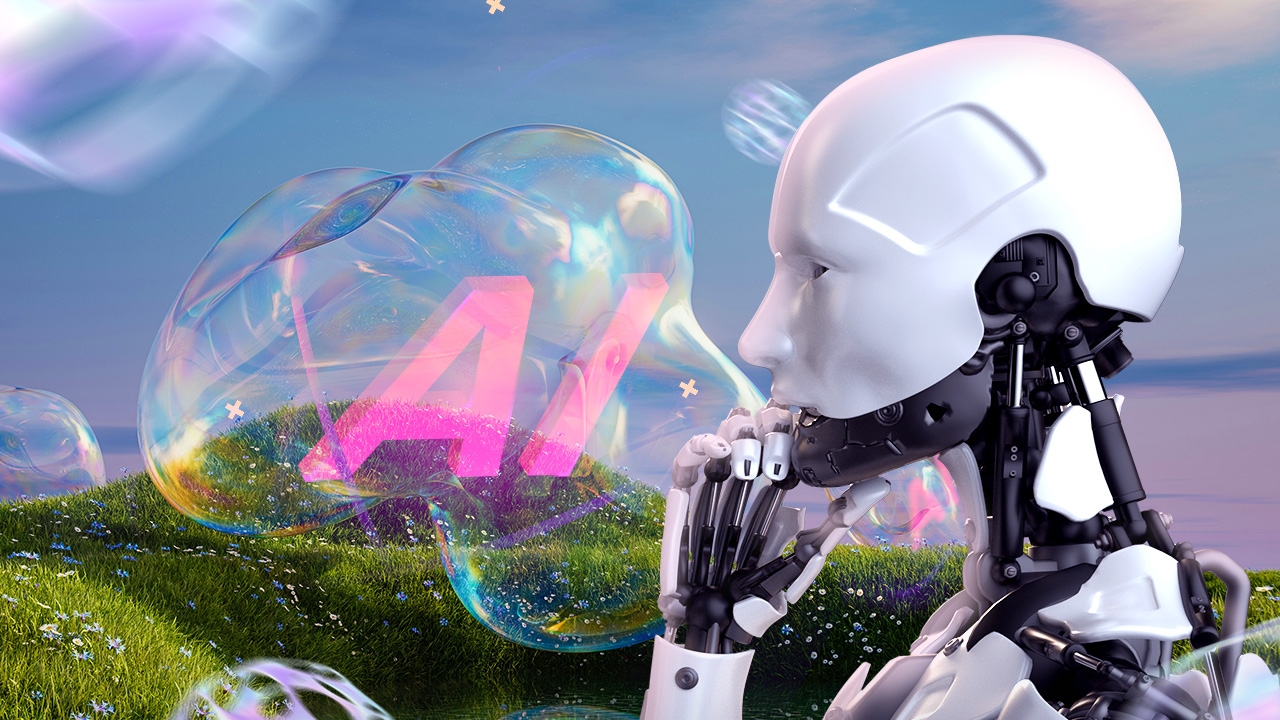
As tens of billions of dollars pour relentlessly into the AI industry, many are questioning whether this is a world-changing innovation or just another bubble waiting to burst.
The $500 billion Stargate project, the $100 billion deal between Nvidia and OpenAI, and Microsoft's massive ongoing investments into OpenAI—all while AI stocks account for 75% of the total growth in the S&P 500.
Behind these impressive figures lie intriguing details: OpenAI made $3.7 billion in revenue but spent over $8 billion, and it is expected to spend up to $115 billion by 2029—about 4.5 trillion baht—to develop technology with no clear timeline for profitability.
This situation reminds many of the 2000 dotcom bubble, when hundreds of tech companies collapsed overnight. So, is this time the same, or is the situation different?
The Digital Frontiers program on YouTube: Thairath Moneyexplained the current AI market overview, compared it with past lessons, and analyzed why AI investment now might differ from previous bubbles, providing viewers with information to make their own decisions.
Back in 2022, when ChatGPT launched, many saw it as just a fun toy that could write essays, code, and tell jokes. But that was only the beginning.
In just three years, AI has become a buzzword everyone talks about and bets on—the belief being that "AI is the future." Silicon Valley resembles an endless party, startups are making huge profits, company valuations soar, and billion-dollar deals are announced weekly.
Nvidia has become a $5 trillion company, while China has clear government plans to lead AI by 2030. Everything seems on track.
Everything looked perfect until mid-year when cracks appeared. Surveys in the U.S. show AI usage in large companies declined from June to August. Companies grew more cautious, especially about "AI Hallucination."
Financial reports are telling a concerning story: where is the return? Currently, they are betting on AGI (Artificial General Intelligence), which is still years away. Until then, OpenAI and most AI companies will continue burning through cash.
The word "bubble" is everywhere, which is understandable since the market is driven by a few companies speculating on AI's future. It's fragile, with warnings from the Bank of England and the International Monetary Fund that AI valuations and investments may be inflated compared to emerging results.
When people talk about tech bubbles, they think of the 2000 dotcom era. A bubble can be good if it doesn’t burst because it means hope, investment, and innovation. But the problem is bubbles don’t burst on their own; something triggers the collapse.
In the dotcom era, several factors were identified as turning points: Microsoft’s antitrust court ruling, MicroStrategy’s heavy stock and financial adjustments, and many companies’ "fast growth but unprofitable" business models. When funding dried up and confidence waned, the bubble burst.
Looking at AI today, there are many worries: unstable markets due to taxes, AI chip regulations, high interest rates, AI training data legal issues, and infrastructure challenges. In 2000, just one critical article could start the dotcom bubble bursting, but now such news appears daily without bursting. Why?
1. Different Sources of Funding
The biggest difference between the AI era and the dotcom era is the source of money. Big tech companies like Microsoft, Meta, Apple, and Alphabet have accumulated massive cash reserves over decades for two reasons.
Before 2017, tax laws encouraged moving money offshore, especially to Ireland, where funds couldn’t be repatriated without paying taxes. This led to accumulating cash until 2017, when Trump’s tax reform lowered repatriation taxes from 35% to 15.5%, freeing up "dry powder" for domestic investment.
Also, for a while, these companies found fewer worthwhile projects since they dominated the market, and large spending was seen as unnecessary. Now, they are making up for a decade of underinvestment.
Most AI funding comes from these long-held cash reserves. Compared to the highly leveraged real estate bubble, AI companies stand on solid financial foundations.
Unlike the dotcom era, when companies continuously relied on investor funding to sustain unprofitable or revenue-less businesses, OpenAI is in a similar position but only receives money from cash-rich companies, not general investors.
2. Circular Dealing: A Risk Mitigation Strategy
This topic draws much criticism: money circulates among AI companies. Imagine Oracle announcing a data center lease from OpenAI, causing its stock to jump; OpenAI receives money from Nvidia investors; Nvidia earns from selling GPUs to Oracle. Money cycles around, making revenues look better but possibly unsustainable.
From another angle, looking back at the dotcom era, even after major adjustments, winners emerged. Nvidia investing in OpenAI may seem suspicious now, but if AOL had invested in Amazon in 1999, the criticism might have been less severe.
Investing across the supply chain theoretically increases chances of capturing AI’s eventual value. Crucially, they aren’t simply using investor money; net outflows show key players pay more than they receive via dividends and share buybacks—unlike the dotcom era’s reliance on ongoing investor funding.
However, this doesn’t mean these companies or the broader economy are entirely safe. Stock prices have risen on expectations that AI products and services will eventually generate trillions in revenue. If those expectations fail, consequences are inevitable.
3. A Big Bet That May Be Worth the Risk
These companies bet on two beliefs: first, that intelligence will continuously improve; second, that higher intelligence requires more computing power.
For AI at a high school level, little compute is needed; for a PhD level, more; for someone with 20 years’ work experience, massive resources are necessary. This is the "Scaling Law"—greater intelligence demands greater investment.
There are risks: Chinese labs might develop intelligence more efficiently; some experts say large language models have hit limits. This explains why this is such a major bet.
The key question is whether the risk of underinvestment outweighs that of overinvestment. Is it more dangerous to invest too little and be overtaken by competitors?
AI has already proven itself sufficiently. AI innovation advances in leaps, not steps.
Investment costs (Capex) illustrate risk distribution. OpenAI lacks sufficient funds, so it partners with wealthy firms like Oracle, SoftBank, and Nvidia to share risk. Google and Meta, with large cash reserves and in-house models, can invest more easily. Microsoft, not an AI innovator itself, chooses less risk and lets OpenAI find computing elsewhere in exchange for a $250 billion Azure usage contract.
Nvidia offered OpenAI a $100 billion deal to build 10 gigawatts of compute, ensuring OpenAI continues using their chips. Meanwhile, Amazon and Google are reducing Nvidia dependence, while Nvidia tries to lock in customers through investments.
Spending huge sums to build infrastructure doesn’t guarantee Nvidia will remain the sole major player, but all systems are betting that intelligence will improve.
If it isn’t a bubble, what is it? The answer is both yes and no.
Not a bubble, because AI is a real future with real technology changing the world, and investments come from more stable sources than in the dotcom era.
A bubble, because AI isn’t yet profitable, costs are soaring, and real returns may take 5 to 10 years to materialize.
But rather than calling it a "bubble," it might be better described as the "Great Bet of the Century." Whether bubble or not, one thing is certain: the world is changing, and we are at one of the most significant turning points in technology history. Who will emerge as the winner? We shall see.