

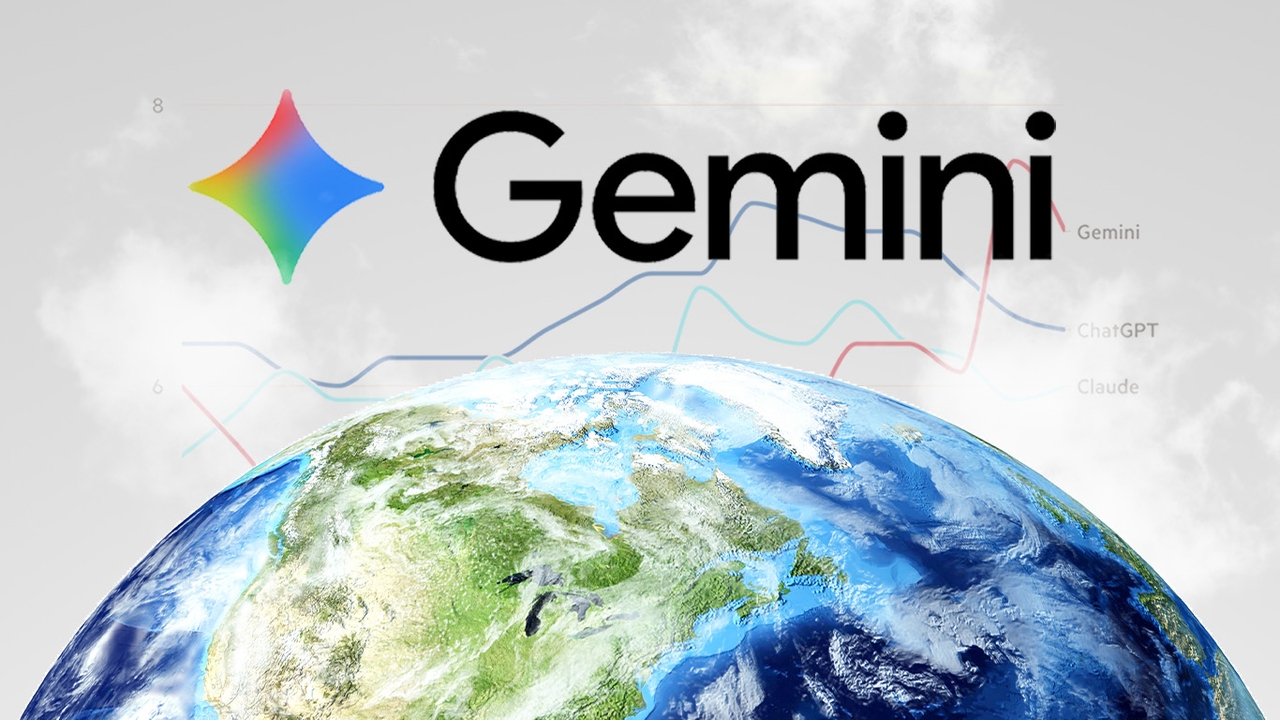
Data from web analytics firm Similarweb indicates that Gemini users spend more average time per conversation than ChatGPT users. This usage has moved beyond mere trial or brief inquiries, establishing Gemini as the AI chatbot platform where users "stay engaged longer," surpassing ChatGPT.
Although OpenAI's ChatGPT currently boasts a larger total user base—about 800 million weekly users and ranking as the number one AI app in many markets—the metric of "time spent" has become a critical factor analysts see as potentially more powerful than total user count. This reflects a pivotal moment for Google, which has accelerated its AI development to overtake OpenAI within a year.
. . . “Average minutes spent per visit” This refers to the average length of time users spend with the chatbot per session. Data shows that Gemini users, on both desktop and mobile, have steadily increased their session duration since April 2025, with a sharp rise from August to October 2025 reaching nearly 8 minutes per session, while ChatGPT’s session times declined after previously leading in this metric.

A closer look reveals that this shift began around late 2024, when Google began substantively upgrading Gemini’s quality, including more effective long-form reasoning and improved accuracy in coding and complex tasks. As a result, users engage in longer conversations instead of quick queries, reflected in rising usage time metrics.
. . . Gemini 3.0 Gemini 3.0 has received high praise for its response quality, reasoning abilities, and coding proficiency. Some users and researchers consider this new model to surpass OpenAI’s GPT-5 across several key criteria.
Furthermore, Google's structural advantages—including access to billions of users via Android, Search, and YouTube, as well as proprietary infrastructure like its TPU chips—are accelerating Gemini’s integration into users’ daily lives faster than market expectations.
Gemini’s rising popularity also stems from continuously released new features, notably Nano Banana, an image generation model that propelled Gemini to become the number one free app, overtaking ChatGPT in September. Additionally, Google's integration of Gemini with its ecosystem—Drive, Gmail, Sheets, Docs, and YouTube—enables users to fetch data, analyze, and generate outputs seamlessly in one platform, effectively increasing user engagement with Gemini.
Three years ago, Google CEO Sundar Pichai declared a “Code Red” in response to ChatGPT’s emergence, which threatened the future of search business. Today, roles have reversed: OpenAI CEO Sam Altman has announced a “Code Red” internally, halting all projects to prioritize resources on ChatGPT, signaling Google’s comeback after Gemini 3.0’s market release.
This clearly signals that Google has abandoned a defensive stance and is now aggressively competing in AI, unlike after ChatGPT’s 2022 launch when Google admitted it was unprepared. Gemini 3.0 demonstrates Google’s renewed confidence through strong testing results, rapid deployment, and unparalleled access to billions of users via its ecosystem.
Behavioral data further reflects a user shift: Gemini users spend more time on the platform, indicating that Google is successfully building genuine user engagement, whereas ChatGPT appears behaviorally saturated. Users now ask more targeted questions, reducing average session time despite high user numbers.
Analysts believe that if this trend of longer conversation times continues, Google may not only catch up to OpenAI but also shift the competitive focus from user quantity to engagement quality—a key driver of revenue and long-term advantage in the AI era ahead.
Read more
Sources Financial Times , Fortune