

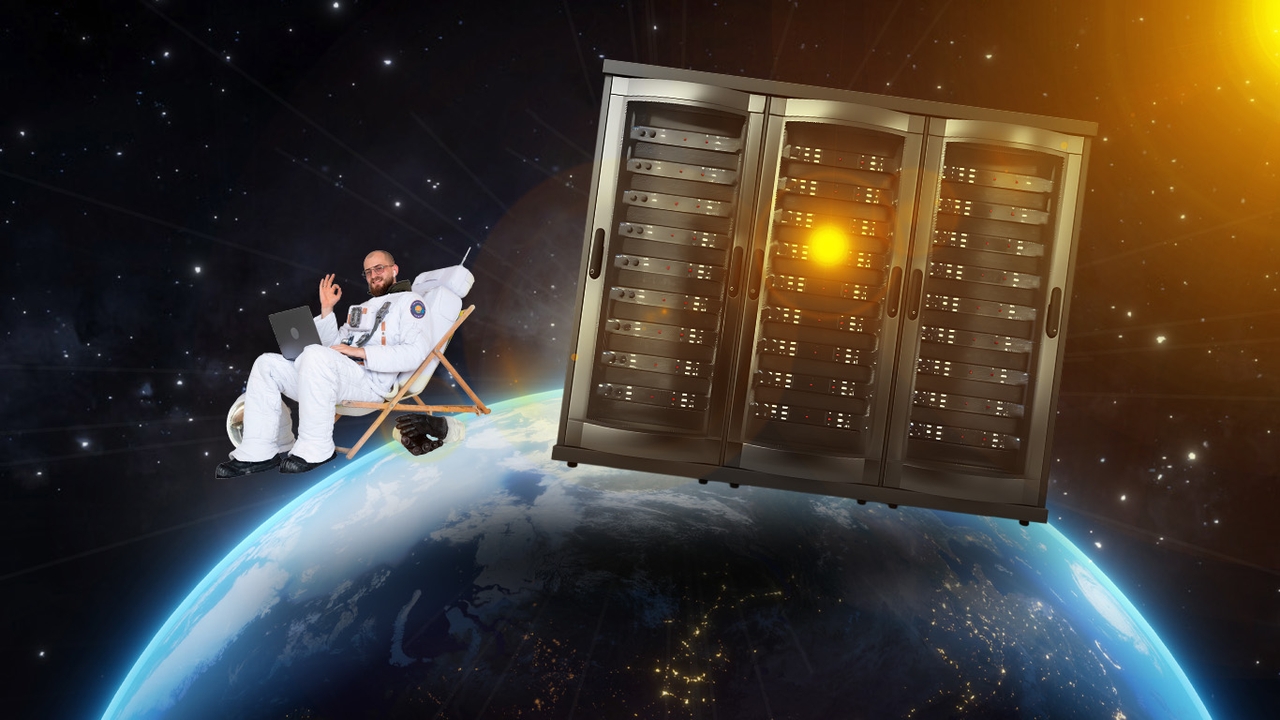
As AI technology and Cloud Computing experience exponential growth, becoming the backbone of the global economy, the energy demand to sustain these systems has surged to unprecedented levels.
. . . " Data Centers —the core of today’s digital world, as vital as roads or power plants—are placing immense pressure on providers and big tech companies reliant on this infrastructure. This includes massive electricity consumption, water usage for cooling systems, and community resistance due to concerns over costs, environmental impact, and resource overuse. This raises a crucial question: how much more can Earth support the growth of data centers?
Currently, leading global tech and aerospace companies are seriously exploring an option once considered science fiction but now seen as a new business opportunity: relocating data centers into space. These would harness solar energy—an immense, inexhaustible power source.
Data from MSCI indicates that over 47 gigawatts (GW) of new data center projects are under construction, representing investments exceeding $550 billion. Projects slated for 2025 alone highlight an unprecedented acceleration in building digital infrastructure worldwide. However, this expansion is placing severe stress on global energy systems and the environment.
Analysts project a sharp rise in global data center electricity demand by the decade's end, especially due to AI workloads running 24/7. Gartner reports that data center power consumption will grow approximately 16% in 2025, with a potential more than doubling by 2030.
Quantitatively, global data center electricity use is expected to rise from about 448 terawatt-hours (TWh) in 2025 to roughly 980 TWh by 2030—comparable to the combined electricity consumption of several large countries.
The United States exemplifies systemic pressure: it has at least 5,400 data centers, ranging from small facilities to hyperscalers with thousands of servers, and this number continues to grow rapidly.
Forecasts estimate total U.S. electricity consumption at around 4,193 billion kilowatt-hours in 2025, with data centers projected to consume up to 12% of national power by 2028, creating challenges to grid stability in multiple states.
Although major providers strive to increase clean energy use and reduce carbon emissions, investment in new energy infrastructure lags behind the escalating demands of data centers, particularly AI, which requires continuous, high-density power. This situation forces tech companies to reconsider where digital infrastructure should be located.
A key reason space is gaining serious consideration is "energy and scalability." The concept of space-based data centers involves deploying data centers as satellites orbiting Earth, powered by nearly limitless solar energy—especially in sun-synchronous orbits, which receive sunlight almost continuously, avoiding night or seasonal limitations. Space data centers do not compete for water or land, do not burden local power grids, and avoid community opposition common on Earth. Providers can harness solar power directly, eliminating reliance on fossil fuels or terrestrial power infrastructure. Theoretically, this offers virtually unlimited scalability to support AI growth long-term without adding strain to Earth's resources.
Several space industry leaders openly support this idea. Elon Musk views space as a vast solar energy source suitable for large-scale AI tasks and recently expressed interest in space-based data center ventures during SpaceX's IPO announcement.
This concept is moving toward practical testing. Google’s Suncatcher project, Nvidia-backed startup Starcloud, and Jeff Bezos’s Blue Origin are investing in technology to explore space data centers' feasibility.
Starcloud launched experimental computing satellites to test real-world capabilities, while Alphabet announced plans to test satellites equipped with specialized AI chips for off-Earth processing later this decade. China is also active, reportedly deploying over a dozen supercomputer satellites capable of processing data directly in space.
Certainly, space-based data centers are not an immediate solution and will not soon replace terrestrial centers due to challenges including launch and maintenance costs, radiation resistance, cooling systems, and the need for high-speed, low-latency satellite networks. Nevertheless, for big tech, this represents a strategic option. In an era of frantic data center expansion for competitive advantage, Earth may no longer be the final frontier for digital infrastructure; space could become the new frontier of the digital economy in the near future.
. . .
Further reading
Sources Business Insider , CNN , The Verge
Follow the Facebook page: Thairath Money at this link -