

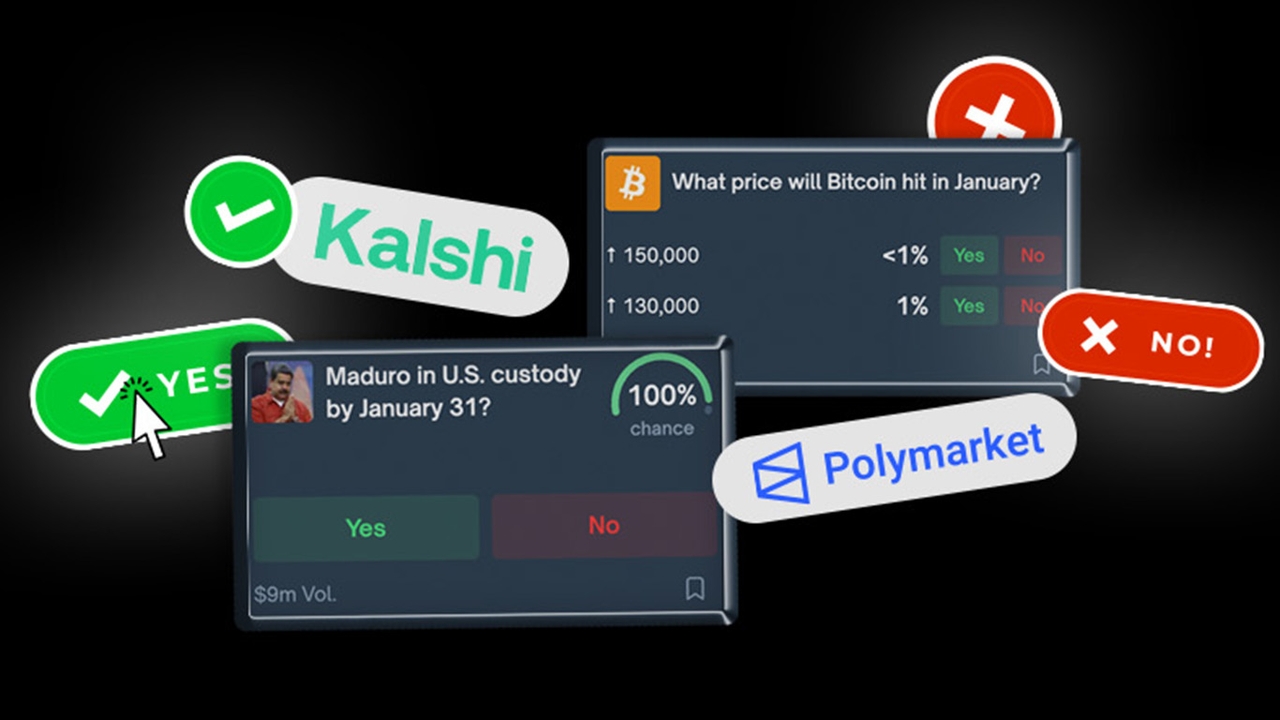
"This is the most accurate thing humanity has ever had." The CEO of Polymarket, a prediction market platform, said this during an interview with CBS News.
So far, platforms like Polymarket have consistently presented themselves as tools to generate insightful social data, while a similar platform, Kalshi, envisions that in the near future, "everything will be able to become an asset," even information whose actual occurrence is still uncertain.
For example, on 3 January, after Venezuelan President Nicolás Maduro was reportedly detained and taken to the United States, the mere announcement of his capture allowed a Polymarket user who bet on Maduro being arrested to earn over 436,000 U.S. dollars (more than 13,586,850 baht) from an initial stake of 32,537 U.S. dollars (about 1 million baht).
Platforms like Polymarket and Kalshi have grown increasingly popular since their founding after the COVID-19 pandemic, especially during U.S. presidential elections when people speculate on the likely winner, turning these markets into intelligence-level tools capable of accurately tracking everything from organizational power struggles to geopolitical tensions such as the overthrow of Nicolás Maduro.
This article by Thairath Money introduces Prediction Markets, or future forecasting markets, in the modern economy—new financial instruments that remain under scrutiny regarding data access, accuracy, transparency, regulation, and their role in potentially reshaping capitalism.
Prediction Markets operate as their name suggests: forecasting or predicting future events. Two main pioneering platforms providing these services are Polymarket and Kalshi. Both allow people to buy and sell probabilities of events that have not yet occurred, covering areas from politics, economy, technology, and sports to global issues like government policies and financial market directions.
Polymarket claims to be the world's largest prediction market platform. It works by having users apply their own information, news, knowledge, and perspectives to set prices reflecting the likelihood of events through buying, selling, or speculating in "YES" or "NO" contracts. The trading prices reflect the market's view on the probability of those events occurring.
"The passion for gambling is the foundation of this system." / Shayne Coplan, founder and CEO of Polymarket, explains that this is not a vice, but a secret formula the platform uses continuously to create a new information mechanism for the modern economy.
What makes Polymarket and Kalshi interesting is that market prices are not set by the platform or a bookmaker (like in gambling), but emerge from the real supply and demand of users, similar to stock markets. When new data, news, or expert opinions arrive, prices adjust immediately. This means the numbers shown are not just "betting odds" but real-time probabilities. Multiple studies indicate that such prediction markets often provide more accurate results than expert guesses or typical opinion polls.
From a user's perspective, Polymarket and Kalshi are not merely gambling venues but markets that allow knowledge to be converted into financial returns. Those who believe they can better assess situations than the market can buy or sell to earn profits, while the market aggregates many opinions into a single figure reflecting society's shared view. This is why some founders see Polymarket as potentially one of the most precise tools for forecasting the world's future.
Both platforms are built on blockchain technology: Polymarket on Polygon and Kalshi on Solana, and they support cryptocurrency use. However, they differ legally: Kalshi is directly regulated by the U.S. Commodity Futures Trading Commission (CFTC), making it a fully legal financial market, whereas Polymarket is not authorized to serve U.S. users and has been fined by regulators in the past.
Throughout 2025, both Polymarket and Kalshi have seen continuous growth in popularity, with company valuations surpassing 10 billion U.S. dollars. This success propelled Luana Lara Lopes, Kalshi’s co-founder, to become the world’s youngest female billionaire at just 29 years old, replacing Lucy Guo.
Investors describe the excitement around prediction markets as socially significant, offering ordinary people opportunities to hedge against shocks from political, economic, and corporate forces shaping modern life.
However, the event that yielded over 400,000 U.S. dollars in profit from betting on President Maduro’s arrest sparked debate over possible insider trading, raising genuine political concerns. Moreover, the platforms’ lack of effective screening mechanisms has led to bets on events like wildfires, disasters, or outcomes influenced by human actions.
U.S. authorities have begun increasing oversight, with some states filing lawsuits and labeling prediction markets as "gambling," even though some operate under proper regulatory supervision. Additionally, individuals connected to the Donald Trump family have acted as advisors to both platforms.
Meanwhile, many young people view speculation as a survival strategy in an unfair economic system, and the founders of both platforms regard this gambling not merely as entertainment but as socially important. Consequently, capital continues to pour in, pushing weekly trading volumes to consistently reach billions of dollars.
Sources:BBC,Bloomberg,CBS News,Polymarket,Kalshi
Follow Thairath Money on Facebook at this link -https://www.facebook.com/ThairathMoney