

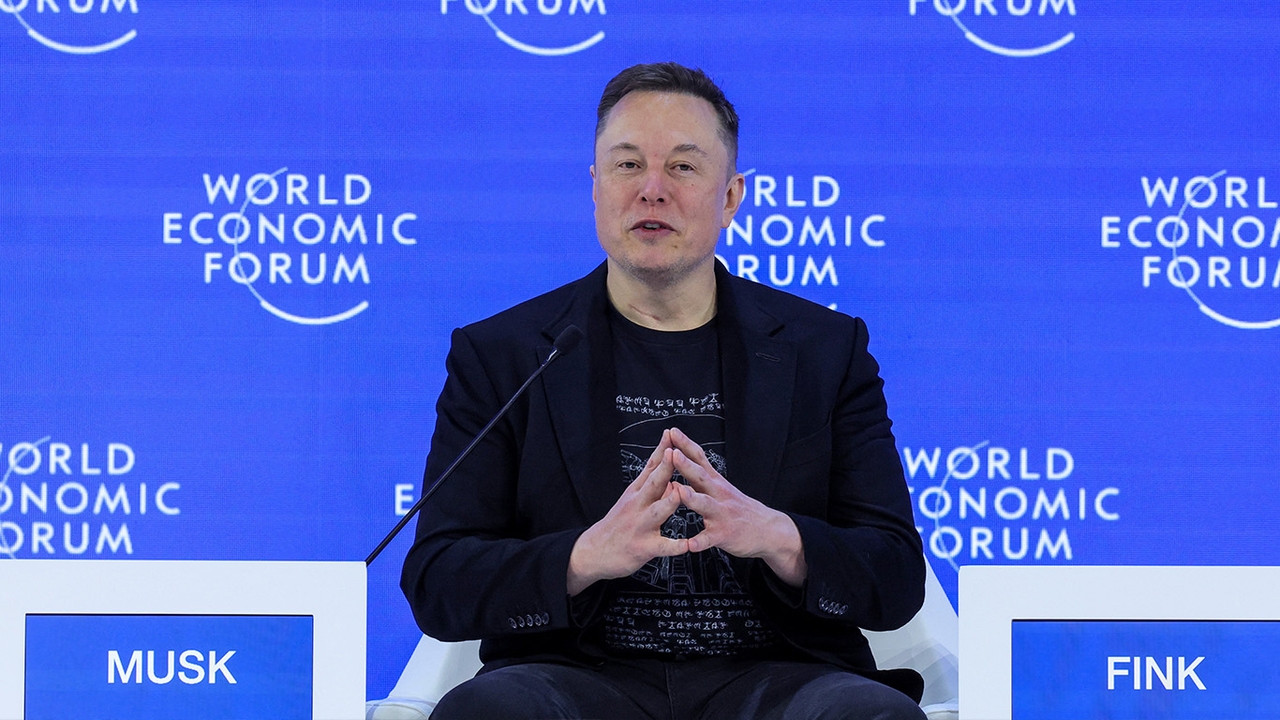
Elon Musk, billionaire owner of Tesla and SpaceX, made an unexpected appearance on the World Economic Forum (WEF) stage in Davos, Switzerland, despite having previously criticized the event as "boring af."
Musk's first appearance at the WEF generated high expectations after his name was added to the morning schedule the same day. Musk appeared on stage alongside Larry Fink, CEO of BlackRock and interim co-chair of the WEF.
Throughout the discussion, Musk spoke about various aspects of his business empire but did not reveal many new details. He began by reiterating Tesla’s mission to create "abundance for everyone," a concept he has previously expressed both on platform X and in other interviews.
He also predicted that the widespread arrival of AI and robots would lead to unprecedented global economic expansion and might make “work” in the traditional sense unnecessary in the future. He estimated that AI would surpass the combined intelligence of all humanity by 2030 or 2031.
“Eventually, we will have an abundance of goods and services because I believe there will be more robots than people,” Musk said.
One of the most concrete points was progress on Optimus. Musk stated that Tesla plans to begin selling humanoid robots to the general public by the end of next year.
However, Musk barely mentioned the Robotaxi self-driving car project, which is a key part of Tesla’s future business, other than emphasizing the company's hope to receive Full Self-Driving technology approval in Europe and China by next month.
Most of the conversation focused on the idea of an “AI data center in space,” which Musk and several big tech executives have discussed repeatedly recently. Musk revealed that SpaceX plans to launch solar-powered AI satellites into space within the next few years to address AI’s massive energy consumption on Earth.
“The end result is that the lowest-cost place for AI will be in space, and I think this will happen within two years, or at the latest three years,” Musk said.
He also touched on technologies aimed at extending human lifespan, viewing aging as a “solvable problem,” but warned that if humans live forever, society might lose “vitality and liveliness.”
Musk concluded with a philosophical note, inviting everyone to look to the future with hope. “I want to encourage everyone to be optimistic and excited about the future,” Musk said. “Generally, for a good quality of life, choosing optimism, even if sometimes mistaken, is better than pessimism, even if correct.”