

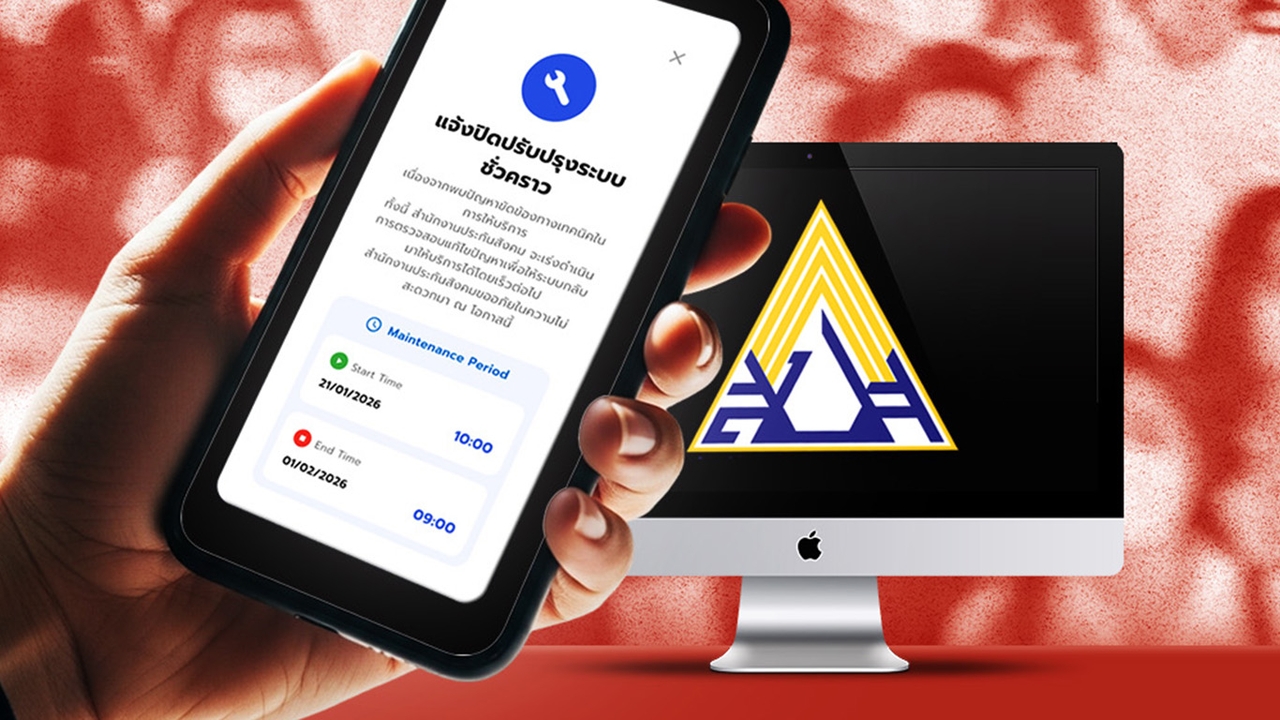
The controversy surrounding the Social Security Office's (SSO) SSO Plus web application escalated as the system announced a temporary shutdown for maintenance starting 21 Jan 2026, with the reopening postponed three times. Initially scheduled to resume on the morning of 27 Jan 2026, the launch was delayed again to 1 Feb 2026 at 09:00, citing technical service issues and urgent repairs.
The delays and system instability have directly affected many insured individuals, especially unemployed beneficiaries awaiting up to 9,000 baht monthly compensation, who cannot verify benefits, track status, or receive payments via the e-Self Service system and SSO Plus app, causing widespread distress. Amid these issues, a critical question arises: why can the new web application project, developed with a hefty 850 million baht budget, fail to provide even basic services?
Following the problems impacting insured workers, the SSO clarified on 27 January that the issues fall into three main categories:
However, the proposed solutions have faced heavy criticism from insured persons and civil society, as the problems reflect a failed transition to the new system under the 850 million baht SSO Core IT reform project, funded by accumulated contributions from over 2.8 trillion baht of insured individuals nationwide.
This situation also prompts serious concerns, especially regarding the project's procurement processes. "Transitioning the Social Security system from mainframe computers to a Web Application" via an electronic bidding (e-bidding) process announced on 29 Sep 2021.

A search of government procurement data on the actai.co website shows the project owner is the Office of Information Technology Administration, with two bidding rounds held in 2020-2021:
First round The first bid was announced on 16 Dec 2020, with the winner declared on 10 Mar 2021. The median price was 850 million baht, covering hardware, software, system development, and other expenses. The winning bidder was International Research Corporation Public Company Limited (IRCP) at 837,886,388 baht. However, the appeals committee voted to cancel this procurement.
Second round The second bid opened on 29 Sep 2021, with two companies submitting proposals: IRCP at 848,500,000 baht (425,000 baht below median) and Yip In Tsoi Co., Ltd. at 848,888,000 baht (37,000 baht below median). IRCP won the second bid.
Beyond service issues, transparency in the procurement process has drawn close scrutiny.Progressive Social SecurityThis group summarized concerning facts and observations, including system readiness post-acceptance, cost-effectiveness, and responsible parties. They noted possible anti-competitive behavior, as the winning bid was only 0.11% below the median price, with competitors' bids differing by just hundreds of thousands in a multi-hundred-million project. They also highlighted barriers to verification and questioned whether the winning bidder met qualification criteria.
Additionally, delays in delivery beyond the contract deadline of 20 Dec 2023 remain unresolved, with many penalty waivers justified by COVID-19, leading to extra expenses involving public funds throughout the period.
Data from the Department of Business Developmentshows that International Research Corporation Public Company Limited (IRCP) was established on 4 Feb 2003 with registered capital of 313,546,050.50 baht, operating in telecommunications and comprehensive information technology services.
IRCP began by manufacturing Thai language display cards for computers before listing on the mai stock exchange in the technology sector on 31 July 2003 to raise funds for expanding its ICT and telecommunications empire. Currently, Mr. Dan Hetrakul serves as CEO, with the top five shareholders according tothe Stock Exchange of Thailand datalisted as follows:
1. Mr. Pracha Hetrakul holding 42,093,021 shares (6.75%)
2. Mr. Wichai Meeying holding 36,554,600 shares (5.86%)
3. Mr. Warot Norkaeo holding 33,751,500 shares (5.41%)
4. Mr. Supanat Kanathanawanich holding 29,790,000 shares (4.78%)
5. Mr. Dan Hetrakul holding 26,832,410 shares (4.30%)
IRCP’s share price on 28 Jan 2026 ranged between 0.27-0.28 baht, with a market capitalization of approximately 168.34 million baht. For fiscal year 2025 (1 Jan 2025 - 30 Sep 2025), total revenue was 525.75 million baht with a net loss of 196.71 million baht.
Besides the 850 million baht web app, the SSO is also developing the "SSO Plus Application" officially titled "Project to Develop a Central Digital Platform Connecting Social Security Services to Insured Persons Specifically" with a budget of 276,303,400 baht. The winning bid was awarded to A&B Consortium, a joint venture between Advance Information Technology Public Company Limited (AIT) and Boss Up Solution Co., Ltd., at 275 million baht.
Examining the SSO’s structure reveals it is not a typical IT agency but an organization managing the funds and benefits for over 20 million insured persons, covering formal workers, informal insured persons, and future elderly beneficiaries.
All crucial processes—from employer registration, contribution payments, medical benefit claims, unemployment compensation to old-age pensions—rely centrally on this core system. Delays, errors, or service interruptions directly affect the public, not just causing inconvenience but impacting legally entitled rights.
Originally, the social security system operated on a mainframe computer since 1991, which was stable in the past but now faces multiple limitations: outdated technology, lack of support for multi-channel digital services, and shortage of skilled personnel to maintain mainframe systems.
Previously, the SSO attempted to develop a replacement web application in 2011, but the project failed due to contractor delays and technological constraints at that time, forcing continued use of the old system until now.
The current redevelopment aligns with the government's digital policy and 20-year national strategy, aiming to improve service efficiency, reduce risks from the old system, and establish a technology foundation for long-term development.
This project is more than just a new website or app; it is a complete overhaul of the core social security system to operate on a web application architecture, covering all insured categories under Sections 33, 39, and 40, including registration, contribution, benefits, medical, financial, accounting, auditing, and data integration with external agencies.
Additionally, the project includes procuring all IT infrastructure—servers, storage, databases, security systems—to support future expansions such as e-Self Service, Big Data, and ERP systems.
A key element is migrating data from the existing mainframe to a new relational database, managing over 8.3 terabytes of accumulated data, growing annually by 5–10%. Without system upgrades, the old structure risks instability and rising costs.
In this context, developing the web application system aims to reduce structural risks tied to the livelihoods of the nation’s workforce. However, the key question is not merely whether to invest, but to ensure the system is stable, functional, and does not inconvenience insured persons—a challenge under close public scrutiny requiring clear accountability.
These concerns have yet to trigger formal complaints, but the procurement structure has been questioned for transparency, becoming a critical issue demanding urgent investigation for the benefit of over 20 million insured individuals potentially affected going forward.
Follow the Thairath Money Facebook page at this link -