

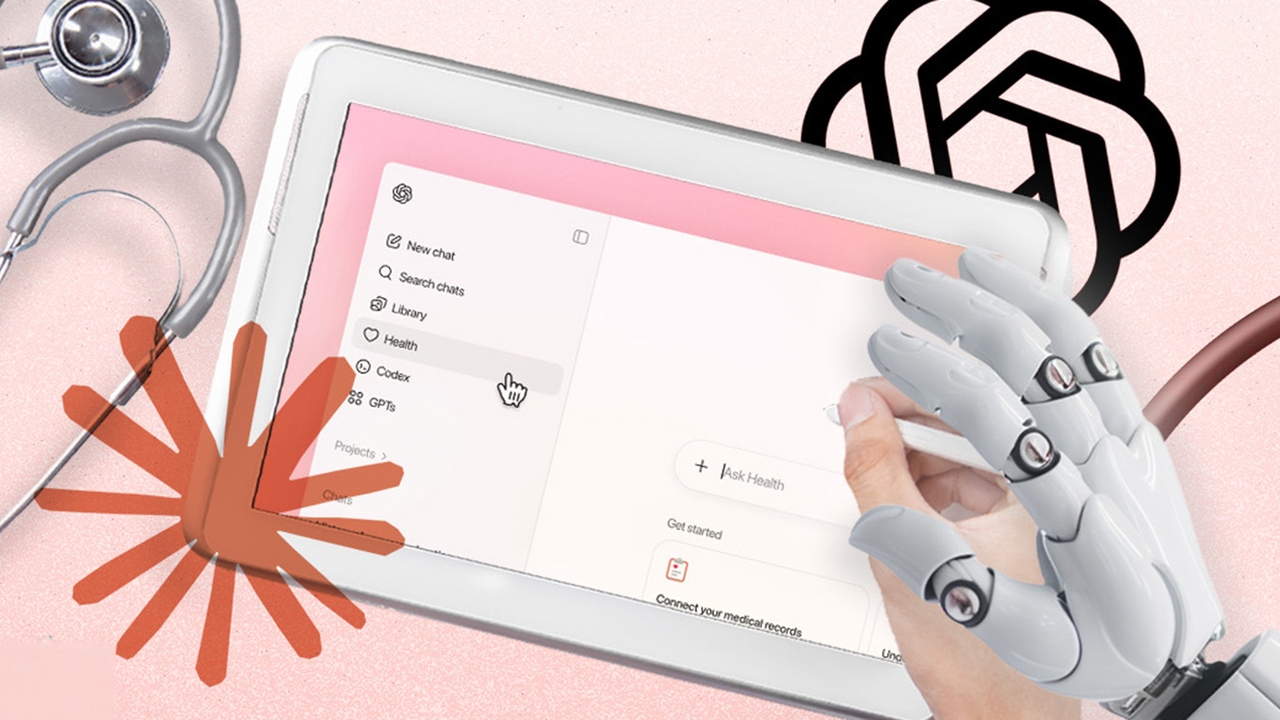
Major technology companies are increasingly investing in healthcare, not to replace doctors with technology, but to create innovations that improve human health and wellness. This aligns with global trends where people focus more on self-care and longer lifespans, supported by innovations that make this possible.
Recently, OpenAI haslaunchedChatGPT Health, a new dedicated tab within ChatGPT for health users. It allows users to upload their own medical records and connect with health devices and apps such as Apple Health, the in-depth health platform Function, and MyFitnessPal. This enables ChatGPT to access personalized data and provide more accurate analyses and responses for each individual.
Besides ChatGPT, there is another chatbot provider, Anthropic, which hasintroducedClaude for Healthcare, entering the health market as well. This AI health toolset is specially designed for healthcare providers, insurance companies, and patients. Users can sync health data from phones, smartwatches, and other platforms. Anthropic claims Claude offers deeper capabilities.
However, both platforms clearly emphasize that ChatGPT Health and Claude for Healthcare are designed assupplemental medical tools, not replacements for doctors.Many people still distrust AI making medical diagnoses instead of human doctors. Yet in reality, if doctors are unavailable, busy, or unable to provide immediate answers, people naturally turn to "alternative options."
According to OpenAI data, up to 230 million users weekly ask health questions through ChatGPT. Before the rise of generative AI, people commonly referred to this behavior as "Dr. Google," using search engines to self-diagnose preliminary symptoms.
In a Time interview, Dr. Danielle Bitterman, a radiation oncologist and leader in Data Science and AI at Mass General Brigham Digital, said“I’m not surprised by this news; it reflects the ‘gap’ in public healthcare that people face, including harder access to physicians, complex medical information searches, and sadly, increasing distrust in the medical system.”
Both ChatGPT and Claude's health-focused versions are designed as“health information hubs,”where users can upload various medical records such as blood test results, doctor visit notes, or past treatment histories. When users ask questions, AI responds based on connected health data, providing more personalized context in answers.
Previously, beyond AI players, big tech like Applehas heavily investedin researching and developing health data collected from users to study comprehensive health links, covering both physical and mental health. This aims to create the largest health research project ever, with findings expected to roll out in 2-3 years, leading to innovations that improve global health in the future.
Meanwhile, Amazon, which operates One Medical—a digital and online medical and health service—has integrated AI to allow users to interact with AI for health Q&A, receive personalized health recommendations, schedule doctor appointments, and manage care plans.
In China, progress is equally significant. Due to more patients than doctors, telemedicine has been popular since the COVID-19 era. Major tech firms like Ping An and Alibaba are heavily investing to enhance medical services and access. Recently, innovations such as AI health kiosks have been developed to provide easy access for preliminary symptom checks and immediate medication dispensing.
Data security remains a major concern for users hesitant to share information with AI, especially since no regulatory body currently oversees health data on AI chatbots. OpenAI confirms partnerships with b.well, a health data connectivity infrastructure company, to securely link users' medical records. The Health tab includes privacy settings that separate health chat histories and memory from general chats. Conversations in Health are not used to train the main AI model, and health data does not cross over to other chats. Users can view, edit, or delete their Health Memory anytime.
Anthropic also confirms that health data will not be used to train AI models. Claude can access key databases such as the U.S. Centers for Medicare and Medicaid Services (CMS) coverage data, ICD-10 disease codes, the National Provider Identifier (NPI) database, and global medical research sources like PubMed. This data supports healthcare professionals by easing documentation and making information more accessible.
Bradley Malin, a bioinformatics professor at Vanderbilt University Medical Center, explained to Time that“This is a contractual agreement directly between the user and OpenAI. If you provide information to a tech company not offering medical services, it’s essentially ‘buyer beware.’”
“When you see a doctor, there’s a professional agreement keeping your information confidential. But in this case, that does not apply. You really don’t know how your data will be used, even if the company claims protection.”Malin added,
Aside from privacy, another key risk is the accuracy of medical information. Language models like ChatGPT are designed to assist users (i.e., please them) rather than prioritize strict medical correctness. They tend to provide answers even when information is incomplete.
Several studies have found that when medical records lack completeness, these systems may “guess” or fabricate information (known as hallucination). A report from the U.S. National Institute of Standards and Technology (NIST) states that the quality of user input data directly impacts AI response quality. Good data must be accurate, complete, consistent, and up to date. However, in many countries’ public healthcare systems, medical records are scattered across multiple providers, leading to incomplete data and increasing risks of incorrect responses.
Imagine a day when we can precisely know our health status as a number, understand the optimal diet for our current condition, the exact exercise needed to meet our goals, or even roughly predict our lifespan...
These possibilities may soon become reality thanks to such technologies. Currently, devices like the WHOOP health wristband and smartwatches many people wear daily collect health data for analysis. As data accumulates, personalized health services tailored to individuals will emerge.
Our health data has become a valuable resource that tech companies are eager to utilize beneficially. Some doctors believe AI’s involvement in healthcare can elevate patients’ health knowledge.
Some physicians view large language models as highly beneficial for improving medical literacy among the public, who often get lost in the vast sea of medical information online and struggle to discern trustworthy sources from misleading but visually appealing websites.
Dr. Adam Rodman, a Harvard Medical School instructor, told Time that in the past, treating patients who self-diagnosed via Google often required time to alleviate anxiety and correct misinformation. Now, he notices patients—whether high school or university graduates—ask questions at a level comparable to early medical students.
The launch of ChatGPT Health and Anthropic’s new health features for Claude reflect that major AI companies are increasingly accepting and officially supporting health applications. Both warn that AI should not replace medical professionals and users should consult experts for accurate, personalized advice.
Risks remain, particularly known behaviors of large language models like over-agreeing with users and fabricating information. Yet these risks must be weighed against the potential benefits.
Today, many AI tools are freely accessible, providing easy health consultations. In the future, as everything develops, the data on our wrists may become crucial to enhancing our health and longevity. When highly accurate services emerge, people might be willing to pay more to achieve optimal health.
Follow the Facebook page: Thairath Money at this link -https://www.facebook.com/ThairathMoney