

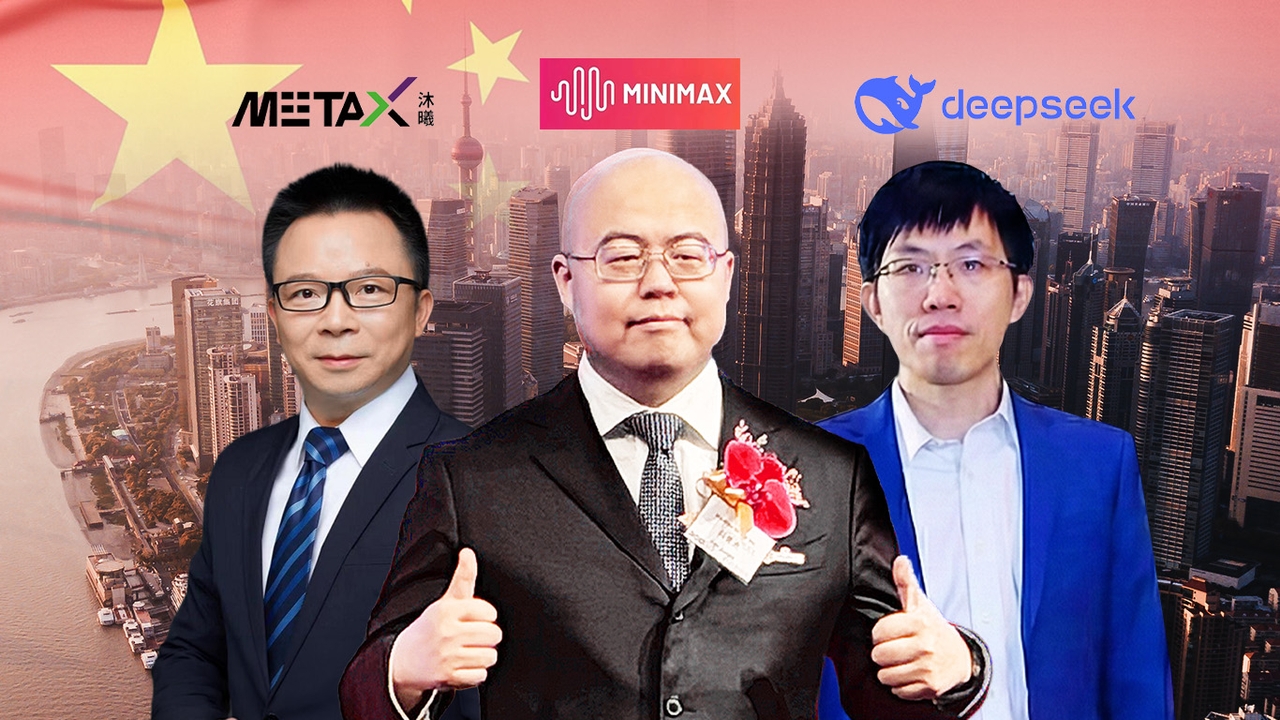
Over the past two to three years, the global technology power map has been rewritten once again, and this time, "China" the U.S.'s wary competitor, is accelerating to become a direct challenger, backed by a new generation of AI entrepreneurs who are not only building tech startups but also generating multi-billion dollar wealth alongside a national mission to reduce dependence on U.S. technology.
Bloomberg and Forbes report on China's rising new AI billionaire class, who are advancing at the forefront of an industry growing from gaps and opportunities amid geopolitical conflicts, technology and trade restrictions, and limited access to critical components like advanced chips, driving rapid technological progress in China.
This shift has also created a new Chinese tech elite. Unlike the rockstar CEO image epitomized by Jack Ma, widely recognized globally, these new CEOs choose to avoid the spotlight. Close coverage often reveals stories of former child prodigies who typically call themselves ordinary researchers, refuse media interviews, and have no public photographs.
This silence is strategic. For China's new tech elite, maintaining a low profile serves as a shield against two threats: risks of being blacklisted by the U.S. and scrutiny from the Chinese government, which has grown uneasy with overt displays of wealth.
The first is Yan Junjie, 36, founder and CEO of MiniMax Group Inc. A company developing multimodal AI models that raised over $618 million through a Hong Kong listing, making Yan's net worth approximately $4.5 billion and positioning him as one of China's youngest AI billionaires.
Next, Liang Wenfeng, founder of DeepSeek, an AI model that caused global stir after launching the low-cost R1 model, positioning itself as a competitor to OpenAI's ChatGPT. This success has increased his net worth to around $11.5 billion.
On the hardware side, the core of the AI battle, Chinese companies are racing to build their own version of Nvidia, Moore Threads Technology Co., founded by Zhang Jianzhong, a former Nvidia executive who spent five years growing Moore Threads to a valuation of $45 billion, pledging to produce new chips to replace those he once sold. Despite being blacklisted by U.S. trade sanctions, he led a Shanghai IPO that raised $1.1 billion, with a net worth of about $4.3 billion.
Meanwhile, a trend of experienced executives returning from major U.S. tech firms to China continues, such as Chen Weiliang of MetaX Integrated Circuits Shanghai Co., a former senior director at AMD, who raised nearly $600 million and has become a key player in China's AI chip sector, with a net worth around $6.5 billion.
A significant development is the IPOs of these companies; since last December, AI firms listed in Hong Kong and Shanghai have collectively raised over $10 billion. Although most are still unprofitable, their stock prices have surged between 95% and over 400%, reflecting investor bets on long-term potential rather than short-term profits.
Morgan Stanley estimates China's AI market could grow to $1.4 trillion by 2030, up from just $3.2 billion in 2024, indicating investors' willingness to accept risk for long-term opportunity.
What distinguishes this wave of Chinese AI billionaires from previous generations is their growth alongside clearer state policies. China is pumping funds, offering tax incentives, and promoting domestic procurement to build a complete tech supply chain—from AI models to processing chips—all aimed at reducing reliance on the U.S. and enhancing competitive capabilities.
Major firms like Baidu have announced plans to spin off their Kunlunxin chip business for Hong Kong listing, showing that competition extends beyond startups to include large domestic tech companies. At the same time, many Chinese AI firms are expanding into developing markets, leveraging lower costs compared to the West—a trend even Microsoft executives acknowledge is gaining popularity.
Clearly, China's new AI billionaires reflect more than just growing tech sector valuations; their momentum symbolizes China's accelerated effort to build its own technology ecosystem amid increasing U.S. efforts to disrupt it. These billionaires are direct products of an era of intensifying technological independence.
Read more
Follow the Facebook page: Thairath Money at this link -