

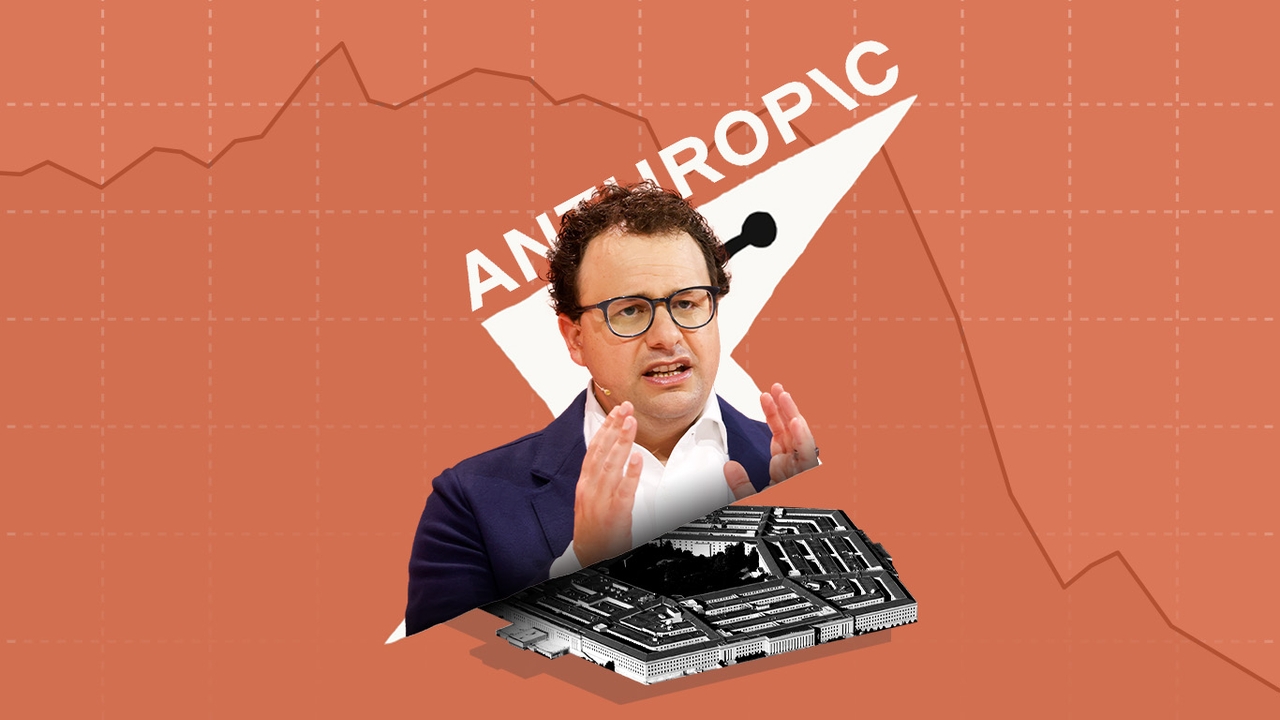
Recently, the name Anthropic “Anthropic” and its founding CEO Dario Amodei have been mentioned on nearly every major global technology stage. Founded by former OpenAI researchers, Anthropic has emerged as a key AI player creating worldwide apprehension after launching “Claude Cowork,” a next-generation platform that can plug into everyday office programs and applications, enabling a greater degree of automated multitasking.
This wave of alarm has caused widespread concern about whether AI will truly replace humans and disrupt the software industry, which some fear will become obsolete. This led to a sell-off in many software stocks, erasing over $1 trillion USD (over 30 trillion baht) in market value in the past week.
Anthropic is an AI company now widely recognized, founded by core former OpenAI researchers who left to start their own firm, led by Dario Amodei and Daniela Amodei. Their mission is to develop AI that is not only highly advanced but also safe. Their commitment is so strong that the company has confronted the U.S. Department of Defense, threatening to prohibit military use of their AI if it crosses ethical lines.
Anthropic’s core philosophy is that AI must accurately interpret human intent. Their models embed ethical frameworks within the architecture, with tuning based on principle-based alignment. This approach led to what they call "Constitutional AI," training models to adhere to a set of internal constitutional principles.
After launching their language model named Claude in 2023, emphasizing “safety” and “accuracy in reasoning” distinct from typical chatbots, the company quickly became a direct competitor to ChatGPT.
Early versions of Claude were seen as competitors to general LLM models, but Anthropic’s team looked further. Their challenge was not just better answering questions, but how much AI could replace human roles by truly understanding organizational context. This led to the creation of the AI agent operating system called Claude Cowork.
Claude Cowork is a feature and workspace designed for enterprises to customize Claude to each company’s work style, centered on the use of “Plugins” and “Connectors.” These transform Claude into a " specialized agent" for specific roles and departments—HR, Design, Engineering, Operations, Marketing, Finance, Wealth Management. It also allows creation of private plugins (private marketplaces) for internal organizational use.
Simply put, Claude Cowork brings AI closer to the actual tools and environments employees use, unlocking work limitations and boosting efficiency. For example,
• enabling faster cross-app and cross-program workflows, Connectors link Claude with popular enterprise software (such as Google Workspace, Docusign, Excel, PowerPoint, or Slack) to accelerate employee productivity without aiming to replace human expertise or essential software.
• enhancing team capabilities rather than replacing humans, The idea is to introduce enterprise-grade AI agents that help employees tackle more challenging tasks, improve decision-making, and engage in strategic work previously unattainable.
• genuinely customizing to organizational needs, Allowing creation of new Plugins or Templates based on workflows, specialized terminology, and desired outcomes tailored to each profession, using simple language commands without complexity.
What makes Claude Cowork more advanced than other AI models? It addresses limitations of cross-ecosystem AI work seen in Google’s Gemini and Microsoft’s Copilot.
• Cross-application functionality (working across apps) A key difference is Claude’s ability to handle complex, multi-step tasks end-to-end across applications. For example, it can analyze data in Excel and directly use that context to create a PowerPoint presentation—mirroring how humans switch between apps.
• Surpassing the limits of traditional AI agents, Mark Hines, COO of Blank Metal, commented that AI agents have been marketed as "digital workers" performing specific, isolated tasks. But Anthropic’s Cowork designs a system where AI accesses an organization’s private databases, connects with external tools, and uses command structures (like Slash commands) that provide a seamless briefing experience.
HR and Talent Acquisition, Previously, recruiters sifted through hundreds of resumes, analyzed skill gaps, and planned workforce annually. With Claude Cowork, thousands of CVs can be analyzed, skills matched to business roadmaps, shortages forecasted 18 months ahead, and hiring strategies plus upskilling plans proposed. The clear impact is that recruiters filtering documents become less critical, while HR strategists gain importance.
Sales teams, Previously relying on CRM pipeline analysis, forecasts, and self-written proposals, Claude Cowork can extract CRM data, identify high-probability clients, recommend pricing strategies, and generate customized proposals. Salespeople spend less time on paperwork but still focus on negotiation, deal closure, insight gathering, and relationship building.
The impact is that organizations will become leaner, especially roles focused mainly on data collection, formatting, and templated reporting. Middle-layer positions responsible for interdepartmental coordination may be partially replaced by an AI layer.
Imagine a company of 500 employees with 40 analysts; in two years, there might be only 20 analysts, with equal or higher revenue because AI handles most data tasks. The remaining team interprets insights, strategizes, and manages stakeholders. Organizations shrink in size but see higher expertise and advanced skill levels.
The Anthropic phenomenon triggered stock market panic, especially following the phased launch of Claude Cowork since late January, then Claude Code Security—an advanced module for code scanning and repair—and the latest Cowork and Plugins updates for enterprise clients, causing a severe sell-off in software stocks. Analysts have dubbed this eventthe “SaaSpocalypse,”or the “end of the SaaS world.”
“SaaS” (Software as a Service) is the subscription-based cloud software model dominating enterprise software today. Combined with “Apocalypse,” meaning disaster or the world’s end, the term suggests AI will destroy or mark the demise of traditional software industries.
SaaS business models are based on organizations purchasing multiple specialized software to handle different tasks. But with AI agents able to connect and process across systems, the need for certain software types may diminish. There are fears AI will erode traditional software firms’ profitability, pricing power, and market share in SaaS businesses.
Agentic AI turns AI into a superior controller over software programs. For example, instead of manually opening a CRM, exporting data, opening documents, writing reports, and sending emails, Claude Cowork automates these steps through Connectors. Existing software remains but is relegated to backend roles.
This caused heavy software stock sell-offs: the S&P 500 Software & Services Index dropped over 4% for eight consecutive days (about 20% decline since the start of the year). Stocks like Thomson Reuters, Salesforce, and LegalZoom were heavily hit, with hedge funds short-selling these stocks to the tune of $24 billion.
Further panic arose from Claude Code Security, which uses human-like reasoning to find complex logical business vulnerabilities and can write code patches automatically. Investors fear this AI tool is dismantling the traditional cybersecurity companies’ moat, which profited from relying on human researchers and expensive platforms.
This led to a flash crash in cybersecurity stocks: the ETF (BUG) dropped nearly 7% in one day; JFrog, focused on code scanning, plunged 25%; even giants like CrowdStrike fell 9.9%, and Microsoft declined 3.2%.
However, beyond the fear, some analysts caution that this panic may be a misunderstanding (the SaaSpocalypse Myth). Enterprise software involves establishing architectures encoding workflows, regulations, and institutional memory. Replacing entire enterprise software systems with AI agents carries high change management risks and costs.
Therefore, the real direction is that AI will not replace all software but will augment it, especially mission-critical software with deeply embedded organizational data that will survive and coexist with AI. Software firms unable to adapt may face pricing pressures.
AI will complement rather than replace all software, particularly mission-critical systems with deeply embedded organizational data, which will endure and integrate with AI. Companies that fail to adapt may experience pricing challenges.
Regarding changes in office workflows, employee tasks will be transformed toward greater automation and seamlessness, shifting from repetitive work to commanding AI to perform comprehensive tasks, with humans remaining in control (human-in-the-loop).
Even in cybersecurity, where AI like Claude Code Security can detect and patch vulnerabilities autonomously, systems are designed so humans retain final decision authority. Every AI-suggested patch must be reviewed and approved by human teams to prevent errors.
This temporary software stock volatility may prompt fundamental questions about organizational structures. If AI agents become middleware connecting all systems, those controlling the AI layer may wield more power than any single software vendor.
In the short term, markets may fluctuate due to fear; midterm, software companies will accelerate adaptation; long term, organizations that design effective human-AI workflows will have structural advantages. Key points to watch include:
Ultimately, this phenomenon may not be the “end of SaaS” but the “beginning of a clearer Agentic AI era.” Whenever a new layer emerges, economic power shifts accordingly. The question is not just how far Anthropic will go but whether global organizations can adapt fast enough. What is changing is not only software but the fundamental way humans collaborate with technology structurally going forward.
Source: CNBC [1] [2] , Fast Company ,Reuters,Anthropic
Follow the Facebook page: Thairath Money at this link -