

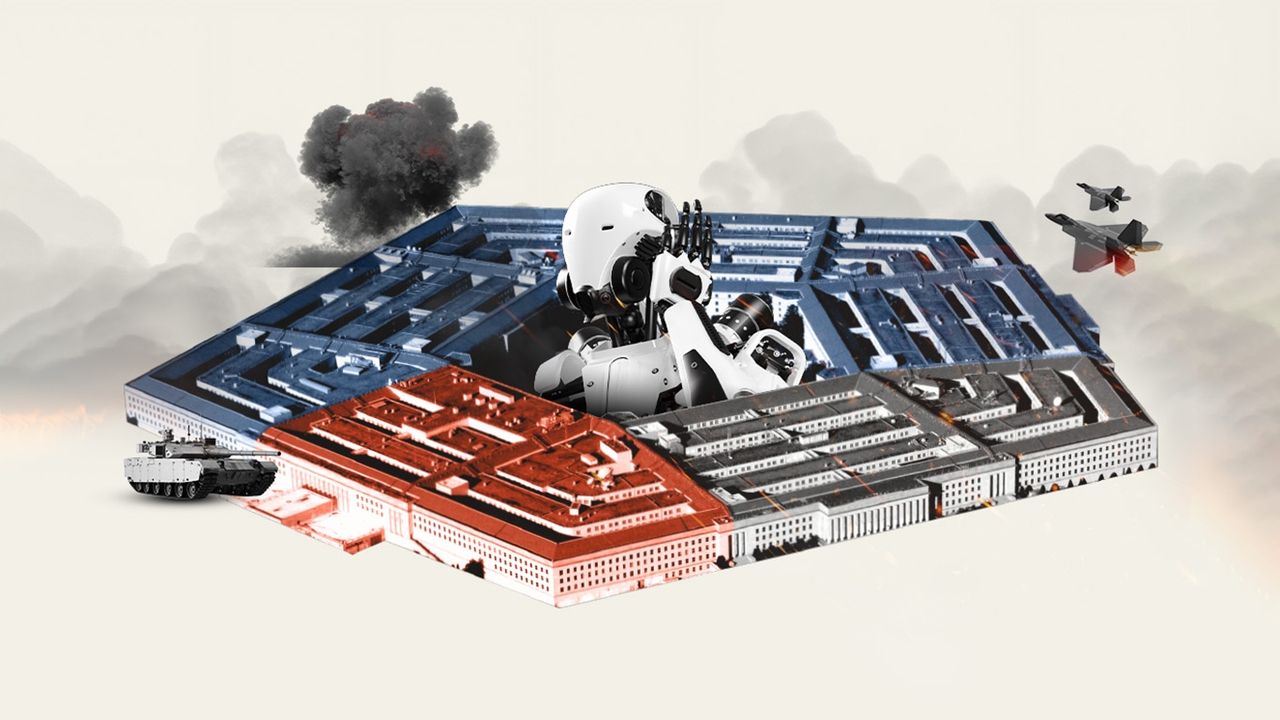
Modern warfare is rapidly evolving. The rising tensions in the Middle East, especially attacks involving the U.S., Israel, and Iran, have renewed global attention on "AI in warfare" (AI-Driven Warfare).
Behind much of the technology used on the battlefield are not only traditional arms manufacturers but also Silicon Valley tech firms playing vital roles—from AI for battlefield data analysis, target selection, and strategic decision-making to cloud systems and advanced processing chips.
What is clear is that modern warfare is no longer driven solely by weapons or limited to fighter jets, tanks, and missiles. AI models, algorithms, and cloud platforms have become the critical infrastructure for military decision-making today, supported by a network of tech companies that have become key Pentagon allies.

Major software companies have become primary infrastructure providers for the military, led by AWS, Google, Microsoft, and Oracle as main contractors. Joint Warfighting Cloud Capability (JWCC) A $9 billion contract authorizing the Pentagon to store and process highly classified data.
/ Amazon Web Services (AWS) The lead contractor on JWCC, providing mobile data centers (Tactical Edge) for frontline combat units.
/ Microsoft A lead JWCC contractor supporting cloud systems used by developers of IVAS (Integrated Visual Augmentation System) smart glasses for soldiers in the field.
/ Google A lead JWCC contractor co-developing Project Nimbus, a secure cloud platform, and providing AI/machine learning tools for object classification, satellite image analysis, target detection, and large-scale battlefield data processing.
/ Oracle A lead JWCC contractor supplying cloud services for Top Secret/SCI data, managing the military’s highest-level classified databases under Project Cloud One, extending AI cloud and database use in classified environments. Oracle also develops ruggedized portable cloud devices that soldiers can carry into combat to run AI and analyze data offline. Additionally, it manages the Pentagon’s largest backend systems, from payroll to weapons procurement and tracking aircraft parts via Oracle Fusion Cloud.
Another segment consists of AI companies developing large-scale AI foundation models under key contracts. AI for National Security Missions Each contract is valued at up to $200 million.
/ OpenAI Its language models and AI systems help summarize intelligence, analyze situations, and support operational planning.
/ Anthropic Develops AI models for security data and situation analysis, used for target selection and battlefield simulation.
/ xAI Develops a government-specific AI model namedGrok for Governmentwhich analyzes large datasets and supports strategic decision-making.
/ Meta Allows the military to use a closed-system military version of its Llama model for handling classified data, collaborating with Scale AI, a startup specializing in AI data labeling for sensitive information.
Additionally, some companies do not directly develop AI but support national-level infrastructure with advanced hardware and intelligent software.
/ Apple Apple’s chip technology and cloud security architecture (Private Cloud Compute: PCC) serve as a high-security infrastructure model. It supplies dual-use devices for both civilian and military purposes, invests in domestic AI chip and server production, and reassures the Pentagon about its supply chain.Supply ChainApple is supported by the government as a "Patriotic Tech" company.
/ Nvidia The U.S. military uses Nvidia’s H100, H200, and Blackwell (B200) chips to run AI models analyzing satellite imagery, simulating combat, and decrypting signals. Nvidia develops battlefield technologies such as Holoscan, which processes real-time sensor, radar, and communication data; Morpheus, which detects cyber threats; and "AI Factory," used by the military and Lockheed Martin to build complex digital twin combat simulations for testing new weapons virtually before production.
This group is directly security-focused and is seen as a new wave reshaping the military industrial balance.
/ Palantir Technologies Holds a $10 billion Army contract for Maven Smart System (MSS) Mission Command software powered by AI, with platforms AIP and Gotham forming the digital backbone of U.S. and NATO battlefield intelligence, integrating data from drones, satellites, and intelligence units into a single system.
/ Anduril Industries Develops autonomous drone control systems (Lattice OS), drone attack defense, and took over the $22 billion AR glasses (IVAS) project from Microsoft, focusing on embedding AI Lattice systems directly into soldiers’ wearable devices.
Shield AI, developer of “Hivemind,” an AI Pilot enabling drones and combat aircraft to fly autonomously without GPS or human controllers.
/ SpaceX Provides military communication satellites through its Starshield unit, launches satellites into space, and holds key contracts with the National Reconnaissance Office (NRO). The official merger of xAI into SpaceX enables the military to procure integrated technology from satellites (Starlink), rockets (Starship), to AI systems (Grok) all within one company.
Despite AI’s prominence, hardware remains the military’s core. These companies are the largest contractors by contract value, responsible for the military’s main armaments for many years.
/ RTX Corporation Develops the Patriot missile defense system and radar technologies.
/ Lockheed Martin Manufactures the F-35 stealth fighter jet and missile systems.
/ Northrop Grumman Produces stealth bombers and space systems.
/ General Dynamics Manufactures tanks, armored vehicles, and submarines.
/ Boeing Produces military aircraft and attack helicopters.
Reports indicate that the U.S. military procurement landscape has significantly shifted. While aerospace and defense companies still dominate the budget, Silicon Valley tech firms—from Defense Tech to Software Intelligence and Cloud Computing platforms—have gained increasing roles over the past two years.
The broad transformation reflects the defense industry’s shift fromthe traditional “Military-Industrial Complex”to a “Tech-Military Alliance” where these tech companies form the infrastructure of modern warfare. Today’s conflicts may not be decided by superior weapons alone but by who holds more information and analyzes it faster—those gain the advantage and likely victory.
Read more
Sources CNBC , Reuters , Army Technology,SGCR
Follow the Facebook page: Thairath Money at this link -