

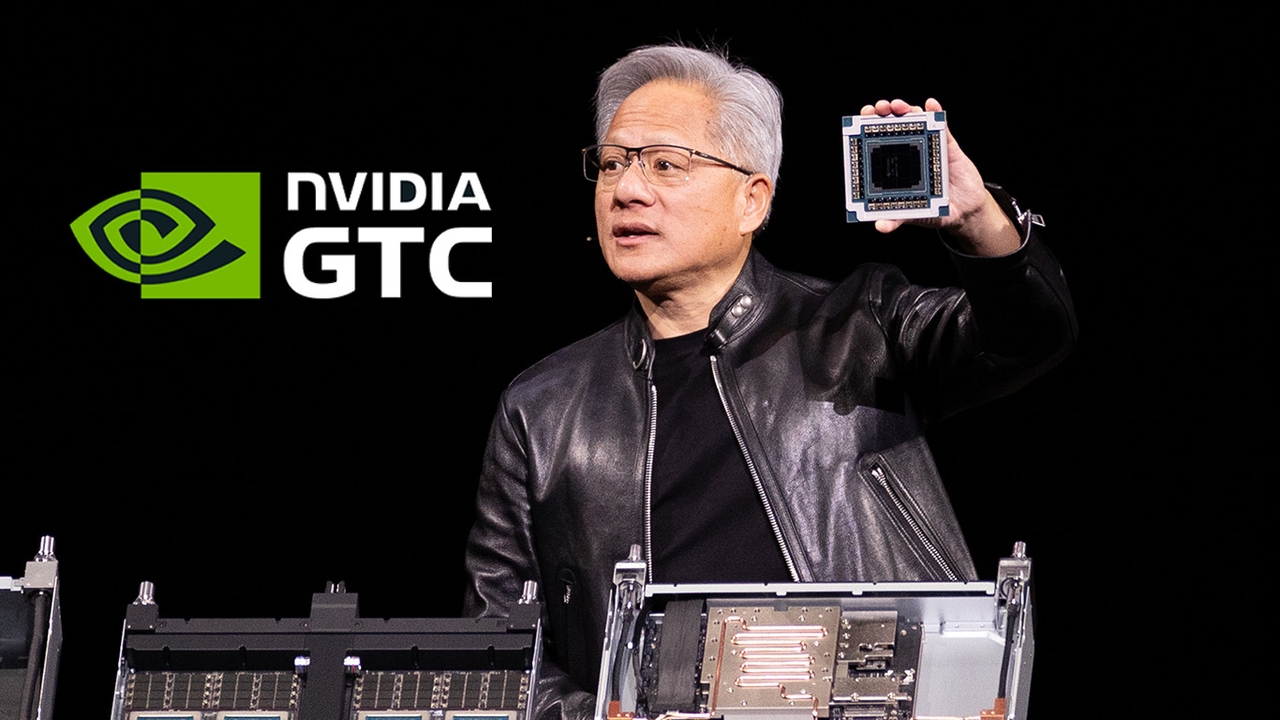
“From where I stand now... by 2027, I see at least $1 trillion in revenue opportunities.”, Jensen Huang, CEO of Nvidia, the world's most valuable company, announced during the keynote at Nvidia GTC, emphasizing his confidence that actual demand will exceed prior estimates.
On Monday, Jensen Huang said he expects the company to generate at least $1 trillion in revenue from AI chips, including Blackwell and Vera Rubin, within roughly two years, driven mainly by tools like Anthropic's Claude Code and OpenAI's OpenClaw.
Last year, Nvidia had estimated revenue opportunities around $500 billion from these two chips, but afterthe latest earnings reportwas released, Colette Kress, the company's Chief Financial Officer, revealed that “growth this year is likely significantly higher than previously expected.”
Earlier in February, the company disclosed that current quarter revenue is projected to rise by up to 77% year-over-year to about $78 billion, marking Nvidia's eleventh consecutive quarter with revenue growth exceeding 55%.
Jensen Huang attributes the surging chip demand to both startups and large companies seeking chips to develop AI models. He said, “Increasing production capacity enables creating more tokens, which in turn increases revenue,” leading Nvidia’s stock price to rise about 2% on Monday.
Meanwhile, AI usage is evolving from “chatbots” to “agentic applications” that can create subordinate agents to perform tasks autonomously on behalf of users. This causes a dramatic increase in token generation and consequently drives up demand for faster inference processing.
During more than two hours on the keynote stage, Jensen Huang also discussed the surge in popularity of OpenClaw, launched earlier this year, which has quickly attracted widespread use by individuals and organizations employing AI Agents to automate decision-making and task execution.
Nvidia introduced a developer tool enabling the creation and experimentation with new AI forms on Nvidia hardware. This tool is called NemoClaw. Specifically for OpenClaw, “it will search for OpenClaw, download it, and build AI Agents for you,” Jensen Huang explained.
On stage, Jensen Huang also highlighted interesting trends in chip and AI sectors, including space-based data centers and energy-efficient chip development, unveiling notable new products such as
The company plans to launch Vera Rubin, Nvidia’s next-generation supercomputer-level AI platform architecture, within this year. The system will comprise up to 1.3 million components working together between Rubin GPUs and Vera CPUs, designed specifically for Agentic AI workloads.
The company also confirmed that this product will deliver energy efficiency ten times greater than Grace Blackwell, a critical advancement given that energy consumption remains a major challenge in scaling AI infrastructure.
Additionally, Vera Rubin Space-1 was introduced as a computing platform focused on data center use in space. Jensen Huang views this as a crucial next step for AI technology in space applications.
The Vera Rubin Space-1 system will be deployed in space missions by multiple companies. These chips are specially designed for environments with constraints on size, weight, and energy consumption. Current partners include Axiom Space, Starcloud, and Planet Labs.
On the same day, Nvidia launched the Groq 3 Language Processing Unit (LPU), the first chip from the startup Groq, which Nvidia acquired for over $20 billion last December—making it the largest deal in the company’s history.
Groq was founded by the creators of Google’s internal Tensor Processing Unit (TPU). Recently, it has gained popularity as a competitor to Nvidia GPUs. The Groq 3 LPU is designed to complement this technology with processing cores optimized to accelerate GPU performance.
Nvidia also unveiled a full rack cabinet for Groq accelerators. The Groq 3 LPX Rack can hold up to 256 LPUs and is engineered to integrate with the Vera Rubin rack system, which will begin shipping to customers this year.
At the keynote, Jensen Huang showcased a prototype of a new rack architecture named Kyber, the next step after Rubin. It will house up to 144 GPUs in a vertically oriented compute tray instead of horizontal, increasing density and reducing system latency. This design will be used in the Vera Rubin Ultra system, expected to launch in 2027.
In the automotive sector, Jensen Huang provided more details on Nvidia’s partnership with Uber, announcing that Uber's ride-hailing platform will deploy a fleet of vehicles powered by Nvidia’s Drive AV software in 28 cities across four continents by 2028.
Nvidia also announced that automakers including Nissan, BYD, Geely, Isuzu, and Hyundai are developing Level 4 autonomous vehicles on the Drive Hyperion platform. Additionally, Isuzu and the Chinese company Tier IV are jointly developing autonomous buses using Nvidia’s AGX Thor robotics chips as a key component.
Source: CNBC [1[2],Nvidia,Financial Times
Follow Thairath Money Facebook page at this link -https://www.facebook.com/ThairathMoney