

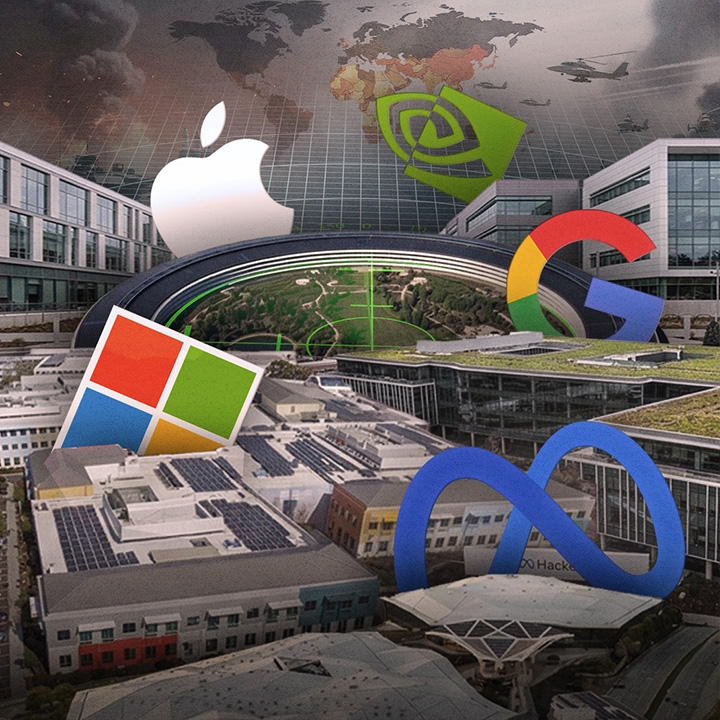
Tensions in the Middle East are escalating as Iran's Islamic Revolutionary Guard Corps (IRGC) has identified 18 technology companies in the region as potential targets for attacks going forward. These include Microsoft, Apple, Google, Meta, AWS, and Nvidia. This comes despite signals of de-escalation from US President Donald Trump, who indicated that US forces would withdraw from Iran within two to three weeks.
On 1 April, the IRGC issued a statement through Iran's Tasnim news agency.[No translation needed as this is a proper noun.]The statement emphasized that US information and communication technology (ICT) and artificial intelligence (AI) companies play a key role in supporting US military operations in the Middle East. Consequently, 18 technology firms have been designated "legitimate targets" in retaliation for US and Israeli attacks on Iran. The IRGC also warned employees of these companies to evacuate their workplaces immediately for safety.
In addition to the aforementioned major tech firms, the statement listed other companies including: Cisco, HP, Intel, Oracle, IBM, Dell, Palantir, JPMorgan, Tesla, GE, Spire Solutions, and Boeing. Also included was the AI company G42 from the United Arab Emirates, which counts the US among its key partners and investors. [No additional translation—this is part of the previous sentence.]
Read more:
James Henderson, CEO of risk management firm Healix, told CNBC that threats against tech companies represent a long-term trend. Technology assets are increasingly seen as integral parts of the battlefield rather than peripheral elements. This indicates that future crises may target data centers and cloud platforms similarly to strategic infrastructure.
Following the IRGC announcement, several companies have begun reviewing security measures at their Middle East offices, instructed employees to work remotely, and temporarily closed offices. They have also heightened data center and office security protocols to guard against physical and cyberattacks, while closely coordinating with government authorities.
In recent years, US tech companies have heavily invested in the Middle East, especially in AI infrastructure, due to the region’s low energy costs, available development space, and supportive ecosystems for funding and R&D. This has made the Middle East a strategic hub for expanding into regional markets, leading to many top tech firms establishing large offices and infrastructure there.
If Iran were to attack the technology infrastructure in the Middle East, the impact would vary depending on the "target" and "scale of the attack."
1. Regional level: Some systems could fail.
The Middle East is a key hub for cloud infrastructure, with data centers from Google, Microsoft, and AWS supporting users across the Middle East, North Africa, and parts of Asia. An attack could cause widespread outages of cloud, email, SaaS, and business applications, immediately disrupting many businesses.
Earlier in March, Iran attacked AWS data centers in the UAE and Bahrain, causing disruptions to numerous digital applications and services in the region. Reports indicated drone strikes impacted AWS billing and inventory systems in some areas, resulting in data loss.
2. Global level: Severe impact if vulnerabilities are exploited.
Although the global internet is designed with redundancy, critical vulnerabilities remain, such as submarine cables, landing stations, and major interconnection data centers. Attacks on these could slow international data transmission or disrupt services like WhatsApp, Gmail, or Instagram.
3. Heightened cyber risk.
Beyond physical attacks, such conflicts often coincide with cyber warfare, including Distributed Denial of Service (DDoS) attacks aimed at overwhelming servers, websites, or networks, system hacks, and digital sabotage.
Previously, Iran claimed to have attacked industrial and communication centers in Israel, including systems linked to Siemens and AT&T. Hacker groups associated with the IRGC, such as Seedworm and Handala, have used "wiper" malware to permanently erase data from Israeli software companies, not just steal it. Such attacks could extend to critical infrastructure in other countries, including financial, transportation, or energy systems.
If the IRGC proceeds with a full-scale operation, the consequences would extend beyond targeted companies, triggering a three-phase effect: business disruptions (Economic Shock), destabilization of digital infrastructure (Infrastructure Risk), and a global decline in trust (Trust Crisis).
Tech companies might reduce investments in high-risk areas, delay Middle East projects, relocate data centers to safer regions, or segment services by region. These trends could lead to long-term "fragmentation" of the global internet.
Meanwhile, financial markets have seen volatility in tech stocks, reflecting investor concerns that escalation could impact not only the Middle East but also the broader digital ecosystem, affecting the stability of many digital services used worldwide daily.
Currently, the tech industry remains on high alert. Although no major destructive event has occurred by the 1 April deadline, Iran's shift in targets and previous data center attacks demonstrate that "technology" is now regarded not just as a business tool but as critical military infrastructure, becoming a frontline in global conflicts.
Sources: CNBC, , Datacenterdynamics, ,DigitalShield
Follow the Facebook page: Thairath Money at this link -