

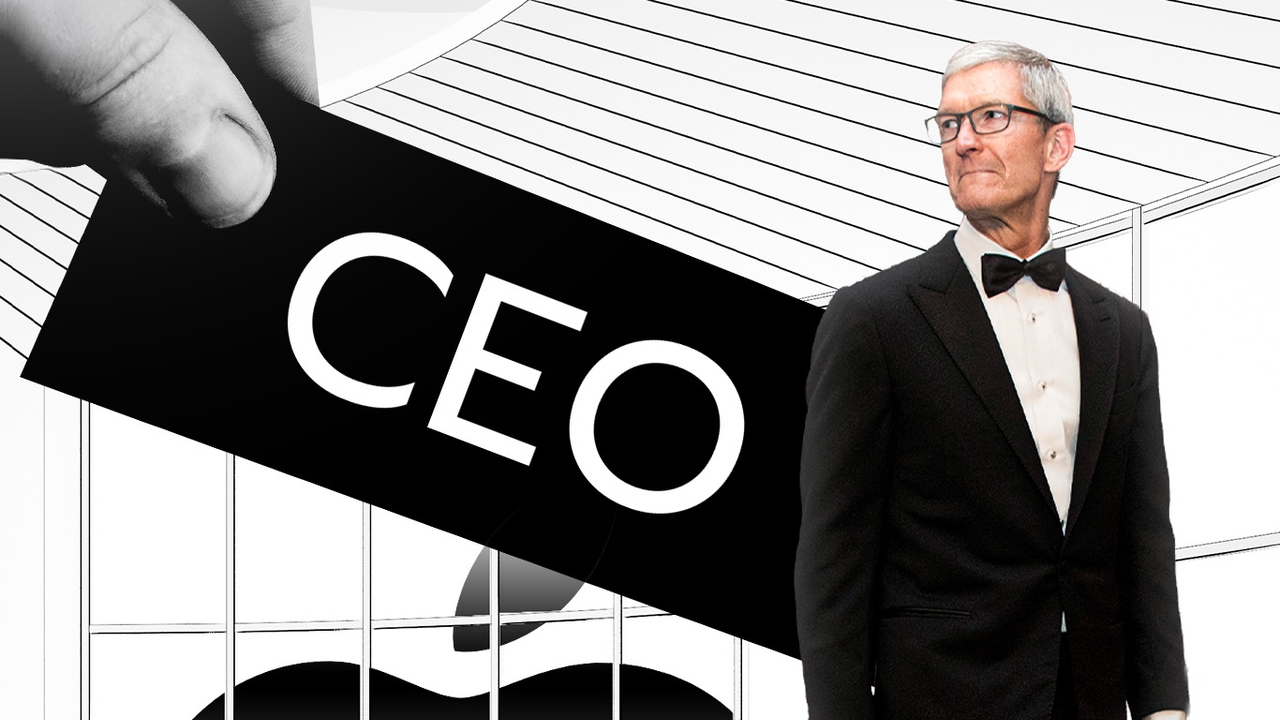
After leading Apple for over 15 years, Tim Cook announced his departure as Chief Executive Officer (CEO), closing the chapter of a leader who not only inherited Steve Jobs' legacy but also played a key role in growing Apple into one of the world's most influential and profitable companies.
Tim Cook will transition to the role of Executive Chairman, while John Ternus, Senior Vice President of Hardware Engineering, will become Apple's next CEO as expected, effective 1 September 2026. Cook will work closely during the transition period and will retain responsibility for certain company duties, particularly engaging with global policymakers.
Tim Cook joined Apple in 1998 as the head of global supply chain and operations before rising to CEO in 2011, shortly after the company lost its founder, Steve Jobs.
When he assumed the CEO role, many questioned whether an "operations expert" could lead an innovation-driven tech company like Apple forward. Cook's answer was to transform Apple from a company known for standout products like computers and smartphones into a Silicon Valley tech powerhouse and one of the world’s major economic engines.
Apple became the first publicly traded company worldwide to reach a market value of one trillion U.S. dollars, continuing to grow and set new records. Currently, its market capitalization is approximately four trillion U.S. dollars, more than ten times its previous value, with a device user base exceeding 2.5 billion and business operations expanded across more than 200 countries.
One of Cook’s standout achievements was spearheading new influential product categories. The Apple Watch became the world's best-selling watch, AirPods defined the wireless headphone market, and most recently, Apple Vision Pro represents an effort to open the door to the Spatial Computing era.
A key strategy he implemented was building an ecosystem difficult to replicate by linking devices and services—from iPhone, iPad, Mac to Apple Watch and AirPods—alongside services like iCloud, Apple Music, Apple TV, and Apple Pay. This model transformed Apple from a hardware seller into a platform generating continuous revenue and fostering strong user loyalty.
What sets Cook apart from other tech leaders is his role beyond products. He is not just an executive but a "negotiator" with a global impact. He is among a few CEOs who balance the intersection of "technology" and "politics."
This includes negotiating with the U.S. and Chinese governments—the largest manufacturing base and overseas market for Apple—to maintain supply chains, as well as advocating for critical issues such as user privacy and environmental responsibility, leading to significant reductions in Apple's carbon emissions.
Although Apple grew enormously under Cook, critics argue it lacks game-changing innovations like the iPhone from Jobs' era. Some projects have failed, such as the autonomous Apple Car program which was halted, and the Vision Pro (VR headset) which has yet to capture the market. Recently, Apple has also faced criticism for its delayed entry into artificial intelligence, with AI projects like Apple Intelligence and new Siri development falling short of expectations.
Nonetheless, overall, Cook has maintained the disciplined growth trajectory begun in Jobs’ era, reducing business volatility. Under his leadership, Apple has become a large, financially stable technology company consistently meeting global consumer expectations.
Over the past 15 years, Cook has achieved tremendous success, making Apple not only one of the strongest organizational structures in history but also a global player influencing both the economy and public policy.

His departure is not an end but a handover of the strongest Apple ever to the next generation of leadership. John Ternus, Senior Vice President of Hardware Engineering. A key figure behind Apple’s products for more than 20 years, Ternus’ succession from Tim Cook is seen as a shift in Apple’s leadership style toward a new era.
Ternus, 50, is a true Apple insider who has grown within the company. He joined in 2001 as a product design team member, rising to Vice President of Hardware Engineering in 2013 and entering the executive team in 2021. Over his 20-plus years, he has been behind almost every product line, including iPhone, iPad, Mac, and Apple Watch, as well as launching new products like AirPods and MacBook Neo. His philosophy is making technology more accessible without compromising quality.
He also played a key role in Apple’s critical transition to custom-designed chips (Apple Silicon), a current strength in product performance and power efficiency. Moreover, he has pushed for product durability, new materials, and sustainable design, such as using recycled materials and extending device lifespans. These efforts have led to Ternus being regarded as a "Product CEO" focused on hardware innovation. The "Product CEO" or hardware-focused CEO. He is expected to refocus Apple on hardware innovation.

This leadership change is not just a personnel shift but also signals a new challenge for Apple, which may no longer grow as explosively as in the past. The smartphone market is saturating, hardware upgrade cycles are lengthening, and while Services revenue continues to grow, it faces increasing global regulatory pressures amid intense AI competition where Apple currently lags behind.
Follow the Facebook page: Thairath Money at the link -