

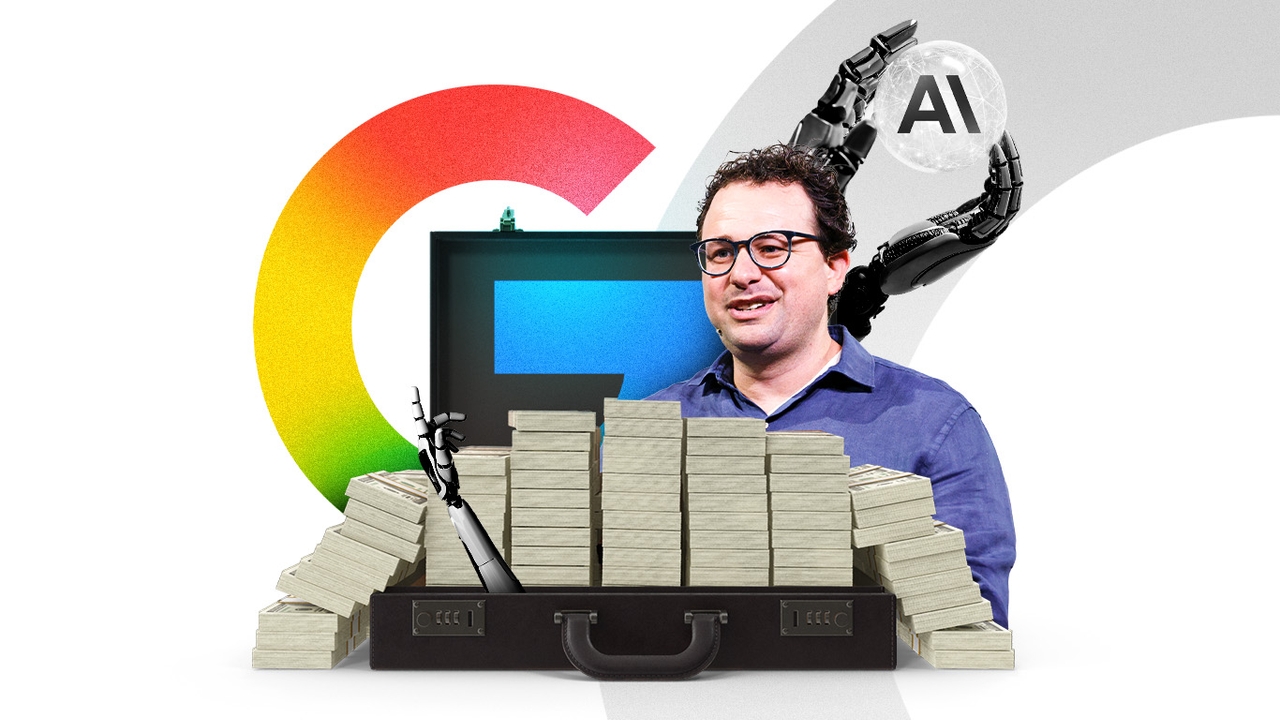
Google is aggressively advancing in the AI arena by announcing plans to invest up to $40 billion, approximately 1.2 trillion baht, in Anthropic to accelerate its influence in the fiercely competitive AI battlefield. Google has already begun with a $10 billion cash investment, while the remaining $30 billion will be gradually invested if Anthropic meets specified performance and growth targets.
Anthropic stated that this deal builds upon the long-term collaboration between the two companies, which recently announced partnerships with Broadcom and Google to supply a 5-gigawatt computing infrastructure set to launch next year, with potential for future expansion.
Currently, Google offers access to Anthropic's Claude model through its cloud service, directly competing with Amazon Web Services (AWS) and Microsoft Azure. Google is also developing its own specialized Tensor Processing Units (TPUs) as an alternative to Nvidia's GPUs. However, Google also has its own AI model, Gemini, competing directly with Anthropic in the same market.
The relationship between the two began in 2023 when Google invested $300 million to acquire about 10% equity, later increasing its investment by another $2 billion. Before this latest deal, Google had invested over $3 billion in Anthropic, holding approximately 14% ownership.
Previously, Anthropic reached a similar agreement with Amazon, which invested $5 billion and plans to increase its investment up to $20 billion in the future, subject to business performance conditions.
This new investment reflects a trend of major tech companies pouring substantial funds into leading AI firms like OpenAI and Anthropic, marking record-high investment values expected to generate future revenue.
The deal comes as Anthropic faces infrastructure pressures due to rapidly increasing demand for its Claude model. Consequently, the new funds from Google will be used to significantly expand compute capacity to accommodate the surging AI demand.
Examining the deal more deeply, Google's investment in a leading AI startup is a strategic move to lock in the AI industry's value chain by pre-purchasing demand.
Google is confident that its TPUs and Google Cloud will experience sustained growth, as Anthropic relies on Google's infrastructure to train and run models. The more Anthropic uses TPUs, the more Google reduces dependency on expensive Nvidia GPUs and better controls costs.
Historically, Google was seen as having missed the AI opportunity, allowing Microsoft and OpenAI or Amazon to take the lead. However, this deal signals Google's transition into a full-stack competitor, controlling chips, models, and robust processing infrastructure.
Thomas Kurian, CEO of Google Cloud, told the Financial Times that new AI chips and advances from DeepMind research labs are key to helping the company's data center business catch up with competitors. Although Google entered the cloud market later and lagged in AI, its full-stack AI strategy—developing everything in-house from chips and data centers to foundational models and products—is beginning to yield results.
“We are not just a hyperscaler reselling others’ technology. Our difference is owning all intellectual property, models, and chips,” Kurian said, adding that this structure allows Google to avoid paying most costs to external model developers or chip makers, enabling more reinvestment.
Recently, Google unveiled the 8th generation TPUs in Las Vegas, including chips for model training and enhanced memory chips for faster inference. Epoch AI estimates Google holds about 25% of global AI compute capacity with roughly 3.8 million TPUs and 1.3 million GPUs. Microsoft ranks second with about 3.2 million Nvidia GPUs. This indicates Google is increasingly competing with Nvidia, potentially straining their relationship despite Alphabet remaining a major GPU customer.
This massive investment comes amid capital market concerns over revenue and profit returns, as startups like Anthropic and OpenAI still face heavy losses due to high processing costs. Nonetheless, Google, confident in its infrastructure advantage, plans substantial capital expenditures estimated at $185 billion this year.
The Google-Anthropic deal aims to establish a durable competitive edge, signaling Google's full commitment to the long-term AI game. Google is clearly betting on its strength as the "owner of the entire stack"—from TPUs and cloud infrastructure to cutting-edge DeepMind research. If successful, Google could redefine its role as the AI infrastructure provider others depend on.
Source information Bloomberg , Financial Times
Follow the Facebook page: Thairath Money at the link below -