

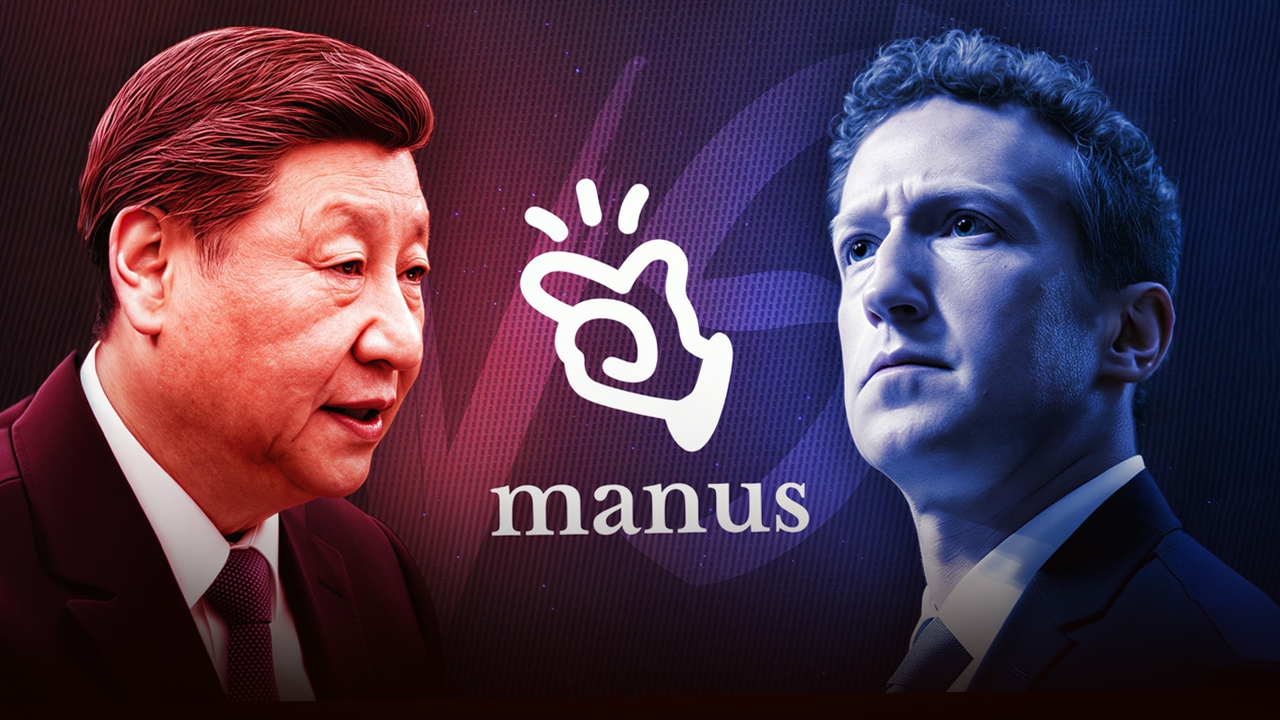
AI Agents capable of performing complex tasks with minimal human intervention have become a key battleground for major tech companies competing to invest. One such company is Manus, an advanced AI Agents platform from China that can execute multiple functions through simple commands. In December 2025, tech giant Meta decided to acquire Manus for over 2 billion U.S. dollars.
What brought the deal into the spotlight is that Manus was created by Butterfly Effect, its parent company in China. The platform was launched only on 6 March 2025 but grew rapidly to generate annual revenue of up to 100 million U.S. dollars. After Meta’s acquisition, the Chinese government intervened to investigate and attempted to block the deal.
Manus operates differently from typical AI chatbots by performing multi-step tasks autonomously through integration with various applications and tools. It can make decisions on behalf of users once authorized. While most AI Agents today require human oversight, Manus is designed to be more independent, able to plan and execute entire task sequences from start to finish on its own.
Regarding its capabilities, the company states that Manus matches the work of a junior analyst, freelance developer, or research assistant, capable of multitasking without step-by-step instructions. It can access the internet, search for information, write and run code, and manage files independently. For example, in customer service, Manus can answer calls, verify user information, check histories, and provide context-aware responses.
Amid intensifying AI competition between the two superpowers, China and the United States, Meta’s acquisition of Manus has drawn global attention, not just from Beijing. Although the deal has technically closed, the Chinese government appears determined to halt its completion.
Manus originated in China as developed by Butterfly Effect, which received investments from major Chinese investors including Tencent Holdings Ltd., ZhenFund, and HSG, along with 500 million U.S. dollars from Silicon Valley venture capital firm Benchmark. This U.S. investment prompted the U.S. Treasury Department to review the deal as well.
In July 2025, Manus decided to relocate its headquarters from China to Singapore, moving all staff there to better access global funding. Shortly after the move, Meta agreed to pay 2 billion U.S. dollars to acquire Manus, aiming to strengthen Meta’s platforms with Manus’s AI Agents technology and personnel.
On 8 January 2026, China’s Ministry of Commerce announced it was reviewing the Meta-Manus deal due to risks of violating technology export controls and foreign investment restrictions.
Then on 27 April, China’s National Development and Reform Commission (NDRC) abruptly ordered the cancellation of the Meta-Manus deal, banning foreign investment and requiring all parties to withdraw without providing detailed reasons.
This decision surprised many because the deal was nearly finalized, Manus had fully relocated to Singapore and shut down operations in China, and Meta insisted it had severed all ties with China.
However, Beijing’s intervention reflects that the Chinese government still views Manus as a Chinese company and is willing to exert cross-border authority to control critical technologies. Although the company relocated, some technology was developed in China and is regarded as a national achievement.
Earlier, when the deal was first announced, Manus’s co-founders Xiao Hong and Ji Yichao were summoned for investigation by Chinese authorities and were banned from leaving the country.
It remains unclear whether China has the legal power to force Meta to cancel the deal, but the current situation has placed the agreement in legal and operational limbo.
Since Manus’s founders and key personnel are Chinese citizens, the government can exert pressure through this channel. Although parts of the deal, such as technology transfer, funding, and team integration with Meta, have progressed, the team remains crucial for future product development.
Meta’s executives may need time to assess whether Beijing will allow a negotiated resolution, possibly involving restructuring through licensing agreements or partnerships with Chinese companies.
The impact of this case goes beyond Meta and Manus, shaking the strategy of Chinese startups relocating to countries like Singapore to access global funding and avoid Chinese regulatory oversight. Meanwhile, the U.S. government is closely monitoring whether Beijing’s actions will disrupt other international AI deals.
Bloomberg Economics analysts Michael Deng and Adam Farrar said, “Chinese-founded AI companies considering the same path as Manus—building domestically, relocating abroad, then selling to Western firms—need to reconsider. The Chinese government can and is prepared to intervene in deals at any time.”
Follow the Thairath Money Facebook page at this link -https://www.facebook.com/ThairathMoney