

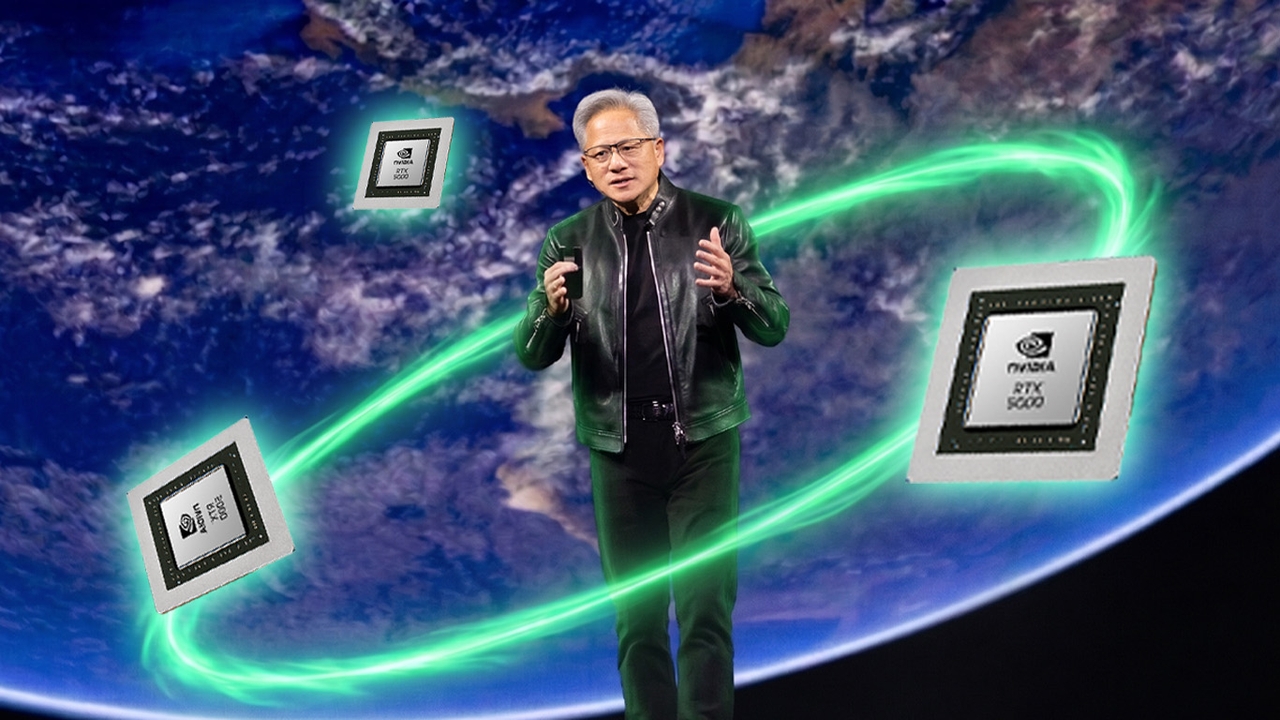
NvidiaNvidia has reaffirmed its position as the central hub of the global AI trend after reporting Q1 fiscal year 2027 results (ending 26 Apr 2026) that once again exceeded market expectations. Total revenue hit a record high of $81.6 billion, up 85% year-on-year, surpassing Wall Street's estimate of about $79.2 billion. Net profit reached $58.3 billion, a 211% increase, while adjusted earnings per share (EPS) stood at $1.87, beating analysts' forecast of $1.76.
The key highlight of this earnings announcement was CEO Jensen Huang’s statement: “This has been an incredible quarter, with demand rising rapidly,” emphasizing that the primary driver was the arrival of “Agentic AI” which refers to AI systems capable of autonomous thinking, decision-making, and performing tasks on behalf of humans.
He further noted that the world is entering a major phase of "Rebuilding Computing Infrastructure" to support both Agentic AI and Physical AI—AI designed for robotics and real-world automation—with Nvidia at the center of this transformation.
- Nvidia plays a role in nearly every frontier-level AI model worldwide, serving as the main platform for almost all leading AI models including OpenAI, Anthropic, xAI, Meta, and Google.
- Nvidia’s chips form the infrastructure backbone for hyperscalers globally, supporting core processing, enterprise machine learning, internal AI services, and GPU demand from public cloud users.
- A broader product portfolio is helping Nvidia enter new markets, including new AI data centers, AI-native clouds, sovereign AI clouds, as well as enterprise AI systems and industrial AI infrastructures.
- Led by the CUDA platform, Nvidia is expanding from AI into autonomous vehicles and robotics, aligning with the Agentic AI trend.
- Following this is the "Vera CPU," a new AI rack system expected to surpass the success of Grace Blackwell and become a new growth driver, aiming to capture market share from established CPU leaders Intel and AMD. The new CPU chip market could be worth over $200 billion, and if successful, Nvidia could become the world’s largest CPU manufacturer.
Huang explained Nvidia’s new earnings report segmentation into two main groups: Data Center and Edge Computing for clarity. He noted that while all relate to AI, customer needs differ greatly.
Hyperscalers like Meta or Alphabet may buy massive numbers of GPUs to build large data centers, whereas governments, general businesses, or robotics firms require different systems, operating systems, and marketing approaches.
For this quarter, the Data Center business remains Nvidia’s core, generating a record $75.2 billion in revenue, up 92% year-on-year, accounting for more than 90% of total company revenue.
Within this, revenue from hyperscalers or large cloud companies accounts for over $38 billion, more than half of Data Center revenue. About $37 billion comes from the "ACIE" business segment, including AI Cloud, Enterprise AI, Industrial AI Infrastructure, and Sovereign AI.
Colette Kress, the company’s CFO, noted that AI Cloud revenue grew more than threefold year-on-year, and Nvidia is helping install AI compute systems in over 80 data centers globally exceeding 10 megawatts in size.
Vera Rubin and the $200 billion new CPU market
A major point of investor focus this quarter is Nvidia’s expansion from a GPU chip company into a full player in the CPU market, following the launch of the next-generation AI Rack system, “Vera Rubin,” which integrates both chip types into a single supercomputer rack. The company has set a clear goal to become the world’s largest CPU manufacturer, a market currently dominated by Intel and AMD.
Huang said “Vera Rubin” is likely to be more successful than the Grace Blackwell chip, as Nvidia rapidly gains market share in inference workloads, especially with the rising number of companies developing frontier AI models.
He cited Anthropic as a key customer this year, utilizing Secure Compute across Microsoft Azure, Amazon Web Services, and CoreWeave. The Vera Rubin system consists of over 1.3 million components, including 72 Rubin GPUs and 36 Vera CPUs, with Nvidia stating it delivers ten times better energy efficiency than previous models.
It is projected that Vera Rubin could open a new market worth over $200 billion for Nvidia, with the company expected to generate up to $20 billion in CPU chip revenue this year.
Although Nvidia’s revenue and profit continue to grow strongly, investors are beginning to focus on more than just growth. One key concern is Nvidia’s candid admission that several major customers are becoming competitors by developing their own AI chips.
The company stated that some customers are developing ASICs (Application-Specific Integrated Circuits), chips designed for specific tasks that may not require the full capabilities of Nvidia’s GPUs.
While no names were directly mentioned, major tech companies such as Google, Amazon, Meta, and Microsoft are all developing custom AI chips. For example, Google has long had its own TPUs and recently announced a new AI infrastructure company centered on TPUs, with Blackstone investing $5 billion. Meta launched several custom AI chips this year manufactured by Taiwan Semiconductor Manufacturing Company (TSMC).
This situation reflects that the AI chip market is entering a new competitive phase. Nvidia also warned that some customers may launch AI cloud services competing directly with Nvidia, potentially impacting Nvidia’s ability to expand its market. Additionally, these companies could compete for foundry capacity and critical materials during supply chain tightness.
Furthermore, the ASIC market is heating up not only among tech giants but also startups like Cerebras Systems, SambaNova Systems, and d-Matrix, which are entering the competition.
Investors are questioning how long Nvidia can maintain its central role in AI globally, whether major customers will continue relying on Nvidia chips or switch more to custom chips, whether the AI market will grow fast enough to support a multi-trillion-dollar company valuation, and whether the “Agentic AI” Huang mentioned will become the next major technology wave. However, based on the latest earnings, Nvidia currently remains clearly the "real winner" of the AI era.
Follow the Facebook page: Thairath Money at this link -