

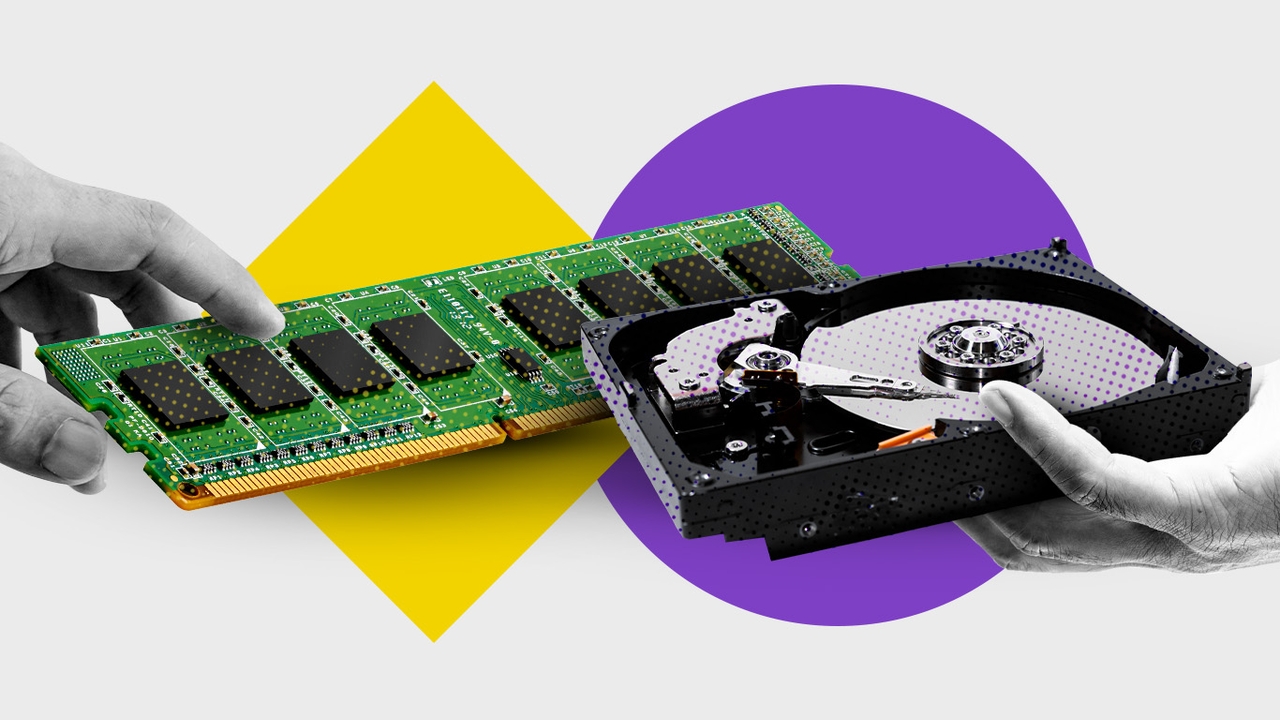
In recent years, AI competition has been driven by the demand for processing chips like Nvidia's GPUs, which are central to training large AI models. However, as the industry expands from Generative AI to Agentic AI and large-scale enterprise AI, the tech world has identified a new critical bottleneck as important as GPUs: "Memory" and "Storage systems."
Because even with many GPUs, if data transfer speeds are insufficient or storage capacity is inadequate, AI cannot operate at full efficiency. This is why the market is increasingly focusing on Memory and Storage stocks, especially as many parts of the industry face a "shortage".

Memory is "temporary memory" used to deliver data to AI accelerators such as GPUs, TPUs, or NPUs in real-time during processing—it is the space AI uses "while thinking."
The role of Memory is to enable AI to access data as quickly as possible, since modern AI processes massive amounts of data simultaneously, whether text, images, videos, or user data.
The main issue is that AI-era demand for Memory grows faster than production capacity, becoming a bottleneck for the entire industry. Notably, HBM (High Bandwidth Memory), designed specifically for AI, is a star product currently in "short supply."
HBM excels by delivering extremely fast data transfer with massive parallel throughput and lower power consumption than typical DRAM. It suits AI training and large language models (LLMs). High-end AI chips like Nvidia's H100 or Blackwell require HBM to reach full performance.
However, HBM is difficult to manufacture because it requires advanced technologies such as 3D chip stacking, advanced packaging, and high-speed interconnections. As a result, global HBM production remains limited while demand from AI, cloud, and data center companies surges rapidly.
Companies benefiting from HBM include SK hynix, which has become a key Nvidia supplier and is regarded as a current market leader in HBM. Samsung Electronics, another South Korean player, is also racing to expand its HBM market share and production capacity to meet the AI boom.
Meanwhile, Micron Technology, a major U.S. memory company, directly benefits from the global rise in demand for AI servers and data centers.
Although HBM is prominent, AI systems still rely on various types of memory. Another important type is DRAM, the main memory in servers and data centers, widely used in cloud systems and digital infrastructure worldwide. While not as fast as HBM, AI systems still need vast amounts of DRAM to manage data.
SRAM is high-speed memory embedded within chips, used to reduce latency in data access, allowing CPUs and GPUs to process faster. Despite its speed, SRAM is costly and occupies significant chip space, so it is used only in areas demanding the highest performance.
If Memory is "temporary workspace," Storage is the "long-term data repository" for AI, storing datasets, AI models, data for retrieval-augmented generation (RAG), vector databases, user data, logs, and AI-generated information.
As AI becomes more advanced, its data needs grow exponentially, leading many to describe this as a "data explosion," a new surge of data challenging traditional systems' capacity and speed.
The most crucial storage in the AI era is SSD and NAND Flash—high-speed storage systems characterized by fast read/write speeds. They accelerate data pipelines for AI and support data retrieval for AI inference.
Modern AI data centers require massive numbers of SSDs because new AI models must access data rapidly and continuously.
Key players in this field include Western Digital and SanDisk, with SanDisk being a major brand in NAND Flash and SSD storage systems, attracting strong market attention.
Although SSDs are growing rapidly, HDDs still play a vital role in the AI era. Training AI requires enormous volumes of data—from videos and images to synthetic data—so large hyperscale data centers still rely heavily on HDDs for cost-effective, long-term storage.
Market leaders here include Seagate Technology and Western Digital.
Modern AI no longer runs on a single machine but depends on cloud and distributed storage to support vast users and data. These systems enable AI to access data from multiple data centers, operate concurrently on many tasks, and support AI agents and enterprise AI.
Companies aligned with this theme include Dell Technologies and NetApp, key players in servers, storage, and enterprise data management.
Today's tech demand reflects that "Memory and Storage" have become the new core of AI. As AI models grow larger, the challenge shifts from just "computation" to "data movement," making Memory and Storage critical new infrastructure where global investments are accelerating, and investors worldwide are closely watching this theme amid the AI boom.
Compiled by Thairath Money
Follow the Facebook page: Thairath Money at this link -https://www.facebook.com/ThairathMoney