

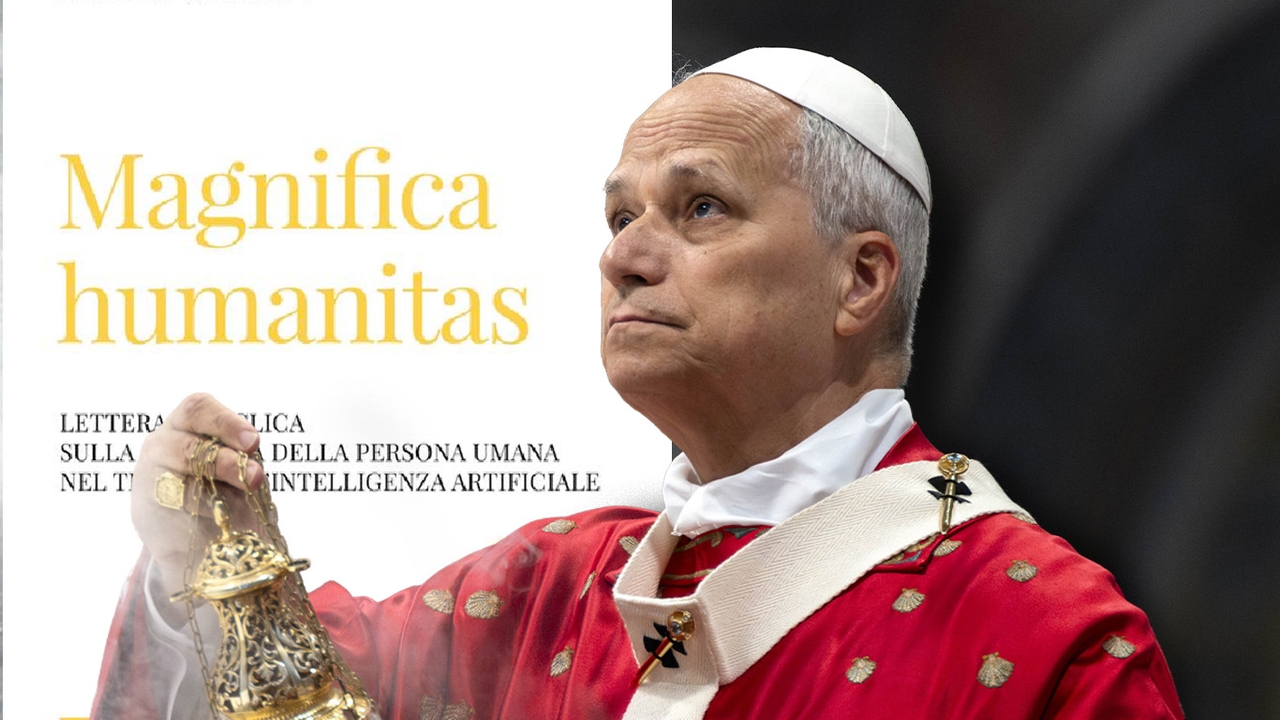
Pope Leo XIV issued a major message on artificial intelligence (AI) on Monday, 25 May 2020 GMT+7, issuing warnings ranging from mass job losses to the monopolization of AI power by major technology companies.
This document is the Pope’s first Encyclical, a formal papal letter expressing the Catholic Church’s moral and social stance on critical global issues.
The key message from Pope Leo focuses on AI technology transforming the world, a subject he has frequently addressed before.//"Magnifica humanitas: on safeguarding the human person in the time of artificial intelligence"It concerns protecting human dignity in the era of artificial intelligence.
In addition to outlining impacts and calls to action, yesterday the Vatican invited Chris Olah, co-founder of Anthropic, to the Encyclical’s launch, during which Pope Leo publicly thanked Olah.
“I accept your invitation to collaborate, to listen and discuss together, and to seek pathways for humanity in the AI era,”the Pope told Chris Olah.
Interestingly, at the same time, many major AI technology companies heavily lobbied the Vatican, explaining that AI is a tool developed for humanity, ahead of the Pope’s release of the 245-paragraph Encyclical.
Though he emphasized that “AI is not inherently evil,” the Pope issued three key warnings that the world must heed, as follows.

Throughout the document, Pope Leo XIV repeatedly warns about AI power concentrating in the hands of a few groups. While he does not name companies directly, it is widely understood that the major players include Nvidia, Microsoft, Amazon, Google, Meta, OpenAI, and Anthropic.
He warns of “major economic and technological players” increasingly controlling platforms, infrastructure, data, and computing power, which will ultimately reduce transparency and lead to more severe digital inequality.
“When such power is concentrated in only a few groups, there is a tendency toward opacity and evasion of public oversight, increasing the risk of distorted development, dependency, exclusion, manipulation, and new forms of inequality.”Excerpts from the Encyclical
The Pope also references Catholic teaching on the “Universal Destination of Goods,” originally applied to natural resources like air and water, suggesting this principle should extend to algorithms, digital platforms, and data.
He warns that a “small but influential group” could use AI to manipulate democratic processes and shape economic systems for their own benefit.
The Encyclical calls for “disarming AI” from the race to develop more powerful algorithms, larger datasets, and commercial competition.
He explains that disarming AI means“freeing technology from monopolistic control, opening it up to debate and discussion, making it human-friendly, and restoring it to cultural and human diversity.”
Pope Leo XIV issues a “special appeal” directly to engineers and AI developers, stating clearly that“Developers must bear special ethical and spiritual responsibility.”Because every decision in AI design“reflects a vision of humanity.”
He urges developers to build AI systems grounded in values of transparency, accountability, and careful consideration of genuine benefits.
He warns users not to trust AI as neutral or fair, since it often reflects and amplifies creators’ biases.
He also questions who is responsible if AI makes mistakes, affirming that“humans must always be held accountable.”He insists that automated systems should never have authority over life-and-death decisions, and if AI training data comes from unequal societies, it will exacerbate inequalities—such as in credit scoring or job selection.
One of the most urgent issues is the labor market, where the Pope warns that mass unemployment could become a true “social calamity.”
Concerns over AI disrupting the labor market have been debated since Generative AI gained popularity. While some companies admit recent layoffs relate to AI, many still doubt the situation is a labor crisis.
For example, Stephen Parker, co-head of global investment strategy at JPMorgan Chase Private Bank, told Business Insider earlier this month, “Many companies are realizing AI’s potential to elevate worker skills rather than replace humans.”
However, the Pope states in the Encyclical that even if AI can safely ease human work,“Protecting employment opportunities and the irreplaceable role of humans must remain fundamental principles.”
He also states that“The pursuit of greater profit should not be used as an excuse for decisions leading to layoffs.”He warns that large-scale job losses from AI could cause“poverty in both human and cultural dimensions.”
Moreover, he believes governments and businesses should prepare for AI’s impact before widespread job loss occurs, saying“Every time automation and AI are introduced, verifiable measures must accompany them to protect employment, retrain skills, and ensure worker participation.”
He concludes that such approaches will help AI focus on“unlocking human potential rather than excluding people from the system.”

The context of the Encyclical Magnifica humanitas compares the emergence of AI to the Industrial Revolution during the time of Pope Leo XIII (Rerum Novarum), noting AI is creating profound changes that will uproot lifestyles, labor, and even warfare.
But ultimately, the core message emphasizes thathuman greatness lies not in technical ability or technology, but in freedom and love./Because if “efficiency” is held as the highest value, humans will be seen merely as systems to be optimized rather than as persons with souls.
Source:Vatican,Business Insider
Follow the Facebook page: Thairath Money at this link –https://www.facebook.com/ThairathMoney