

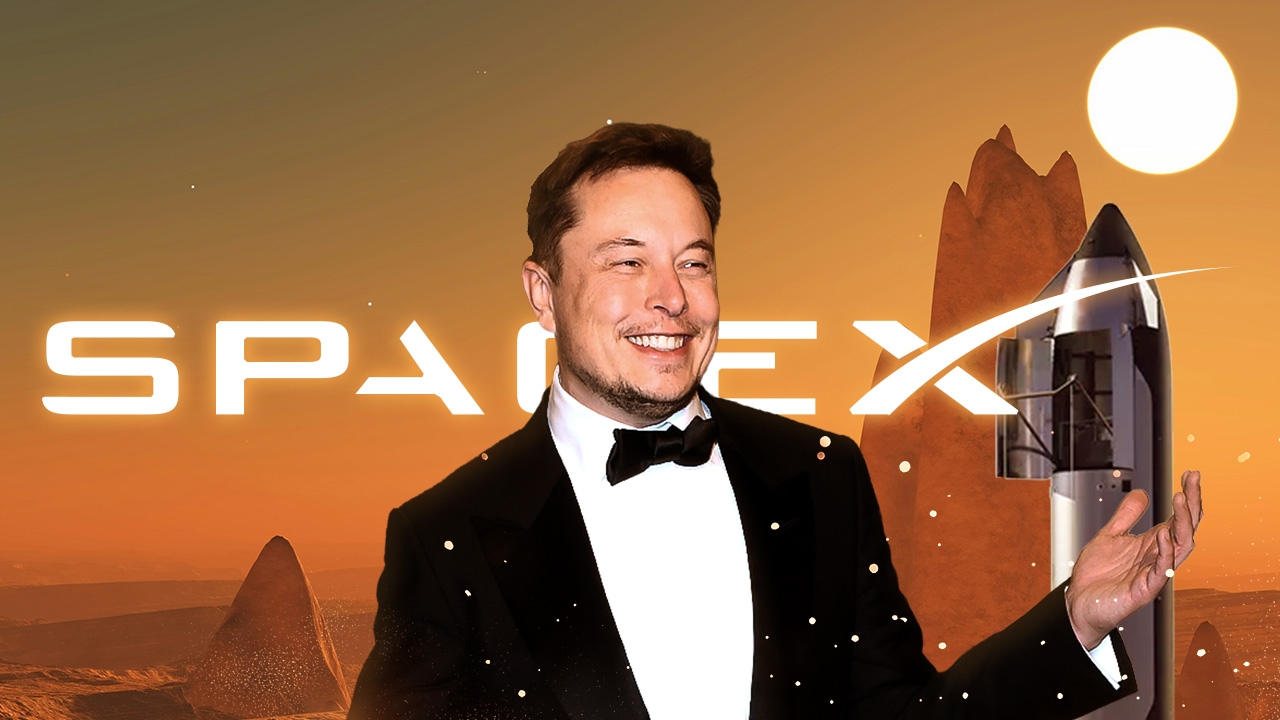
Amid reports that SpaceX is set to list on the stock market in the near future, many see it as a future-shaping company poised to become a historic IPO with soaring valuation. However, some raise questions after reviewing its financial statements.They ask whether it is worth the risk for a company carrying huge costs and debts and potentially unable to turn a profit for a very long time.
Thairath Money takes a deep dive to understand SpaceX's business through a conversation on the program Digital Frontier. Between Rada-Laphatsrada Pipat and Tle-Natthanon Duangsongnoen, editor-in-chief of Spaceth.co. They explore SpaceX's background and, if the company remains unprofitable, what investors can expect from this IPO.
Viewing SpaceX merely as a “rocket manufacturer” is too narrow, because the company is building more than spacecraft—it is creating the infrastructure of the new space economy that accelerates technology development and fundamentally transforms humanity’s relationship with the universe.
Many think SpaceX just manufactures and launches rockets, but its business model has evolved significantly. Initially, its main revenue came from logistics—transporting cargo for NASA and private satellite launches.
The key turning point was developing reusable rockets, which drastically cut costs. Previously, rocket launches were like expensive charter flights made to order. Now, with a defined launch cadence, prices are much lower because customers can plan for scheduled rocket launches.
While Elon Musk’s ultimate vision is to build a human colony on Mars, SpaceX’s current main revenue driver is Starlink, the company’s satellite internet service.
Satellite internet isn’t a new idea; companies like Iridium tried before but failed due to high satellite launch costs and insufficient market demand. SpaceX succeeded thanks to three critical factors:
This gives SpaceX a major competitive advantage that is difficult for rivals to match. It exemplifies vertical integration—controlling the entire business chain. Owning the cheapest space transport system allows SpaceX to deploy its satellites more cheaply than competitors.
Today, Starlink is a highly successful business, projected to have 8.9 million users by the end of 2025, offering high-speed internet suitable for video calls, online gaming, and use even on commercial flights in remote areas.
Before Starlink became the financial backbone, SpaceX grew by winning major contracts from both government and private sectors, especially transporting cargo for NASA after the U.S. retired the Space Shuttle program in 2011.
SpaceX completed its first commercial cargo mission to the International Space Station (ISS) in 2012, and by 2020, it became the first private company to send humans to space.
A crucial turning point in the rocket launch business was establishing a predictable and consistent launch cadence.
Previously, rocket launches were like high-cost, mission-specific charter taxis. SpaceX transformed this model into a “public transport system” with fixed launch schedules, allowing multiple customers to share a single rocket launch, significantly reducing average costs per customer.
As a result, even small companies, universities, and schools can access the space economy through SpaceX's services.
With Starlink generating stable revenue, SpaceX is eyeing its next leap: artificial intelligence (AI) and advanced processing infrastructure.
Elon Musk emphasizes the “Machine-Build-Machine” concept, where automated factories produce AI chips that train smarter AI models, which then help design and build the next generation of systems, creating a self-accelerating technology development cycle.
Pushing this idea further, Musk is serious about building AI data centers in space—a concept that sounds like science fiction (which he enjoys), but has very practical reasons, explained as follows:
The key question iswhy does space competition matter to ordinary people on Earth?
Historically, space exploration has been a major driver of humanity’s greatest innovations. Technologies that fueled Silicon Valley and modern microprocessors originated from the effort to miniaturize computers to fit in Apollo spacecraft bound for the moon.
Today, the space economy plays a similar role through what many call the “Apollo Effect,” accelerating development in AI, advanced materials science, medical technologies, and new industries.
This innovation race, driven by the new space era, is a geopolitical contest between the U.S. and China. The competition is not only technological but a global game, with SpaceX acting as a key spearhead for the U.S. against China’s aggressive space industry advancements.
China is building large satellite manufacturing facilities and developing its own reusable rockets to compete with SpaceX. NASA regards China as the most significant rival in current space competition.
Ultimately, SpaceX’s success is making space more accessible. As rocket launch costs drop drastically, space is no longer the exclusive domain of superpowers.
Today, developing countries, universities, and independent researchers can genuinely benefit from space.
For example, Thai universities and research institutes have started sending experiments to the International Space Station, including drug mixing in microgravity and developing new LCD screens, thanks to greatly reduced space access costs through companies like SpaceX.
Many may still see SpaceX as unprofitable for years, but what attracts attention now is
Therefore, investing in SpaceX or the space economy is not just a bet on one man’s dream to go to Mars; it is an investment in foundational infrastructure that may shape humanity’s innovation trajectory for decades.
Watch the full program atDigital Frontiers EP.67 | Behind SpaceX: If Not Profitable, What Do Investors Expect from This IPO?
Follow the Facebook page: Thairath Money at this link -https://www.facebook.com/ThairathMoney