

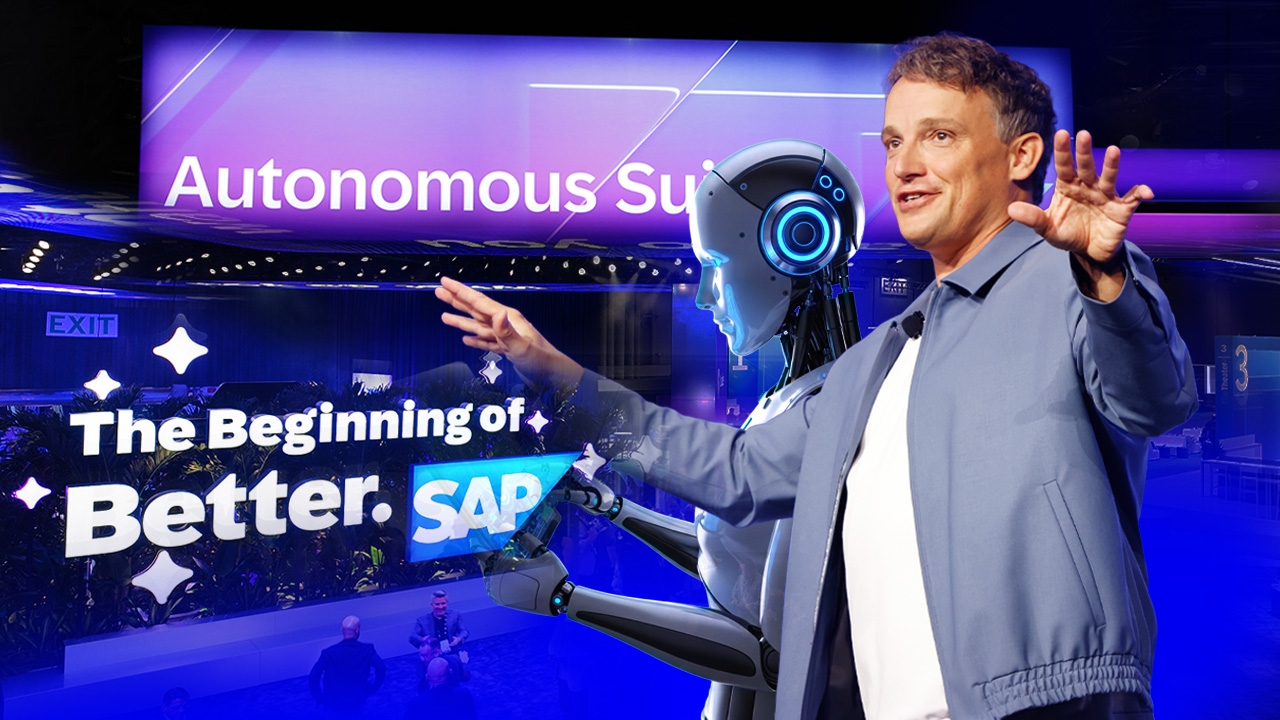
"SaaSpocalypse" is a term that has shaken the global software stock market, metaphorically describing an apocalyptic end to traditional software due to the arrival of AI Agents from leading AI companies launching new products almost weekly. These AI Agents can perform a wide range of tasks previously done by humans, from summarizing information and performing preliminary data analysis to managing multiple workflows automatically, prompting many investors to question,
“If AI can do everything, is traditional business software still necessary when anyone can develop their own internal software at a lower cost?” This concern caused heavy sell-offs in many Software-as-a-Service (SaaS) stocks, wiping out hundreds of billions of dollars in market value rapidly. However, events at SAP Sapphire 2026 in the United States this year proved that the world is misunderstanding the future of software.
This year, Thairath Money reporters were invited as Southeast Asian media representatives to hear SAP’s important vision announcement about its new and more significant role as
“the infrastructure of the AI-era business world,” which goes beyond traditional business software. This marks the beginning of a new era where software companies partner with AI firms, working side-by-side to help businesses truly transition to the Autonomous Enterpriseera.From legendary ERP to becoming the AI-Ecosystem Builder of the business world

However, in an era where AI is transforming how businesses operate, SAP recognizes that if it remains merely a traditional software vendor, it risks disruption. This is why SAP announced a significant transformation, evolving from a “Software Company” into a fully-fledged “Business AI Company” to help organizations enhance their foundations and adapt smoothly to the AI era. SAP is building a digital pathway toward a future where organizations can autonomously operate everything.
.
Get to know SAP, the German tech giant that has become the largest company in Europe, surpassing major pharmaceutical manufacturers and top fashion brands. Why software is more important than ever in the AI era.
At Sapphire 2026, SAP introduced the key concept of the Autonomous Enterprise, an organization capable of operating automatically with AI.
SAP believes the future of organizations lies not in connecting multiple software systems but in transforming end-to-end business processes into intelligent systems that can think, analyze, and operate independently.
SAP distinguishes itself from typical AI platforms by embedding AI directly into core business processes to deliver measurable business outcomes—not just AI for experimentation or chat tools—but AI that clearly impacts revenue, costs, or overall organizational performance.
ERP is the Brain of Every Company
Systems of Execution, ERP systems used worldwide to manage business, where humans command all actions through software. Today, SAP flips this model to a world where AI Agents proactively work on behalf of humans, leveraging the company’s greatest strength—ERP systems and decades of business process knowledge—as the "brain" for AI Agents that truly understand the unique context of each business. All of this is built on a platform called
SAP Business AI Platform, which integrates SAP Business Technology Platform, SAP Business Data Cloud, and SAP Business AI within a single environment featuring comprehensive governance. It consists of three key components: The Context Layer uses Knowledge Graph and SAP Business Data Cloud to link all business data, enabling AI to understand relationships and end-to-end processes.

SAP Autonomous Suite, an AI solution suite covering five main domains: Finance, Spend Management, Supply Chain, Human Capital Management (HCM), and Customer Experience (CX). These are embedded in SAP’s core business applications and can operate end-to-end autonomously. Moreover, SAP challenges the misconception that AI replaces software. While AI may replace user interfaces, it cannot replace business systems.
Previously, users had to open multiple programs, click through many menus, and fill out numerous screens. Now, one simply states a goal or command prompt, and the AI Agent performs all tasks behind the scenes. But the crucial question is: How does AI know the organization's financial procedures, approval authorities, critical data, compliance workflows, or supply chain operations?
The answer is that AI cannot do this alone without a "Software Infrastructure" supporting it behind the scenes. This is where SAP sees a major opportunity.
Software Company + AI Company Building a New Business World Together

Despite concerns that AI Agents are destroying the traditional SaaS business model—coined as SaaSpocalypse—
Christian Klein, SAP’s CEO, is among the industry leaders who most clearly oppose this notion. Interestingly, SAP does not reject AI but sees it as “the reason enterprise software will become even more important.”Klein expressed this view in an article published in the
Financial Timesin March 2026, stating that AI is the most significant technological change since the internet era and will transform enterprise software the most—not because AI threatens enterprise software but because AI depends on enterprise software.This sentence reflects the core of SAP’s AI-era strategy. Klein believes the market is misinterpreting the winners of the AI era as only AI model creators or infrastructure owners, whereas historically, every platform shift has seen long-term value flow back to the application layer—the software that turns technology into actual business outcomes, as was the case with the internet and cloud computing.
Therefore, SAP does not compete directly with OpenAI, Anthropic, or Google but chooses to serve as the "operating system of the enterprise" that all AI must connect to. Under this strategy, SAP is undergoing major transformations, such as:
Promoting Joule as the main orchestration layer coordinating multiple AI Agents across sales, supply chain, and procurement.

Anthropic, developer of Claude, stated their belief that as AI capabilities grow, organizations must understand how AI makes decisions and ensure AI operates within defined boundaries. Nvidia described SAP as building "one of the world’s most important AI platforms for enterprises," noting the enterprise software world is transitioning from hand-coded software to AI that can understand, think, analyze, and act autonomously.
SAP is also expanding cooperation with global firms like JPMorgan Chase and KPMG to develop specialized AI Agents for large organizations. Examples include embedding AI into JPMorgan’s accounting and financial ledger systems, which have strict regulations, and creating AI Agents with KPMG to help reduce contract leakage—a risk that can cost organizations millions of dollars.
All of this reflects SAP’s transformation of enterprise software from merely employee tools into an "AI ecosystem for organizations," with AI Agents as the new workforce of the business world.
SaaSpocalypse May Be a Misunderstanding
In the Autonomous Enterprise era, software becomes the "brain of the business" that AI uses to make decisions and act. The more the world embraces AI, the more critical the underlying business systems, data, and security supporting the software become.
Therefore, what is happening may not be the feared SaaSpocalypse but rather the dawn of "The Next Era of Software," where software does not disappear but evolves into the infrastructure of a new AI-driven economy, becoming a crucial accelerator of value chains and productivity in the post-AI work era.
Watch more

[Pickup] In the AI Agent era, "Software becomes even more important." Find out more at SAP Sapphire, Europe's largest software company. Follow the Facebook page: Thairath Money at this link -
https://www.facebook.com/ThairathMoney