

If there is any technology event that reflects how much the world is revolving around AI, it is no longer CES in Las Vegas or MWC in Barcelona becauseComputex 2026held in Taipei from June 2-5 has revealed the next chapter for the computing industry in the AI era—from processing technologies to semiconductor industry forecasts that have investors worldwide following the event in real time.
One person who generated excitement and transformed the tech expo into a decisive stage for the industry was Jensen Huang, CEO of Nvidia, the world's leading AI chip manufacturer and a key keynote speaker.
During his days in Taiwan, the restaurants he visited became new landmarks for tourists, fans gathered outside his hotel and barber shops, journalists tracked his every move, and people queued for hours to buy Nvidia T-shirts, leading locals to call this phenomenon “Jensanity” or the frenzy over Jensen Huang.
For investors worldwide, more interesting than his superstar status are the signals his every word and announcement this year send about Nvidia’s future, as the company has become one of the most valuable businesses globally with seemingly no rival capable of surpassing it.
Although Nvidia continues to generate revenue and profits envied by the semiconductor industry, the stock market has started to ask how the company can grow further from here. Recently, Nvidia’s shares have not surged as sharply as during the initial AI boom while investors begin to look at other AI ecosystem players.
Huang told investors in Taiwan, “Anyone still doubting AI’s returns is crazy.” This statement reflects the pressure Nvidia faces today: the company is no longer competing to prove AI will happen but to prove it can remain the biggest winner in AI.
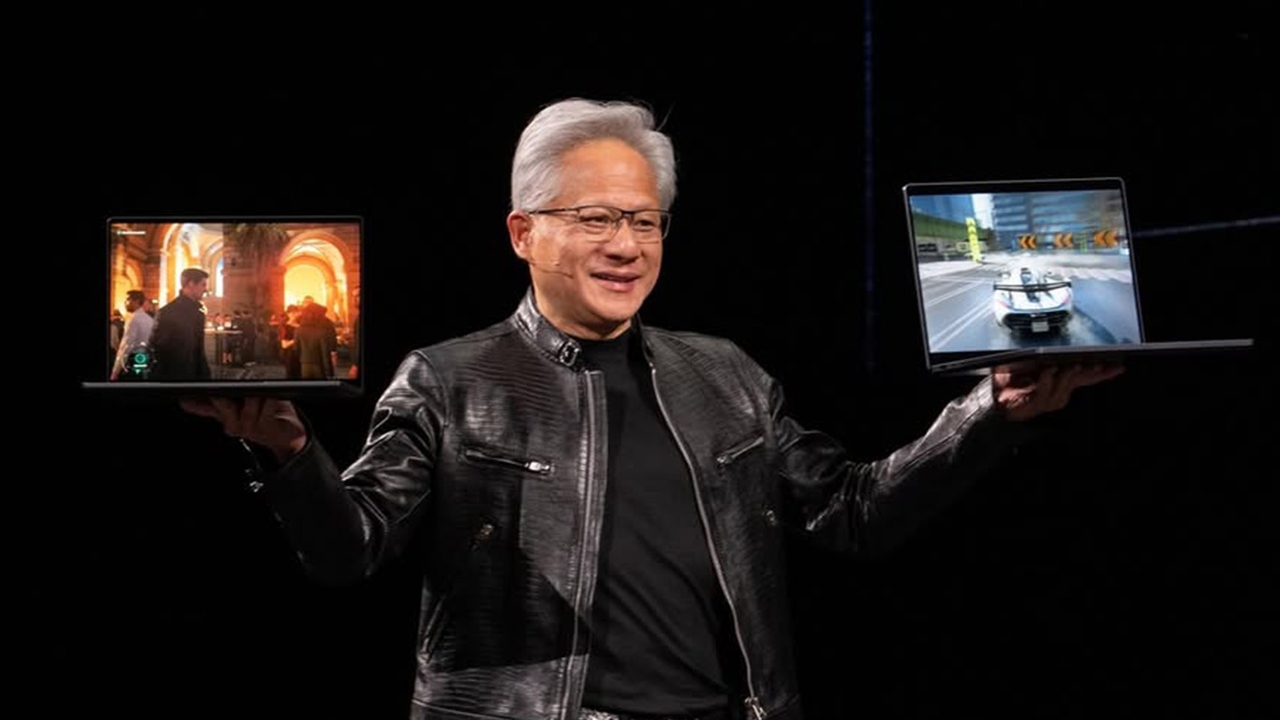
Over the years, Nvidia’s growth has come from selling GPUs to data centers, but in 2026 the company is trying to create a new market. At Computex, Nvidia unveiled the “RTX Spark Superchip,” the first AI PC chip designed to enable AI agents to operate directly on personal computers without relying on the cloud or sending data externally, capable of thinking, planning, and acting on behalf of users—potentially opening a new avenue for market expansion.
Huang compared this shift to the transformation from ordinary phones to smartphones. If realized, Nvidia will no longer be just a chipmaker for data centers but a major player in the personal computer market dominated by Intel and AMD for decades. This is why the shares of both rivals dropped immediately after the announcement.
The RTX Spark launch is seen as Nvidia seriously expanding its influence into the PC market with strong partners, attracting nearly all major computer manufacturers into its new ecosystem, led by Microsoft, which fully supports the project as the owner of the Windows operating system. Lenovo, Dell, and Taiwanese manufacturers like Asus showcased RTX Spark prototypes and announced plans for launching laptops, desktops, and workstations in the near future.
Another major point Huang emphasized throughout his Taiwan visit is that Nvidia no longer wants to be seen merely as a chip company; its future direction is to become the infrastructure backbone of the industry.
Besides RTX Spark, Nvidia also introduced “DSX,” a toolset for building and managing AI factories—modern data centers producing AI at an industrial scale. Nvidia has been stressing that data centers will become AI factories and computing power will become a direct source of revenue and profit rather than just a cost.
“Compute is Revenue, Compute is Profit.” This phrase encapsulates the company’s vision to position itself as the creator of the global AI economy’s infrastructure, akin to how energy companies were the backbone of the industrial economy in the past.
While AI remains a global megatrend, concerns are rising that AI investments may be growing faster than actual usage, and without clear use cases, the risk of an AI bubble could become a market issue. For Nvidia, the challenge now is not proving it can grow but proving there is more growth potential than markets currently expect.
One of the most applauded moments at the event was the launch of a new AI platform, “Vera Rubin,” an architecture designed for the Agentic AI era—AI capable of independent thinking, planning, decision-making, and execution.
What is particularly notable is not just the chip itself, but how Huang spent significant time praising Taiwan, which is becoming the world’s future factory amid global competition to build AI infrastructure.
He stated that Vera Rubin is an engineering miracle made possible by over 150 companies in Taiwan’s supply chain, including TSMC, Foxconn, Pegatron, Wistron, Inventec, and many smaller component manufacturers. A single Vera Rubin AI rack contains over 1.3 million parts and approximately 6 trillion transistors. “Only Taiwan can build this,” Huang said.
Although the atmosphere in Taiwan was full of excitement, China remains a key concern for investors worldwide because currently Nvidia earns almost no revenue from its data center business in China due to U.S. restrictions on exporting advanced AI chips.
Meanwhile, the Chinese government discourages domestic companies from purchasing downgraded products to circumvent these restrictions. This risk is heavily discussed by investors because if Nvidia manages to regain access to the Chinese market, its growth potential could increase dramatically. Consequently, Huang has been meeting continuously with government leaders, politicians, and policymakers in Washington, Beijing, and Taipei throughout the past year to negotiate and rebuild these relationships.
The Jensanity phenomenon is not only due to Nvidia’s multi-trillion-dollar valuation but also because Taiwanese people see Huang as a reflection of their country’s success—a boy from Tainan who moved to the U.S. at age nine and now leads the company driving the global AI revolution.
International media have published images and videos of Huang speaking Hokkien with people on the street, eating at night markets, thanking Taiwan’s supply chain on the world stage, and announcing further investments in Taiwan at a time when global attention on Taiwan is intensified by U.S.-China tensions.
Summarizing the key points from the Taiwan trip, Nvidia is telling the market three things: the company is expanding from data centers to AI PCs via RTX Spark; it does not want to be just a chip seller but aims to be the global AI infrastructure provider; and future AI competition will be inseparable from geopolitics and global supply chains.
Thus, every step Huang took in Taiwan signaled the future of the entire AI industry—from Taiwan’s factories to the Chinese market, and from desktop computers to multi-hundred-billion-dollar AI factories being built worldwide.
Read more
Sources Nvidia , Reuters , Business Insider , Bloomberg [1] , [2]
Follow the Facebook page: Thairath Money at this link -