

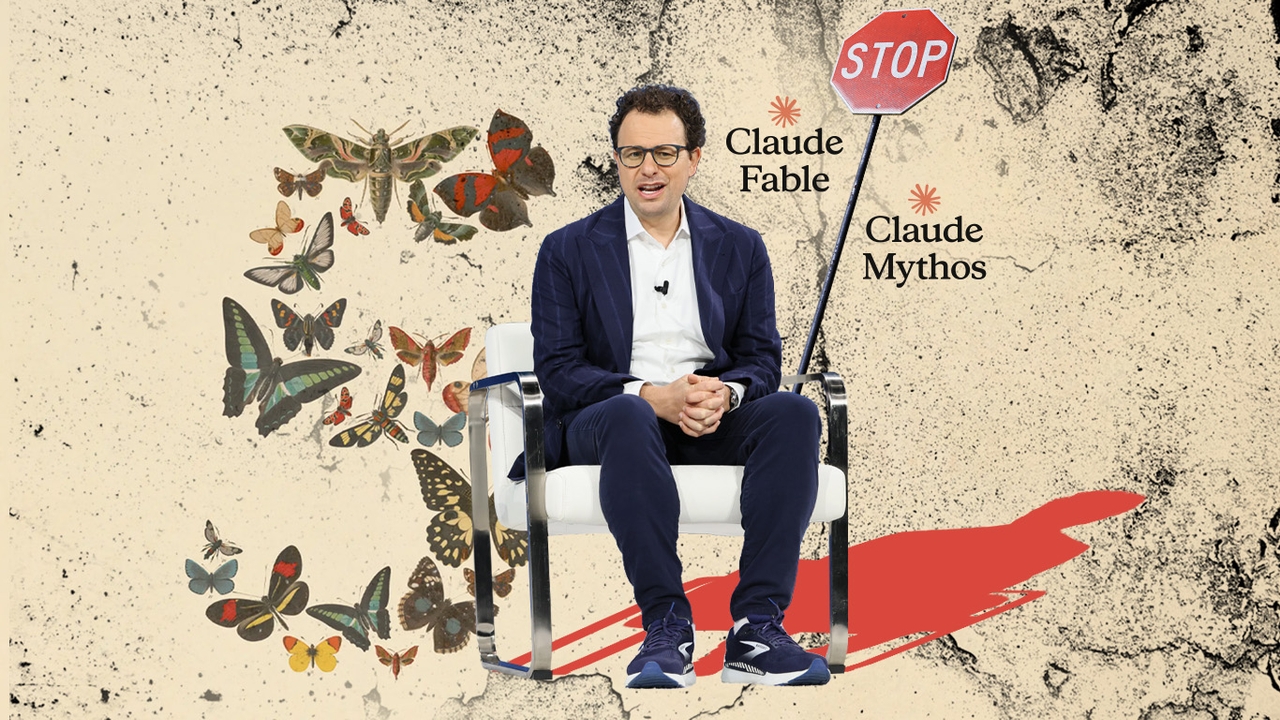
Last week, the global AI sector faced an unprecedented event after Anthropic, the developer behind the popular Claude AI, announced the worldwide shutdown of access to its latest models, Fable 5 and Mythos 5, just days after their official launch.
The cause was not a technical failure or system crash, but a direct result of a U.S. government order invoking national security powers to suspend access to these models for all foreign nationals, whether inside or outside the United States.
This marks the first time the U.S. government has imposed such control over access to frontier AI models developed by an American company in this manner, potentially representing a significant turning point for the global AI industry.
Anthropic revealed that at 17:21 on Friday, 12 Jun 2024 GMT+7, it received an order from the U.S. government to suspend access to Fable 5 and Mythos 5 for “all non-U.S. persons,” including company employees holding foreign nationalities.
Given the broad scope and immediate effect required by the order, Anthropic chose to disable access to both models for all users worldwide to ensure compliance with the government’s requirements.
Subsequently, users actively using Fable 5 or Mythos 5 were immediately disconnected, while all new requests were redirected to the older model Opus 4.8 and other Anthropic models still authorized for use. The company stated that other Anthropic models were unaffected by the order.
To date, the U.S. government has not officially disclosed detailed national security reasons behind the order. However, many believe the order is connected to a recent “jailbreak” incident involving the Fable 5 model that has become a major issue over the past few days.
On 10 Jun 2024 GMT+7, a researcher and AI hacker known as “Pliny the Liberator” published tests on platform X claiming to have bypassed Fable 5’s safety mechanisms. He stated the model could then generate normally restricted content such as methods for cyberattacks, bomb-related information, hazardous chemical synthesis processes, drug manufacturing techniques, and cyber exploit strategies to leverage hidden vulnerabilities in software or networks.
. Anthropicissued a statement apologizing to affected customers worldwide for the abrupt shutdown of Fable 5 and Mythos 5 services, affirming that it had no choice but to comply with the U.S. government’s legal order.
The company acknowledged that the government had indicated the possibility of certain jailbreak forms but clearly stated its disagreement with the justification for the shutdown, believing the government may have misunderstood the model’s risk profile.
Anthropic explained that the evidence provided was limited and represented a specific, isolated vulnerability rather than a broadly exploitable flaw, leading the company to oppose such a drastic recall of the models.
The company has heavily invested in developing safeguards against harmful use, collaborating with U.S. government agencies, the UK AI safety authorities, independent external organizations, and internal testing teams for thousands of hours of vulnerability assessments before launching Fable 5.
Fable 5 features stronger protections than any model previously publicly available, and so far, no testers have identified a “Universal Jailbreak” or a widely usable method to circumvent its safeguards.
Anthropic also noted that the U.S. government did not provide formal technical evidence but only verbal information regarding a limited form of jailbreak primarily involving the model’s ability to analyze code and detect software vulnerabilities.
The company reviewed the report believed to have triggered the order and found that the capabilities described are common in other public AI models, including OpenAI’s GPT-5.5, and are regularly used by cybersecurity experts to defend systems.
Anthropic warned that if a single isolated jailbreak case suffices for government-mandated recalls of commercial AI models, it could set a new standard making it nearly impossible for leading companies to launch new AI models industry-wide.
The recent order did not occur in a vacuum; over the past year, relations between Anthropic and U.S. government agencies, particularly security-related ones, have become increasingly tense.
Previously, Anthropic restricted Claude’s use for certain tasks involving mass surveillance and autonomous weapons systems. This conflict escalated to the point where the U.S. Department of Defense designated Anthropic as a “Supply Chain Risk,” a status historically applied to organizations from geopolitical competitors rather than American tech firms. Anthropic subsequently filed a lawsuit seeking to overturn this designation; the case remains under review.
For general users, the most apparent impact is the loss of access to Anthropic’s most advanced models. For enterprise customers, however, the consequences may be much deeper.
Many organizations have integrated AI into core workflows, from data analysis and software development to customer service and autonomous AI agent creation. The sudden shutdown of key models could immediately disrupt these systems.
This event has sparked diverse criticism within the tech community. One perspective is that AI is increasingly regarded on par with other strategic technologies such as nuclear technology, military communication systems, and advanced processing chips.
Historically, the U.S. has restricted AI chip exports to China and limited access to supercomputers and advanced processing equipment. This is the first time such restrictions have directly targeted AI models themselves, raising concerns that similar measures could become standard, affecting other AI developers like OpenAI, Google, Meta, and other leading U.S. AI firms.
Moreover, this incident serves as a stark warning that relying on a single AI provider poses business risks many organizations may overlook. Following the order, the AI community has renewed discussions on “AI Sovereignty,” the concept that organizations should control AI internally.
Proponents argue that using open-source or open-weight models deployed on an organization’s own infrastructure reduces risks from government intervention, provider policy changes, legal issues, or sudden service discontinuations.
What happened to Anthropic is an important caution for users, investors, and organizations worldwide: although AI is cloud-based and accessible globally, these technologies remain under state regulation—in this case, the U.S. government—and can be restricted or shut down within hours if deemed a national security risk.
Read more
Follow the Facebook page: Thairath Money at this link -