

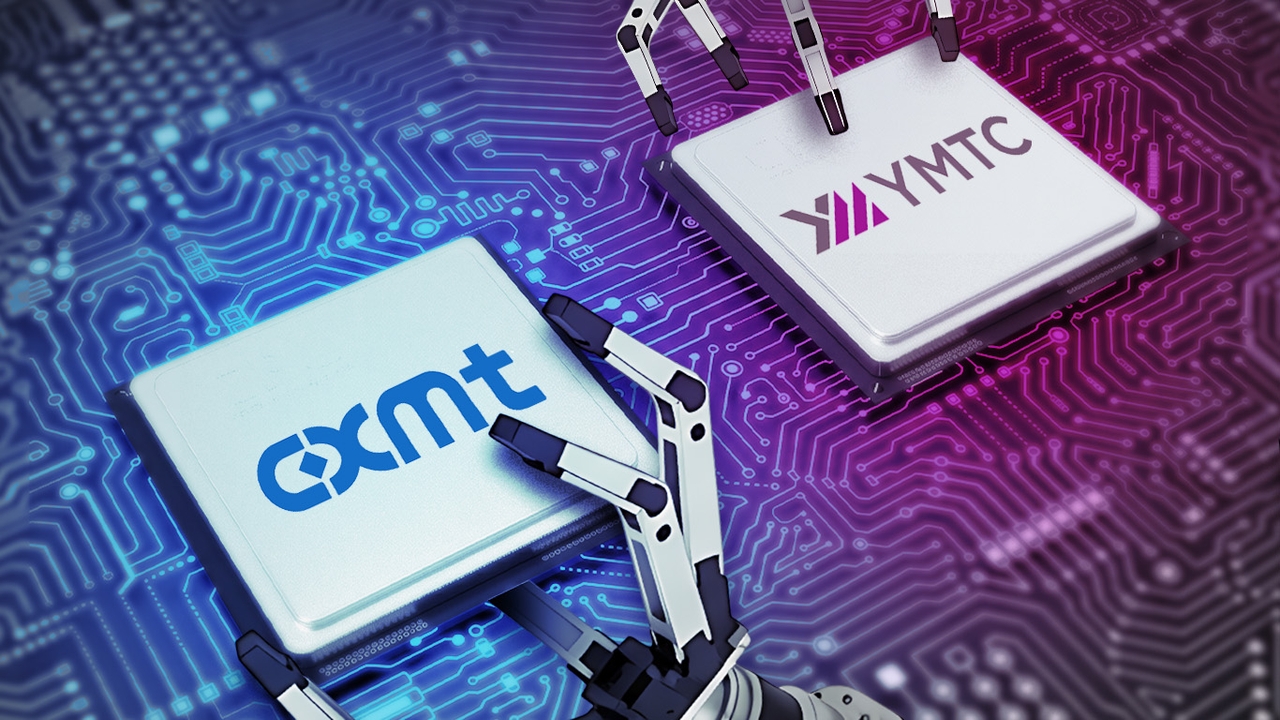
When discussing the global memory chip industry, most people likely think of Samsung, SK Hynix, and Micron—three giants long dominating the market. However, there are now two Chinese players increasingly attracting worldwide attention.ChangXin Memory Technologies (CXMT), a DRAM chip manufacturer, and Yangtze Memory Technologies (YMTC)a NAND Flash manufacturer, are emerging as “challengers” that the industry is starting to focus on.
What is notable is that both companies are rapidly expanding production capacity to capture market share from established players and have recently gained recognition from direct competitor Micron, while Apple is reported to be lobbying the U.S. government to approve memory chip purchases from CXMT due to rising chip costs driven by AI demand.
Although CXMT and YMTC may still be unfamiliar names to general consumers, in the semiconductor industry they are viewed as China’s hope to reduce reliance on memory chip manufacturers from South Korea, the U.S., and Japan, serving as the spearhead of the country’s technology self-reliance strategy.
ChangXin Memory Technologies (CXMT) was founded in 2016 in Hefei, Anhui Province, with support from local government and state funds to build China’s DRAM industry capable of competing with Samsung, SK Hynix, and Micron.
CXMT is the largest DRAM manufacturer in China, operating factories in Hefei, Shanghai, and Beijing. It produces chips for smartphones, laptops, PCs, servers, IoT devices, and AI Data Centers. The company’s main products include DDR4, DDR5, and LPDDR5/LPDDR5X, with ongoing development of HBM chips for AI workloads to catch up with market leaders Samsung, SK Hynix, and Micron.
Data shows that in 2025, CXMT’s revenue is approximately $8 billion, up 130% from the previous year, while production capacity has increased from 100,000 wafers per month to 290,000 wafers per month within just one year.
According to Counterpoint Research, CXMT’s share of global DRAM revenue rose from 3% to 8% within a year. The company is currently preparing a major IPO to raise funds to expand capacity and invest in next-generation technologies.
If CXMT is China’s hope in DRAM, Yangtze Memory Technologies (YMTC) is the country’s leader in the 3D NAND Flash market and the largest domestic player. Data indicates that YMTC’s global NAND revenue share increased from 8% to 13% within one year, driven by the growing demand for storage devices for AI Data Centers.
Founded in 2016 in Wuhan, YMTC originated from Wuhan Xinxin Semiconductor (XMC) and is supported by China’s National Integrated Circuit Industry Investment Fund (Big Fund) to build a world-class NAND manufacturer.
YMTC’s strength lies in its Xtacking technology, a wafer bonding (Hybrid Bonding) technique that enhances data transfer speed and reduces power consumption, recognized as one of China’s most advanced NAND technologies.
Currently, YMTC produces NAND chips for SSDs, smartphones, Data Centers, and AI storage systems. It is rapidly expanding a new factory in Wuhan set to open in the second half of 2026 to increase capacity and plans to list on the Chinese stock exchange. Analysts expect YMTC to surpass Micron and SK Hynix to become the world’s third-largest NAND producer, behind only Samsung and Kioxia.
The growth of both companies is driven by the surge in AI investment, which has pushed the memory chip market into a new super cycle.
The demand for AI Data Centers and servers has tightened supply of all types of memory chips, especially DRAM and NAND. Micron has estimated that this shortage could last beyond 2027 due to demand outpacing industry production capacity.
While the HBM market—high-end memory chips for AI—remains dominated by Samsung, SK Hynix, and Micron, the general DRAM and NAND markets have become opportunities for Chinese producers. For decades, the global memory chip market was controlled by a few players.
The emergence of CXMT and YMTC marks the first time China has national-level memory chip manufacturers challenging established players. Though still about 2-3 years behind the world’s technology leaders, their market shares have grown rapidly, earning acknowledgment from competitors like Micron.
Specifically, Sumit Sadana, Micron’s Chief Business Officer, stated during the latest earnings announcement that CXMT and YMTC have technological potential and are steadily increasing their market shares, although most sales remain within China.
Meanwhile, Apple is reportedly seeking U.S. government approval to purchase DRAM chips from CXMT despite the company being listed by the U.S. Department of Defense as linked to the Chinese military. Apple acknowledged that rising AI-driven demand has pushed memory chip costs to unsustainable levels. If this deal goes through, it would indicate CXMT is being viewed as a global supplier, not just a domestic manufacturer.
An interesting point is that although Chinese manufacturers still have about a 15% price advantage over foreign competitors, analysts now believe their key strength lies in rapidly expanding production capacity with Chinese government support, enabling them to meet market demand when established producers face capacity constraints.
With AI-driven demand growing quickly and major factory expansions underway, CXMT and YMTC are transforming into challengers that are starting to take DRAM and NAND market share from global giants.
Read more
Sources Nikkei Asia , SCMP , Reuters , Financial Times
Follow the Facebook page: Thairath Money at this link -