

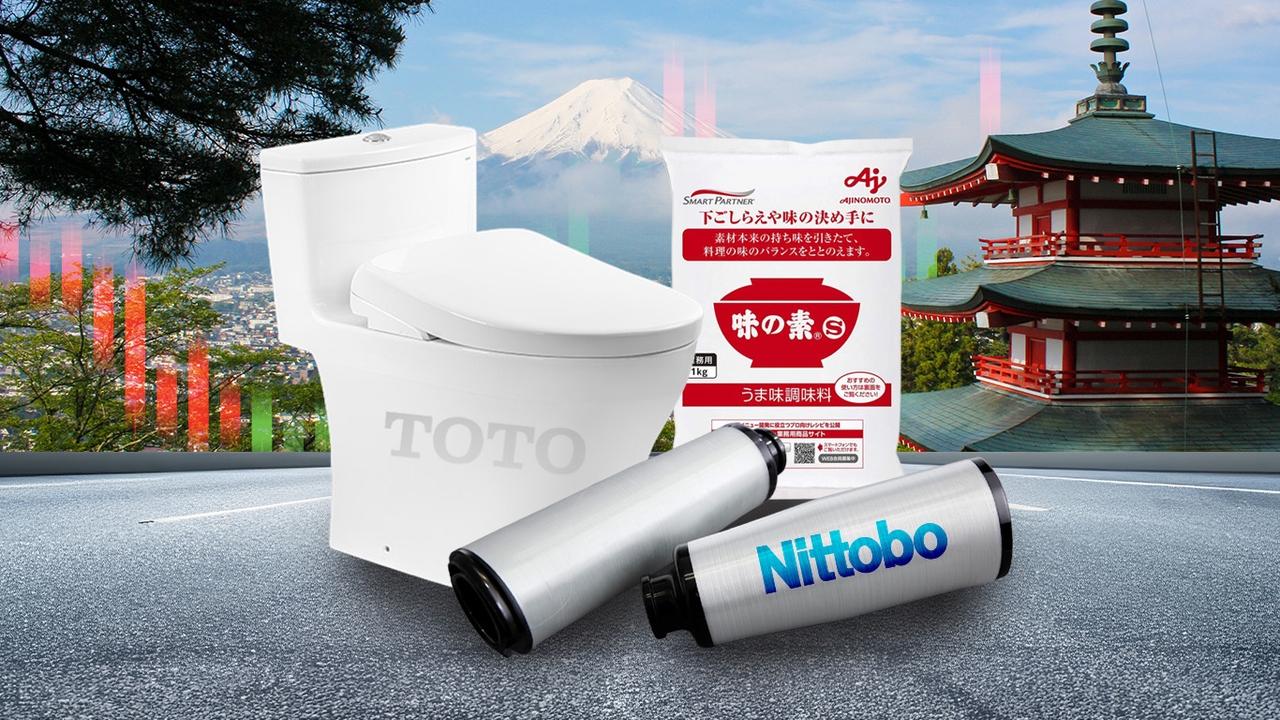
When discussing AI-era winners, most investors think of Nvidia, TSMC, ASML, or SK Hynix—companies upstream in the semiconductor industry. However, in Japan, another group of companies is quietly benefiting from the AI wave, even though their core businesses appear unrelated to technology. Among them is a company selling sanitary ware, another producing glass fibers, and a third known worldwide for its seasoning products.
The interesting point is that none of these three established semiconductor business units because of the AI boom; rather, they built advanced materials businesses by leveraging accumulated expertise from their traditional industries, now supporting AI chip manufacturing.
This article introduces these new winners overlooked by investors, showing that AI’s benefits extend beyond big tech and upstream players.
Many recognize Toto as a premium Japanese sanitary ware brand, but behind it lies an Advanced Ceramics business with over 100 years of experience in producing high-grade ceramics.
Originally, this expertise was applied to manufacturing sanitary ware, requiring precise ceramic forming, firing, and quality control. After the 1970s oil crisis, the company sought new uses for this capability, investing in Fine Ceramics research from 1976 and developing Electrostatic Chucks by 1982, officially establishing the Advanced Ceramics unit in 1984.
An Electrostatic Chuck is a ceramic plate that uses electrostatic force to hold silicon wafers inside chip fabrication equipment. It resists high heat, resists warping, and has micron-level flatness. This part is crucial for stabilizing wafers during etching, directly affecting chip quality and yield.
Recent results show Advanced Ceramics revenue grew 34%, operating profit increased 42%, and ceramic business profit nearly reached 29 billion yen, surpassing the Japanese sanitary ware business for the first time.
Today, Toto hasn’t shifted from sanitary ware to chip making but applies the same advanced ceramic science to produce materials essential to chip factories worldwide. Despite ceramics becoming a growth engine, Toto affirms it will maintain balance with its stable sanitary ware revenue base.

Another lesser-known company is Nittobo or Nittobo Boseki, which started in textiles and fibers before expanding into producing glass fibers for industrial materials.
In 1984, Nittobo developed T-glass, a special glass fiber stronger than before, with low thermal expansion and shape stability at high temperatures. It’s used in composites and general industries, later adopted in the semiconductor industry.
The company applied its glass fiber technology to develop materials for semiconductor package substrates—chip package base plates essential for connecting high-performance chips to systems. As AI drives demand for servers and data centers, demand for these materials rises accordingly.
Nittobo did not transform from fiber producer to tech company but upgraded glass fibers into key materials for the AI world. Currently, T-glass is used in substrates for AI accelerators, CPUs, ASICs, high-speed switches, servers, and data centers.
Latest financials show Electronic Materials revenue up 20.4%, profit nearly 40%, accounting for over 91% of total sales growth. Nittobo states this segment will be a growth pillar for the next decade, with increased investment, research, and production capacity to meet AI industry demand.

Ajinomoto is perhaps the most surprising example, as few associate seasoning or flavor enhancers with AI chips. Few know the company developed Ajinomoto Build-up Film (ABF), a critical material for manufacturing high-performance chips.
The journey began with byproducts from seasoning production, which were developed into chemicals for resin industries. The company gradually built expertise in polymers, epoxy resins, adhesives, and insulating materials before launching ABF in 1999.
ABF is an insulating film used in chip packaging, especially for CPUs and AI server chips. It connects chips to circuit boards and supports high-density signal routing. As AI increases transistor counts in GPUs and CPUs, packaging complexity rises, making ABF a vital material for high-performance chips.
Though Ajinomoto does not separate ABF revenue specifically, its Healthcare and Others segment—which includes ABF—saw revenue rise about 4% and profit increase 45.1%. Profit grew from around 45 billion yen to over 65 billion yen. Ajinomoto notes that AI, 5G, and data center chip demand will continue driving ABF business growth.
As mentioned, these three companies do not compete with Nvidia or TSMC but rather compete through Materials Science technology accumulated over decades.
They exemplify that AI creates opportunities not only for chip designers but also for companies with specialized technologies, enabling them to enter the semiconductor supply chain. Correspondingly, since the start of the year, Toto’s shares have gained 78%, Nittobo 63%, and Ajinomoto 61%, reflecting growing investor focus on AI supply chain firms.
Especially as the world accelerates investment in data centers and AI infrastructure, demand rises not only for GPUs and memory chips but also for the materials, ceramics, glass fibers, and insulating films essential to manufacturing every advanced chip powering today's AI performance.
Source Information CNBC
Follow the Facebook page: Thairath Money at this link -