

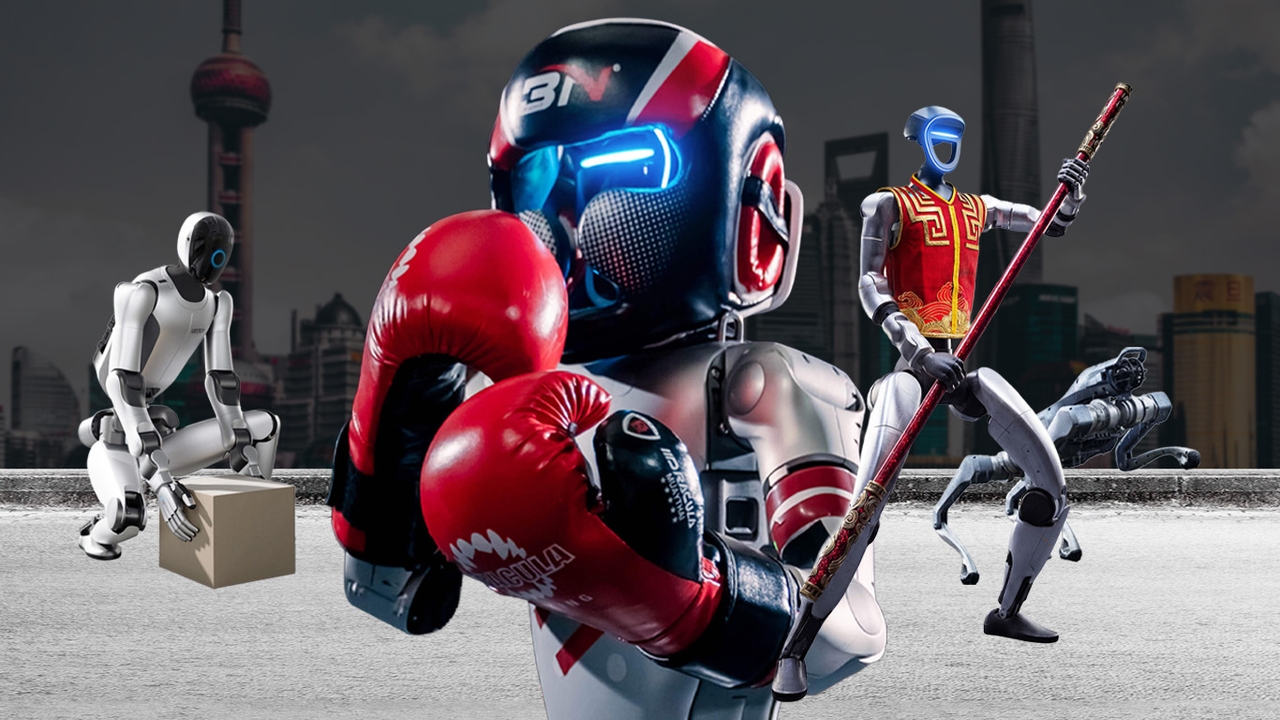
From cheerleaders waving cloths and bouncing on stage at national exhibitions, Chinese humanoid robots have evolved to perform smoothly, flawlessly execute flips, and even run faster than the world's fastest humans without stumbling. In less than two years, China has elevated "robots" to a national agenda and developed them so rapidly that the world watches closely.
The viral popularity of these robots began as internet jokes, but recently the World Humanoid Robot Games 2026 was organized to showcase robot competitions. While many see this as humorous, behind the scenes it signals China’s declaration: "We are the leaders in this field."
Currently, China accounts for more than half of the world's new industrial robot installations annually. This momentum is driven by strong domestic government support, leading to a proliferation of factories—robot manufacturers, training centers, and component producers—sprouting like mushrooms across many cities, where even a single missing screw can be bought on the spot.
This gives China a significant cost advantage in production, enabling the company to sell robots at lower prices. Last year, Unitree, one of the country's leading companies, sold 5,215 humanoid robots at around 810,000 baht each, a steep price drop from 2,890,000 baht per unit in 2023.
Last week, Unitree debuted on the Shanghai Stock Exchange, with its stock price soaring over 600% from the opening price. This made Unitree the first Chinese humanoid robot company to go public domestically, with its stock outperforming even the beloved national chipmaker CXMT.
China’s rapid advancement in humanoid robots aims to dominate the market and surpass the United States, which has fewer players. However, a major bottleneck in humanoid development remains: the lack of sufficiently high-quality data needed for robots to operate smoothly.
So why is China pushing humanoid development so aggressively despite data shortages? And who are the buyers for these vast quantities of robots being produced?
Over the 14 years since Xi Jinping came to power, the global narrative that "innovation must be market-driven" has shifted. His administration embraces the Chinese Communist Party’s "Unified Leadership" concept, where technology direction is centrally governed by the government.
China's central government sets directives throughout society, and local governments compete to implement central policies. Cities strive to attract startups to establish bases locally, elevate companies into “Local Champions,” and draw talented individuals and jobs to their regions.
Competition in the robotics market intensifies continuously, with each city acting like a sponsor in a Hunger Games-style contest, promoting its own robotics firms: Hangzhou has Unitree, Shanghai has AgiBot, Beijing hosts Galbot, and Shenzhen fields UBTech.
Another well-supported sector is robot training centers, which collect data to train AI before selling it back to robot manufacturers for further technology development.
All this occurs under China’s government plan to develop the humanoid robot industry, encouraging local governments to build large robot training centers where humans "teach" robots to perform physical tasks remotely through teleoperation.
This policy has rapidly increased the number of robotics startups, with nearly 370 new companies emerging in the past two years, more than 50 of which have gone public or are preparing for IPOs.
Data from consulting firm Interact Analysis indicates that as of June, China had over 90 operational or under-construction robot training centers. Data costs vary by task complexity; one data seller told the Financial Times that five minutes of robot dance training data can cost up to 1 million yuan (about 4,900,000 baht).
This government-backed approach is modeled after the electric vehicle and solar industries, which initially benefited from state purchases and support before expanding into globally competitive sectors.
For local governments, building robot training centers is not only about technology development but also a tool to attract investment, talent, and supply chains to their areas.
This is increasingly important as land sale revenues, once a major income source for local governments, decline. Some centers even employ university students as robot trainers and charge children and teens for visits during school breaks to foster early interest in robotics.
Another key factor behind China's rapid humanoid industry growth is its view of research and development as a "spectrum," emphasizing incremental but rapid progress, with distinct specialization in different robot capabilities.
This spectrum ranges from general-purpose humanoid robots, the sci-fi dream of machines doing everything humans can, to highly specialized robots trained to perform a single task excellently, trading versatility for commercial reliability.
Due to pressure to bring products to market quickly, government contracts, fierce competition, and systems rewarding differentiation and profit over pure research, Chinese companies lean toward excelling in specific tasks rather than general-purpose robots.
Conversely, U.S. companies backed by venture capital face less business pressure and can pursue general-purpose robots more freely. Nonetheless, China maintains a strong cost advantage, allowing continuous model updates as older versions become outdated.
Ultimately, the future may see the U.S. lead in versatile humanoid technology, while China becomes a mass producer of affordable, reliable robots each designed for specific tasks.
The U.S. might create a single robot that can mow lawns, walk dogs, and care for children, but meanwhile, we might buy three Chinese robots, each highly capable at one task and much cheaper.
Apart from industrial robotic arms used in large-scale manufacturing, humanoid and quadruped robots are not yet widely deployed commercially. Mostly, they appear in demonstrations, stage performances, or walking on the streets.
Currently, humanoid robots have yet to prove their utility in large factories. However, viral images of robot performances, marathon competitions, and internet memes serve as effective marketing for China.
In reality, the main customers are labs and universities. Leading institutions like Oxford, Carnegie Mellon, UC San Diego, and robot companies such as Boston Dynamics have purchased robots to develop smarter software.
Contracts between robot companies and governments also drive sales. Morgan Stanley recently raised its forecast for Chinese humanoid robot deliveries in 2026 to 50,000 units from 28,000 projected in June, citing stronger-than-expected purchases by local governments and commercial users.
Financial Times reports that nearly three-quarters of Unitree's humanoid robot revenue in the first nine months of 2025 came from educational and research clients, including universities.
UBTech disclosed it received government-supported robot training center orders worth 140 million yuan last year. Although not yet profitable, UBTech said robot deliveries accounted for 41% of its total 2 billion yuan revenue last year.
However, the close relationship between local governments and robot manufacturers in China makes it difficult to determine if sales reflect genuine market demand or are driven by government policies.
Besides selling robots, companies also generate revenue by selling data used to train robots. Although this data cannot be fully reused, high-quality, extensive data is required to train a robot to perform tasks smoothly, as external factors also impact performance.
True to Chinese investment style, early stages tolerate redundant investments and allow experimental projects to fail, which analysts see as typical for strategic industries.
China does not expect success from any single company but anticipates that numerous experiments will lead to technological learning, stronger supply chains, and global market competitiveness.
Therefore, even if many companies lose money or some projects fail, if China ultimately produces global winners in robotics, these losses are considered the cost of building the industry.
Follow the Facebook page: Thairath Money at the link below -https://www.facebook.com/ThairathMoney