

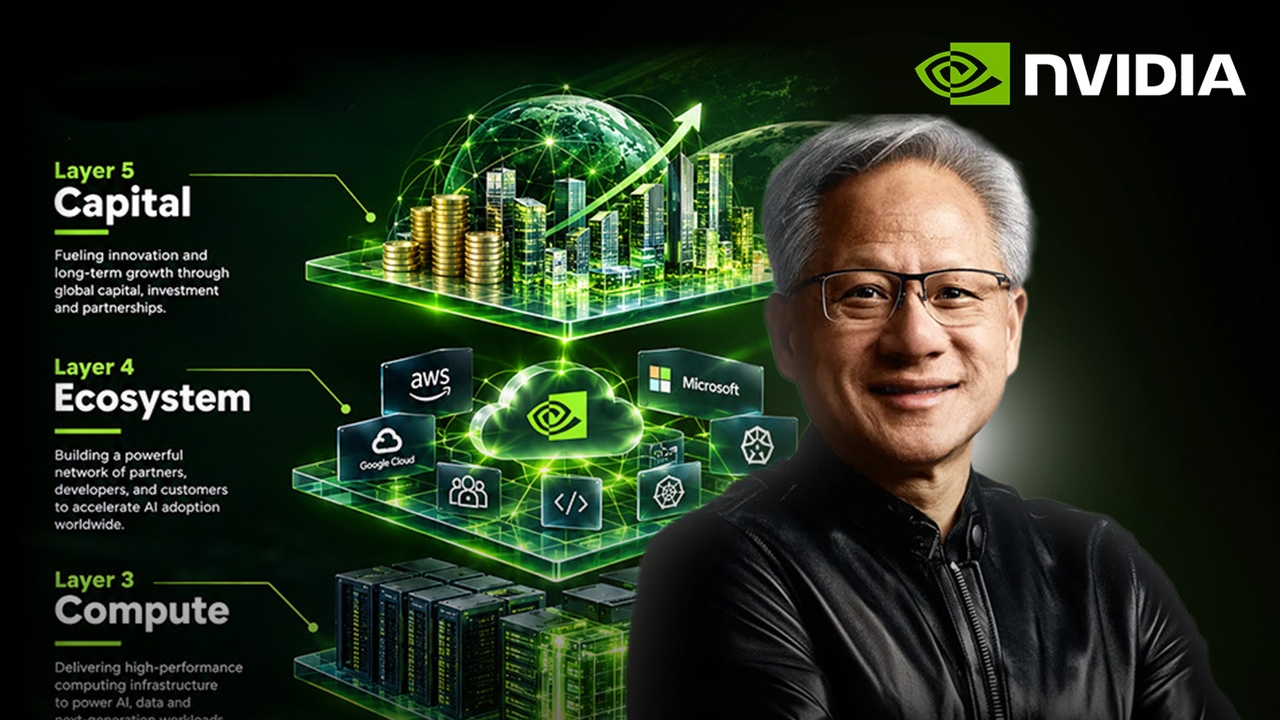
A few years ago, NVIDIA was primarily seen as a maker of GPUs or graphics processing chips for gaming cards. However, with the advent of Generative AI transforming computing, NVIDIA's image is undergoing a significant shift.
NVIDIA is no longer just competing to produce the most powerful chips but is moving towards becoming a full-stack AI infrastructure provider, encompassing everything from GPU, CPU, Networking, Systems, Software. This expansion extends to involvement with Data Center Capacity, Land, Power, and the infrastructure that enables the AI Factory concept.
Recent figures clearly reflect this transformation in fiscal Q2 2027.NVIDIAreported total revenue of $96.2 billion, a 106% increase year-on-year, with Data Center revenue reaching $89 billion, up 117% year-on-year, accounting for over 90% of total revenue that quarter.
Simply put, NVIDIA's core business today is no longer just "selling chips" but is fully focused on building compute infrastructure for the AI era.

The key reason NVIDIA expanded beyond chips is that current AI processing requires not only more powerful chips but complete systems enabling massive numbers of GPUs to operate efficiently together. Imagine an AI-era data center not merely as a server room but as an "AI factory."
Visualize an AI-era data center as an AI factory, which must integrate GPU/CPU, memory and storage, networking and interconnects, servers and rack-scale systems, power, cooling, data center infrastructure, and AI software and models, with NVIDIA progressively covering each layer of this system.
The first visible layer is that NVIDIA no longer confines itself to GPUs. The introduction of Grace CPU and Vera CPU brings NVIDIA into the CPU domain, a critical component of AI servers. Platforms like Blackwell and Vera Rubin are designed at the system and data center level rather than as standalone chips.
In the latest quarter, NVIDIA stated that Vera Rubin is entering full production, with racks running this platform deployed by major cloud providers such as CoreWeave, Google Cloud, Microsoft Azure, Oracle Cloud Infrastructure, and Nebius. NVIDIA’s offerings increasingly resemble turnkey AI supercomputers rather than individual chips.
Another crucial layer is networking. With massive numbers of GPUs in data centers, it is not enough for GPUs to be fast; they must communicate rapidly among themselves. NVIDIA has expanded into technologies like InfiniBand, Ethernet, NVLink, switch systems, and BlueField.
In the AI Factory, the network is what enables a huge number of GPUs to operate as a unified system. Thus, NVIDIA sells not just the AI engine but also the roads that connect all engines together.
The third layer is software. NVIDIA’s CUDA platform has long built an ecosystem of developers and software on NVIDIA hardware. Today, the company is extending this to AI libraries, development tools, inference software, AI agents, robotics, autonomous vehicles, and physical AI.
This includes NVIDIA DSX, a blueprint for designing, simulating, and managing gigawatt-scale AI factories, integrating building design, electrical systems, cooling, and AI infrastructure before construction begins. All of this culminates in NVIDIA’s core concept:AI Factory.

In its 2024 annual report, Jensen Huang, NVIDIA’s CEO and founder, stated that Generative AI is driving a platform transition and ushering in a new industrial revolution. NVIDIA views the AI Factory as infrastructure producing intelligence or computational power, analogous to factories producing goods in the industrial era.
At COMPUTEX in June 2024, Huang clarified that NVIDIA no longer sees itself merely as a GPU maker but as building a full-stack computing platform for companies to create their own AI factories. A telling quote was
meaning NVIDIA designs entire data center systems and sells components—from chips to processing systems to networking and infrastructure—separately to customers. This marks a key pivot in its business model.
One year later, at COMPUTEX 2025, Jensen Huang made the vision even clearer:"AI is now infrastructure… just like the internet, just like electricity, needs factories."
He posits that traditional data centers are evolving and what is being built should not merely be called data centers but AI factories that combine power, data, and compute to produce economically valuable tokens.
The most insightful phrase explaining this business model is "The more you buy, the more you make." As AI becomes infrastructure, greater investment in AI factories creates more compute capacity, enabling more AI applications, generating more revenue, and justifying further compute investments—a new investment cycle in the AI economy.
Notably, in 2026 the AI Factory concept began manifesting in revenue models. In August 2026, NVIDIA announced partnerships with Apollo, BlackRock, Blackstone, Brookfield, Goldman Sachs, and KKR to create financing platforms for AI infrastructure, aiming to raise over $500 billion in private capital over the long term.
The rationale is that next-generation AI factories require massive investments, so NVIDIA need not own all data centers but can act as a technology platform, infrastructure partner, and financial intermediary to accelerate data center development.
Recently, NVIDIA altered its revenue model to earn double from the same data center: hardware sales plus revenue sharing from compute rentals. NVIDIA disclosed a revenue-sharing model with Neoclouds during its Q2 2027 earnings call.
The structure involves NVIDIA providing take-or-pay commitments guaranteeing minimum revenue from capacity, enabling Neocloud operators to secure financing more easily. In return, NVIDIA receives a share of compute rental revenue exceeding the guaranteed minimum.
Huang candidly explained this model’s potential to generate recurring, usage-linked revenue alongside core platform income, potentially amounting to billions in medium to long term. As AI grows, the world must build more data centers, and AI-era data centers involve more than just GPU orders.
NVIDIA’s latest reports highlight land, power, shell, and capital as critical resources for AI infrastructure expansion, with constraints in these areas potentially bottlenecking customer deployments of NVIDIA infrastructure.
Initially, AI compute demand was driven by training large models, but as AI is deployed in search, copilots, AI agents, enterprise software, robotics, and autonomous systems, inference compute demand rises significantly with each user interaction. The global expansion of data centers by infrastructure providers further fuels this growth.
Simply put, new data centers create expanding markets for NVIDIA and similar providers to sell more infrastructure.
This is why NVIDIA’sfull-stackmodel is commercially compelling: by embedding itself in multiple AI infrastructure layers, a single data center generates multiple business opportunities for NVIDIA, which need not own all data centers but participates in the growing global value chain. The layers are:
NVIDIA,
[1],
[2],
Forbes,
Entrepreneur. Read more technology and digital transformation news with ThairathMoney for better finance and life at https://www.thairath.co.th/money/tech_innovation Follow the Facebook page: Thairath Money at the link below - https://www.facebook.com/ThairathMoney