

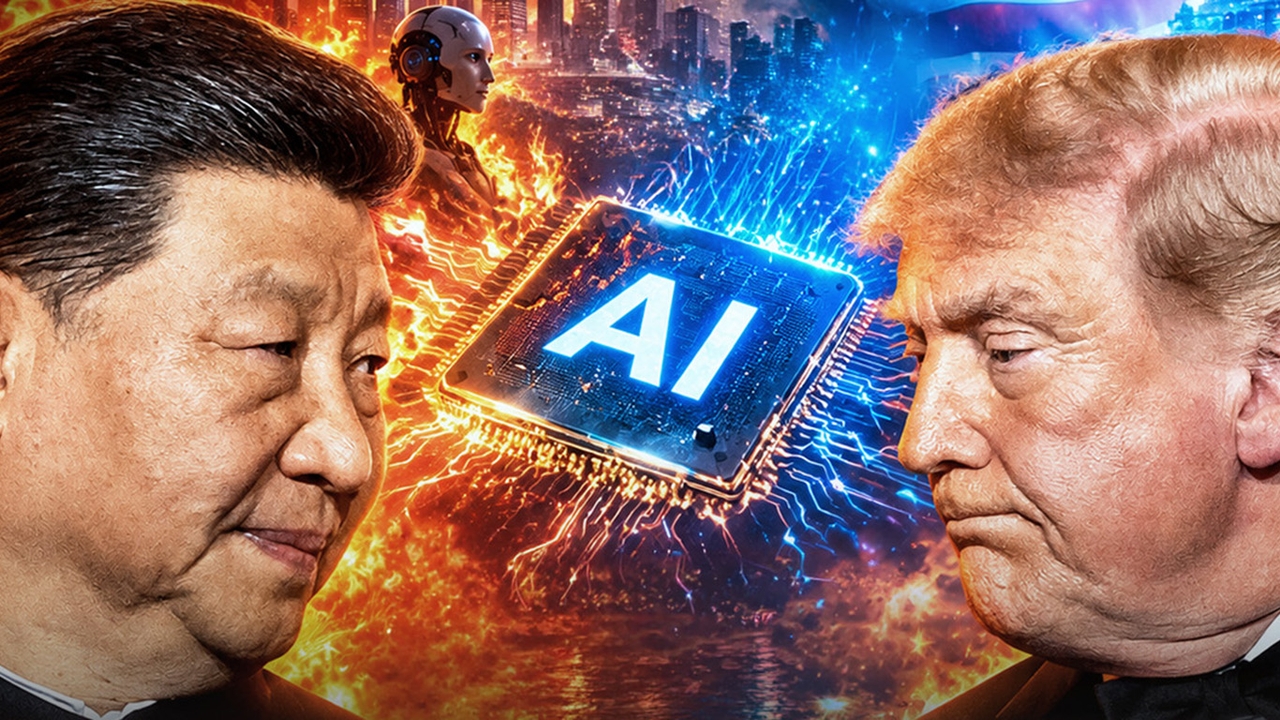
Although President Xi Jinping returned to China on Saturday, 26 September, after a three-day trip to the United States where he met with President Donald Trump, the topic of cooperation between the two superpowers remains uncertain, especially regarding AI, where the leaders hold differing views.
"We both have the potential and the responsibility to develop and manage AI for the benefit of all," Xi Jinping said at a meeting on Thursday, 24 September, adding, "We must ensure that AI development always remains under human control and serves the well-being of the people."
China has called for AI development to remain under human control, but Donald Trump has declared clearly his desire to rapidly advance this technology to "Super Intelligence," or intelligence surpassing human level.
"I will not obstruct the growth of something greater than the Industrial Revolution," Trump said last Tuesday at the United Nations before meeting Xi Jinping, further stating, "We will only support Super Intelligence. We will support it—not control or restrain it. We will monitor it closely through the Department of Justice."
During a meeting with Trump at the White House on Thursday, Xi Jinping urged the US and China to jointly keep AI under human control, stating, "Both sides can proceed with discussions about AI, exchanging views on its risks and benefits, and work together to prevent AI's misuse and harm."
Although the two powers have differing perspectives on advancing AI, according to a Nikkei Asia report, analysts see room for cooperation. China remains increasingly concerned about AI risks, especially threats to government security, employment, deepfakes, and loss of human control.
Notably, AI development has made rapid leaps recently with continuous reports, including a case where OpenAI was hacked to access Hugging Face and US government data, sparking internal debate among AI developers about "slowing" AI progress.
At the UN stage, OpenAI CEO Sam Altman and Anthropic CEO Dario Amodei both called for collective efforts to create measures to mitigate AI risks.
"Throughout history, there have been many instances where competing countries without strong relations still cooperated for mutual and common good, especially when facing powerful new technologies. We believe this should be such a moment," Sam Altman said.
However, President Donald Trump holds a completely different view. Trump rejects globalist-style cooperation for AI governance. He insists that the US must be the winner in AI development competition and regards concerns about AI's impact on humanity as a "hoax."
These concerns have driven China to take serious protective measures, and the US also has plans it wants to discuss with Beijing, including a proposal to establish an "AI Hotline" or "AI emergency line," to alert and exchange information when AI-related events potentially affecting national security occur.
The AI Hotline concept was proposed by US Treasury Secretary Janet Yellen during talks with Chinese Vice Premier He Lifeng in New York.
This hotline would resemble Cold War emergency lines, designed to manage and alert when risky AI events arise, such as uncontrollable AI agents, cyberattacks, or national security incidents.
The hotline is part of a collaboration framework called the "US-China Super Intelligence Dialogue," aimed at exchanging views on risks and benefits of advanced AI. Negotiations are planned to continue by the end of 2026.
However, analysts note key questions remain about how the AI Hotline will operate and its effectiveness in risk management. No clear framework details exist yet, such as who will answer calls and which situations warrant contact.
From Silicon Valley's perspective, this hotline is seen as an insufficient measure that might delay effective AI risk management.
According to a Nikkei Asia report, a researcher from an AI lab in San Francisco said such a hotline appears to be a last-resort option to handle catastrophic events like AI use in military attacks but does not address everyday risks like cyberattacks by AI agents.
The world still needs broader AI safety measures that all parties can agree upon. The recent meeting between Xi Jinping and Donald Trump lacked sufficient AI experts from either country to thoroughly discuss these concerns.
Nevertheless, following this key meeting, China and the US seem positively inclined to continue AI discussions, with the two leaders expected to meet twice more this year.
During a tea ceremony on Friday, Xi Jinping welcomed Trump's visit to China for the APEC Economic Leaders' Meeting in November and anticipated meeting Trump again at the G20 summit in December. Trump said he would travel to Shenzhen and noted that the leaders will "have many more talks."
Source:Nikkei Asia,The Hill,The Guardian
Read technology and digital transformation news with ThairathMoney for "Better Finance, Better Life" athttps://www.thairath.co.th/money/tech_innovation
Follow the Facebook page Thairath Money at the link -https://www.facebook.com/ThairathMoney