

Today's global travel industry competition is no longer just about who builds a better hotel booking platform, offers better prices, or attracts more travelers. It also hinges on who can use technology to understand travelers' needs and transform massive data into simpler, more tailored travel experiences.
For travelers, planning a trip often means visiting multiple websites, comparing accommodations, checking prices, reading reviews, searching transportation options, and trying to understand unfamiliar destinations. Meanwhile, travel businesses, especially local ones, must find ways to make their services discoverable and accessible to customers worldwide.
This challenge has made technology a crucial part of competition in the travel business and explains why companies like Agoda are shifting from being just lodging booking platforms to becoming Global Technology Platforms for Travel, using technology to drive broader travel experiences.
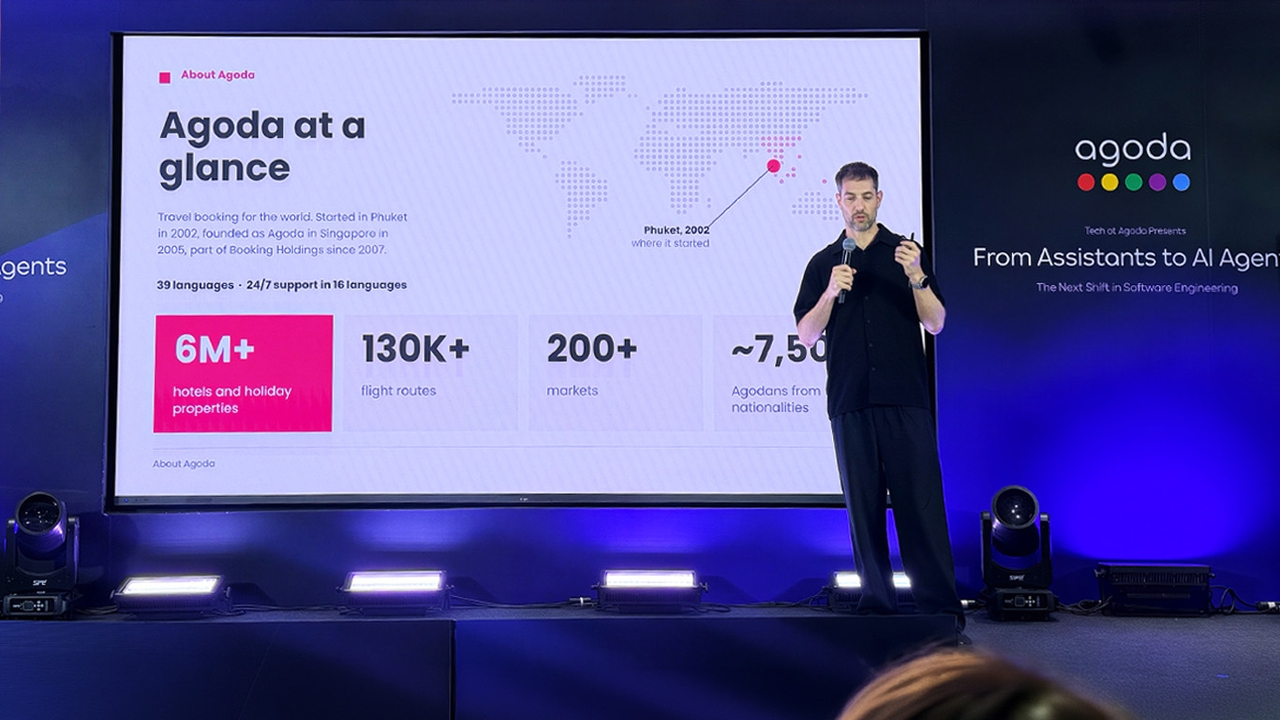
Thairath Money Had the opportunity to attend an event “From Assistants to AI Agents - The Next Shift in Software Engineering” The event gathered over 300 developers and tech professionals to exchange views on AI's transition from a work-assisting tool to systems capable of performing multiple tasks independently.
Although the event mainly focused on Software Engineering, the discussions reflected a broader question beyond programming: as AI not only speeds human work but begins to take over certain tasks independently, how will companies redesign workflows, and how far will this change impact technology-dependent businesses?

To the general public, Agoda may be known as a platform to search and book hotels, but behind these services lies technology systems that manage vast amounts of data and complex decision-making.
Idan Zalzberg, Chief Technology Officer (CTO) of Agoda, shared experiences developing AI internally, from assisting employees to integrating AI Agents in Agoda’s software development processes.
Agoda faces distinct challenges in applying AI compared to typical organizations, as its platform must handle large accommodation data, dynamic pricing and travel demand, and user experiences across diverse countries.
Idan shared data illustrating Agoda’s system scale, including trillions of daily price checks, around 2 billion user interactions, and about 1,000 simultaneous system experiments—figures underscoring technology development as a direct competitive advantage.
As systems grow larger, product development speed becomes as critical as cost control and quality maintenance. Meanwhile, AI offers opportunities to test new approaches without proportionally increasing human workload, which is why Agoda prioritizes transitioning from AI Assistants to AI Agents.

Idan gave practical examples showing Agoda’s gradual expansion of AI capabilities—from low-risk tasks initially to more interconnected work—rather than starting with fully autonomous AI operations.
One process where Agoda applies AI is code review, a vital step in software development. Although coding speed has increased, the resulting code still requires thorough checking before deployment.
Idan described Code Buddy, a tool that helps review code and can approve certain low-risk changes. In these cases, AI takes over some approval roles from humans, reducing repetitive checking tasks and freeing developers to focus on system design or complex problem-solving.
Another example is AI assisting internal support tasks, which often require searching across documents and scattered systems. AI involvement has shortened average ticket handling time from 2.3 hours to about 40 minutes.
This illustrates AI's benefit beyond generating new work quickly—productivity also improves by cutting time spent on information retrieval, task handoffs, and repetitive support steps.
Moving beyond AI assisting individual steps, Agoda is experimenting with Coding Agent operating within company cloud infrastructure through a tool called Coding Master. This allows AI use beyond developers’ personal tools, enabling operations within a company-defined environment.
If AI Assistants handle specific tasks and Coding Agents take on more complex jobs, the next phase is orchestrating multiple AI agents to work together systematically, known as Agent Orchestration.
In this model, software development may no longer be human commands triggering AI to write code step-by-step. Instead, one AI performs tasks, passes results to another system for review or the next step, with humans overseeing goals and critical checkpoints.
However, increasing AI autonomy does not remove human responsibility. On the contrary, the more tasks agents perform, the more organizations must clearly define work boundaries, access rights, and approval conditions.

Reflecting on a previous interview with Thairath Money, Agoda explained its AI development via the Inside-Out Framework, starting with internal AI adoption before expanding to user products and experiences. This clarifies that Agoda’s system is moving from enhancing individual employee efficiency toward redesigning entire workflows.
This is significant for a global travel company because the products travelers see are only a part of the backend system—from managing accommodation data, price processing, ranking options, to developing features that help users decide more easily. Over time, this approach aligns with Agoda’s vision of evolving into a Travel Companion that assists travelers with comprehensive trip planning beyond just booking or price comparison.
Looking beyond internal tech development, Agoda’s global platform role connects with opportunities for travel businesses, especially in countries like Thailand that attract international travelers.
Idan stated Agoda’s core business is supporting travel, with the platform helping hotels and local operators gain recognition among travelers worldwide. Meanwhile, AI-driven trip planning assists users in discovering and accessing destinations more conveniently.
He noted that for many travelers, Thailand remains an unfamiliar destination due to language and travel context. Making these experiences easier and more welcoming is part of the technology’s role, potentially enhancing local travel businesses’ access to customers.
“For Thailand, this is a direct opportunity for the travel industry. When destination discovery and trip planning become easier, local businesses are more likely to be found by international tourists. However, this doesn’t mean revenue will be evenly distributed, as competitiveness depends on service quality, pricing, and readiness to accommodate tourists.”
Therefore, Thailand’s challenge is not just adopting AI in travel businesses but preparing operators—especially small ones—to leverage digital channels, reach foreign customers, and adapt services to evolving needs.
Besides connecting businesses to global travelers, Agoda values developing Thailand’s tech talent through initiatives like Tech Day. Agoda has taught high school students about tech creation and offers internships, viewing knowledge transfer and confidence-building as essential to fostering the country’s next generation of tech entrepreneurs, Idan said.
For Thailand’s travel industry, global platform technology may open doors to international markets, but turning these opportunities into widely distributed economic value requires local business readiness, skill development, and collaboration between businesses and government.
Ultimately, AI may enable tech companies to develop faster, but true advantage arises when technology becomes better services, creates user value, and opens economic opportunities for businesses within the same ecosystem.
At Agoda, the journey from AI Assistant to AI Agent began with internal AI use, expanding to code review, technical support, and trials where AI handles multiple sequential tasks, while humans retain key roles in risk management and critical decisions.
In travel business competition, the next phase depends on how much a platform can simplify the entire travel process—from discovering destinations to planning and booking decisions. Ultimately, AI may accelerate tech development, but real advantage comes when technology translates into better services, user value, and economic opportunities for businesses in the ecosystem.
Read technology and innovation news, digital transformation with ThairathMoney for "Better Finance, Better Life" at https://www.thairath.co.th/money/tech_innovation
Follow Thairath Money's Facebook page at this link - https://www.facebook.com/ThairathMoney