

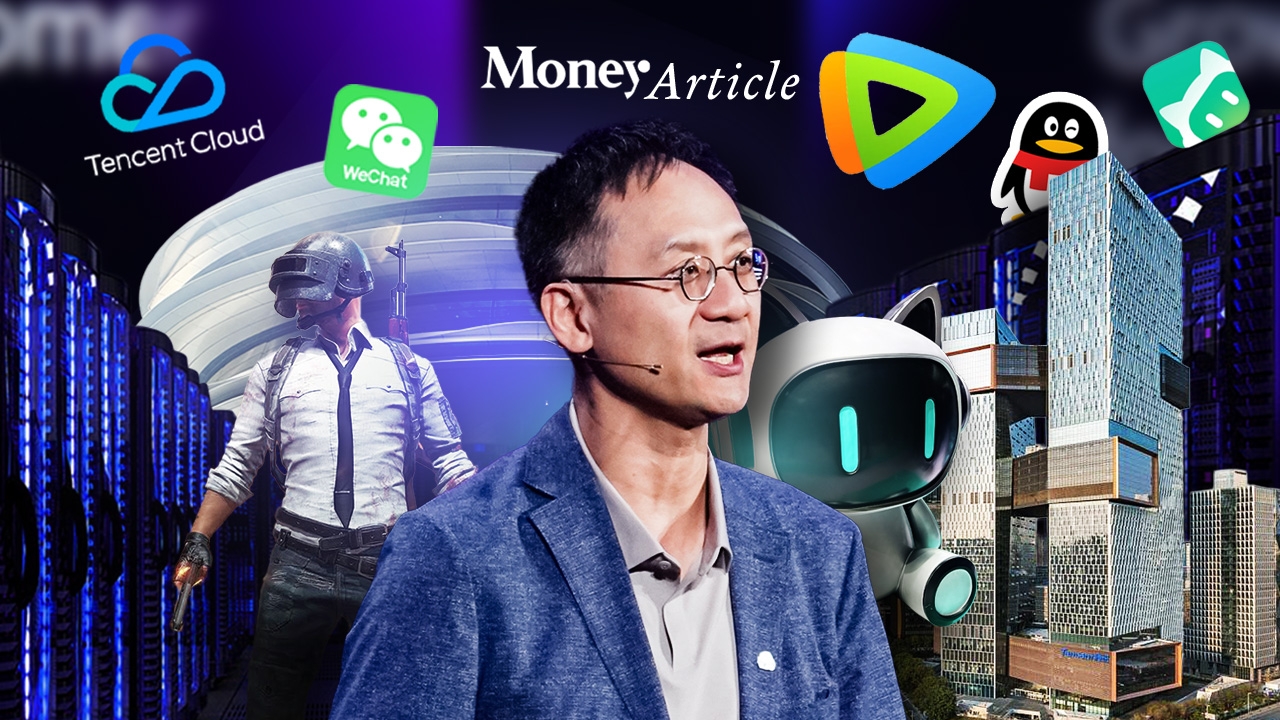
For many Thai people, the name Tencent may evoke associations with WeChat, online games, or entertainment platforms from China. However, this technology company headquartered in Shenzhen has built a business empire that permeates almost every dimension of digital life—from communication, shopping, entertainment, advertising, to the technological infrastructure that powers organizations worldwide.
Over the past 28 years, Tencent has accumulated technological expertise and business insights across diverse industries, which today serve as vital assets in the new technological competition centered on AI.

Thairath Money reporters attended the Tencent Global Digital Ecosystem Summit 2026 (GDES ) in Shenzhen, China. This key event is used by Tencent to reveal technology directions and business strategies, providing an opportunity to engage with executives for in-depth discussions on AI market competition and new technology investment revenue models.
Notably, Tencent is transforming its long-standing internet business strengths into a growth engine for the AI era, particularly by expanding its AI and Cloud business for enterprises worldwide.
This positions Tencent as one of the most noteworthy Chinese technology companies, since it is not starting from scratch but leveraging a large business ecosystem spanning gaming, social media, payments, content, and Cloud infrastructure that can be extended into AI products and solutions.
This story traces Tencent's transition from a Chinese internet empire to building a global AI empire, including its positioning to compete with global players, market expansion strategies, new technology monetization approaches, and Thailand's role as a growth market for the company.

Tencent was founded in November 1998 in Shenzhen, China, by a founding group led by Pony Ma, also known as Ma Huateng. At a time when China's internet industry was just beginning to grow, Tencent launched QQ, an online messaging service in 1999 that became one of the products that established Tencent's widespread recognition.
Starting as an online chat company, Tencent gradually expanded into gaming, music, video, and digital services before going public on the Hong Kong Stock Exchange in 2004 and building a more interconnected business network.
A pivotal moment occurred in 2011 when Tencent launched Weixin, or WeChat, which evolved from a communication app into a super app integral to daily life in China, encompassing messaging, payments, shopping, and access to various services.
The development of payment services on Weixin Pay in 2013 and the launch of Mini Programs in 2017 further transformed the platform into a hub connecting consumers, merchants, and service providers. By the end of 2025, Weixin and WeChat combined had approximately 1.418 billion monthly active accounts.
Simultaneously, Tencent began expanding its role from consumer internet business to the enterprise market by launching Tencent Cloud in 2013, followed by a major business restructuring in 2018 to promote the Industrial Internet concept and support digital transformation for businesses.
This transition laid the groundwork for Tencent's entry into the AI era with the 2023 launch of Hunyuan, its self-developed AI model, followed by the consumer AI assistant Yuanbao in 2024 and AI Agent products like CodeBuddy and WorkBuddy, which are now key parts of its current strategy.
Tencent currently operates three main business groups: Value-added Services, including games and digital services; Marketing Services, or advertising; and FinTech and Business Services, covering financial and enterprise technology services.
In 2025, Tencent reported total revenue of about 751.8 billion yuan (over 3 trillion baht), with Value-added Services generating roughly 369.3 billion yuan, FinTech and Business Services about 229.4 billion yuan, and Marketing Services approximately 145 billion yuan.
Beyond its large user base, one of the clearest reflections of Tencent's empire size is its gaming and digital content business, where Tencent Games backs global hits such as Honor of Kings, RoV, PUBG Mobile, League of Legends, VALORANT, and Clash of Clans through development, service, and equity stakes in top studios like Riot Games, Supercell, and Epic Games.
Meanwhile, Tencent's large entertainment empire includes Tencent Video and WeTV, streaming platforms expanding Chinese content internationally, as well as Tencent Music and China Literature (Yuewen), which host extensive online novel networks and intellectual property that can be adapted into series, animation, games, and merchandise.

Strength in gaming and content has made Tencent a leading technology provider behind the global media industry. Tencent Cloud is ranked as the number one cloud provider in the Asia-Pacific Media Services market by Frost & Sullivan, leveraging expertise in video streaming, live broadcasting, and content delivery networks supporting massive global audiences.
This shows that Tencent is not only a content owner but also an infrastructure provider that delivers media content worldwide, now extending this expertise with AI to enhance content production, distribution, and monetization.
Up to this point, Tencent's growth is not merely expansion into new businesses but leveraging accumulated expertise from each era—from internet communications to smartphone-era games and content, to cloud and AI for enterprises. As AI transforms the global economy, this large ecosystem becomes a strategic asset Tencent aims to use for new growth.

One key question Thairath Money asked Dowson Tong, Senior Executive Vice President of Tencent and CEO of Cloud and Smart Industries Group (CSIG), was how Tencent leverages its comprehensive ecosystem spanning social media, gaming, payments, and Cloud to accelerate AI adoption, create sustainable revenue, and boost competitiveness in the global AI market.
Dowson explained that integrating capabilities across Tencent's businesses has long helped the company expand its technology business. Even before the AI era, global game providers regarded Tencent Cloud as a close partner due to Tencent's deep expertise and understanding of the gaming industry.
This approach continues in the AI era. Tencent currently applies AI technology internally across game development, advertising, social network products, and content businesses, then leverages these experiences to develop industry-specific products and solutions for external clients through Tencent Cloud.
An example Dowson cited is China's short drama and series industry, where many content producers use Tencent's AI technology to enhance production efficiency, employing AI Agents via Agent Runtime and various AI models from Tencent and third parties to create images and videos.
However, client needs extend beyond content creation to reducing production and streaming costs. Tencent thus leverages its content business expertise and existing video infrastructure to develop comprehensive industry solutions.
This advantage is what Tencent aims to build in the AI era: not only possessing technology but also real business operation experience, which can be developed into products for customers in the same industries. In other words, Tencent's strength is not owning a single AI model but the ability to connect models with data, tools, workflows, and infrastructure that businesses already use.

In the intensifying global AI competition—developing more capable models, competing for computing power, and cutting costs—Tencent positions itself by emphasizing practical AI value creation over competing solely on model performance.
Dowson observed that the AI market is highly competitive, particularly among open-weight models where developers strive to enhance efficiency and reduce costs for more economical usage. For Tencent, it develops its own AI models alongside building applications tailored to user needs in both consumer and enterprise markets, especially the rapidly growing interest in Agentic AI. Its key strategy is to create user value, ensuring AI models solve real problems and deliver tangible work results beyond benchmark scores. ,
,
Another interesting point is Tencent's view on intensifying competition among Chinese AI companies regarding performance and pricing. Dowson noted that intense competition is typical in many Chinese industries and drives players to advance technology and competitiveness simultaneously. Currently, Chinese AI models aim beyond domestic markets, seeking overseas opportunities with significant growth potential.
From discussions with corporate clients in various markets, Tencent finds that many businesses do not want to be tied to a single AI model but prefer options to select or switch among multiple models based on task characteristics, performance, and cost-efficiency.
This is why Tencent Cloud developed TokenHub, a platform supporting both Tencent's and external developers’ models like DeepSeek, GLM, Kimi, and MiniMax, through a unified system with management tools for usage and cost. It also supports on-premises deployment for clients requiring data security and control, beyond public cloud offerings.
This strategy allows Tencent to build AI usage business even if clients do not choose its own models, by providing infrastructure, model management, security tools, and applications interoperable with various models.
In essence, Tencent is positioning itself as a comprehensive AI service provider competing through practical technology application, model flexibility, cost-effectiveness, and expertise from its existing business ecosystem.

This year, AI has become central at Tencent's events, aiming to demonstrate that technology is evolving from experimental tools to systems integrated with actual business processes, including expanding AI and Cloud business internationally—another key Tencent strategy.
Dowson revealed that Tencent Cloud currently serves customers in over 150 countries and regions, doubling its foreign customer base in the past year. Its overseas AI business has grown triple-digit percentages, driven by rising demand for Agentic AI solutions.
Nine out of ten Chinese internet companies expanding abroad use Tencent Cloud, reflecting its role supporting Chinese enterprises' global growth. However, Tencent is not solely targeting Chinese companies overseas but expanding its customer base across industries worldwide.

Dowson outlined Tencent Cloud's international strategy focusing on three key areas: introducing AI capabilities globally,
investing in infrastructure expansion,
and integrating products with technology ecosystems and partners in each country.
One product Tencent is promoting is WorkBuddy, an AI Agent for enterprise work that connects with systems, data, and employee tools to assist with document preparation, data analysis, and workflow automation.
Since launching WorkBuddy in March, Tencent disclosed it has processed over 9 billion accumulated work requests, covers more than 50 industries, reaches about half of China's top 500 companies, and has over 50,000 partners and developers with more than 200,000 work-related skills.
The company is currently expanding WorkBuddy internationally, supporting over 50 languages and connecting with various enterprise platforms and systems. It also offers customers model choices tailored to each market, notably in Southeast Asia, where Tencent sees opportunities from its existing cloud and big data enterprise clients to extend AI Agent adoption in workflows.
How will Tencent convert AI investments into revenue?


For Tencent, this is particularly interesting as it competes not only in AI models but develops multiple product tiers, from consumer AI to AI Agents and enterprise platforms.
Dowson
said Tencent is still in the investment and market-building phase, citing WorkBuddy's free Tokens to encourage trial and familiarity with AI tools in daily life. Although Tencent has begun generating revenue from various AI products and solutions, building scalable business models will take time. Notably, Tencent separates revenue approaches between consumer and enterprise AI markets.
For consumer-focused AI products like Yuanbao, the business may gradually evolve to advertising revenue or linking users to e-commerce transactions. For enterprises, revenue channels include subscription services, AI solution sales, and cloud infrastructure usage.
An example is the
Agent Development Platform (ADP) which operates on a subscription model, while products like WorkBuddy can integrate into cloud and internal enterprise solutions. This approach shows Tencent does not need to rely solely on selling its own AI models but can monetize surrounding services such as processing, model management, security, and cloud infrastructure.
Dowson

explained that many enterprise clients seek comprehensive, practical solutions rather than isolated technologies, which is why Tencent emphasizes delivering interoperable product suites over competing with a single AI model. However, a major challenge remains infrastructure costs, as global demand for computing power is high and expected to outpace supply, especially with growing AI Agent usage.
Tencent is therefore improving model and inference system efficiency to enable existing hardware to process more tokens and reduce cost per use.
Dowson believes reducing AI costs is crucial to broader adoption. Thus, Tencent's key challenge is not only building the most capable AI but also ensuring technology is cost-effective and delivers enough business value for customers to pay continuously. Where does Thailand fit in Tencent's empire?

Jimmy Chen, Vice President of Tencent Cloud and Head of Asia Pacific Business,
told Thairath Money that Tencent Cloud now has a substantial enterprise customer base in Thailand, covering retail, telecommunications, and financial services. Specifically, in AI Agent expansion, Thailand and Indonesia are among the first markets showing interest and inquiries about AI workflow solutions like WorkBuddy.
Tencent Cloud's focus has moved beyond just cloud infrastructure offerings, as many large organizations already have cloud systems. The key challenge is integrating AI with existing systems, data, and workflows to achieve measurable business outcomes.
This approach requires collaboration with local partners who can adapt Tencent Cloud's technology into solutions tailored to specific customer needs.
Jimmy

revealed that retail is a clear opportunity sector in Thailand, especially using AI to enhance supply chain management, logistics, customer service, reporting, and finance. A prime example is the partnership with
CP AXTRA, operator of Makro and Lotus’s with over 2,600 stores, where Tencent Cloud is working to upgrade supply chain management, finance, and internal workflows through cloud infrastructure and AI tools. Another noteworthy collaboration is with
Central Retail Digital, which is exploring AI Agents to boost competitiveness and innovation in retail. Tencent Cloud's Thai client base spans diverse businesses, from e-commerce platform
Amaze,using livestreaming technology to support online sales, toBitkub Group,which employs cloud infrastructure for digital asset business,andOOKBEE,an e-book platform leveraging Tencent Cloud's real-time audio and video technology to enhance communication and content creation.
On the infrastructure side, Tencent has expanded data center capacity in Thailand and gained several major local clients over the past two years. Future growth will depend on customer demand and partner readiness, Jimmy said. For Tencent, Thailand is not merely a market for cloud services but a key region where the company aims to leverage its business ecosystem expertise to develop AI solutions for enterprises. For Thai businesses, the crucial opportunity lies in how effectively these technologies can reduce costs, boost productivity, and enhance competitiveness. "From Internet Empire to AI Empire"
Visiting Tencent's Shenzhen headquarters reflects a Chinese tech company striving to extend internet-era strengths into the AI era.
Tencent's key advantage is its user base, operational expertise, and infrastructure that can be immediately leveraged without building a new market from scratch.
However, these strengths do not guarantee success in the AI era, as the company faces fierce competition, high technology development costs, and customer expectations for tangible business results.
Ultimately, for Tencent, this may be one of the most critical tests of its nearly three-decade-old technology empire: how effectively it can transform its internet-era greatness into an advantage in the AI-driven economy.
Read technology news and digital transformation innovation with ThairathMoney to help you achieve "Good Finance, Good Life" at
https://www.thairath.co.th/money/tech_innovation

Follow the Facebook page: Thairath Money at the link - https://www.facebook.com/ThairathMoney