

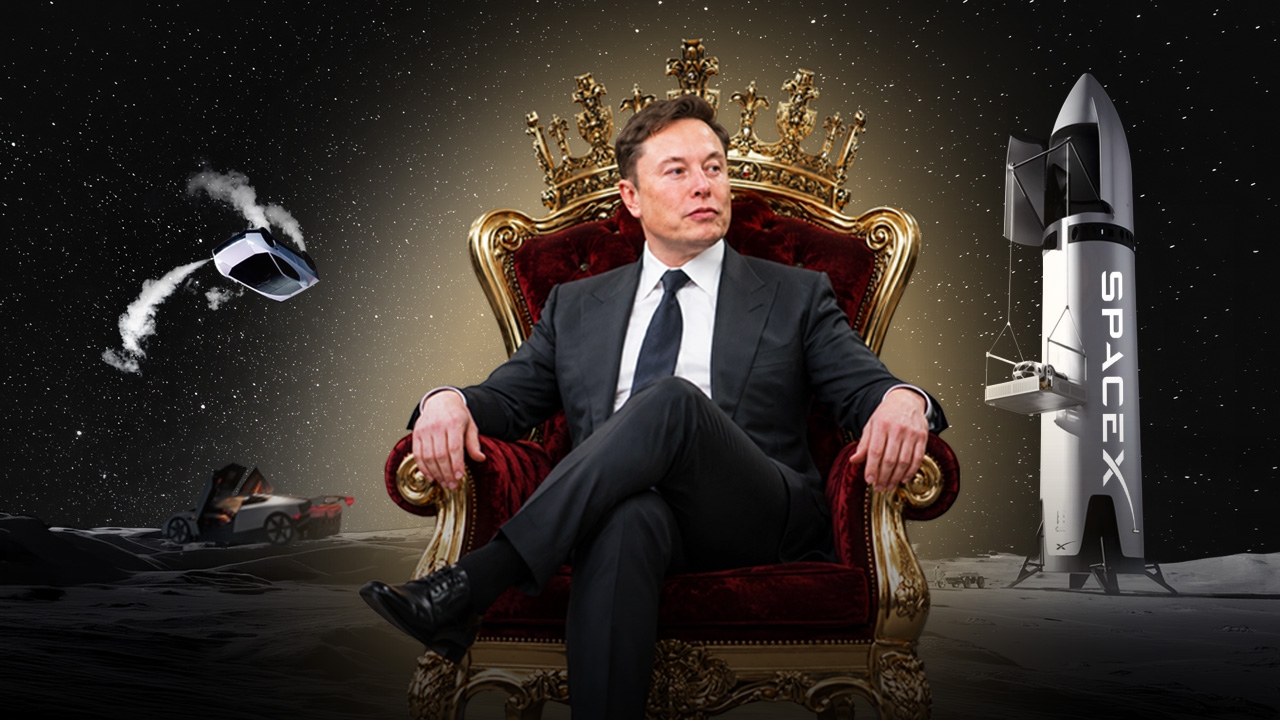
Electric vehicles, robotics, artificial intelligence, chips, satellites, rockets, and data centers in space—the future businesses Elon Musk has built over the years may soon be merged into a single company.
The potential merger between SpaceX and Tesla is gaining attention in capital markets after reports indicated that both companies have begun merger negotiations, with prediction markets assigning nearly a 90% chance of a deal announcement by 2027.
The focus now extends beyond simply restructuring Musk’s business empire; if the merger succeeds, the new company would create a competitive advantage that could reshape the technology industry landscape and alter global stock market investment flows.
The Financial Times recently reported that SpaceX and Tesla are advancing merger talks that, if successful, could become the largest merger in world history, creating an Elon Musk technology empire valued at about $3.5 trillion, roughly 112 trillion baht.
Meanwhile, analysis from The Motley Fool projects that the merged company’s market value could reach $5.8 trillion, approximately 185.6 trillion baht, by the end of 2028 if business operations and revenue targets meet analyst expectations.
If the merger is completed, the new company would form a technology empire covering everything from infrastructure to end products and services, with key businesses linked and reinforcing each other, including:
Space and transportation (SpaceX), developing rockets, space transport systems, and commercial space exploration missions.
Telecommunications (Starlink), a global satellite internet network providing worldwide connectivity.
Artificial intelligence (xAI), developing AI models like Grok and AI processing infrastructure.
Automotive and mobility (Tesla), electric vehicles, Full Self-Driving (FSD) systems, and Robotaxi services.
Robotics (Optimus), developing humanoid robots for industrial and daily use.
Energy (Tesla Energy), solar power generation and energy storage systems such as Megapack and Powerwall.
Semiconductors (Terafab), a chip manufacturing plant project to meet processing demands within the group.
AI infrastructure in space (Orbital Data Center), plans to develop space-based data centers integrating expertise in space transport, energy, and AI processing.
The strength of this merger lies in creating an "Integrated Technology Ecosystem" spanning chip production, energy supply, AI processing, satellite connectivity, and real-world AI applications in vehicles and robots.
Successfully linking these businesses would allow Musk to reduce reliance on external providers, lower inter-business costs, and gain advantages from controlling the technology value chain (vertical integration), while competing with major players in AI, semiconductors, energy, telecommunications, and robotics simultaneously.
Beyond the current estimated combined value of $3.5 trillion, the market is focusing on the growth potential of the merged company.
The Motley Fool analysis estimates that if the merger is announced in 2027 and completed by the end of 2028, the new company could reach a market value of $5.8 trillion, based on 2029 revenue projections for both companies.
Projected 2029 revenues are $336 billion for SpaceX and $146 billion for Tesla, totaling $482 billion, or about 15.4 trillion baht.
Applying a forward price-to-sales ratio of 12, this revenue forecast implies a market value of approximately $5.8 trillion, or about 185.6 trillion baht, for the new company.
HSBC analysts suggest that if SpaceX acquires Tesla, the deal might be structured as an all-stock transaction with an acquisition premium of around 33% over Tesla’s 30-day average share price. HSBC’s model estimates a purchase price near $507 per Tesla share.
The Motley Fool also simulated that an investor who currently invests about $5,000 in Tesla shares could see their investment grow to approximately $10,150 by the end of 2028 if the merger succeeds and the new company grows as projected.
However, the $5.8 trillion valuation is not the official acquisition price or announced company value but rather a future potential estimate depending on revenue growth and market valuation levels.
Another key impact of the merger would be the potential to reshape global capital market investment flows.
J.P. Morgan recently assessed that merging with Tesla could enable SpaceX to join the S&P 500 index faster, triggering about 10% of SpaceX’s free-float shares to be bought by passive funds.
Currently, SpaceX faces listing time restrictions and net profit criteria, but merging with Tesla, already in the index, might prompt the index committee to waive some conditions.
If SpaceX enters the S&P 500, ETFs and index funds globally tracking the index will need to adjust portfolios to reflect new components and weights. Investors who have never directly held SpaceX shares might indirectly invest in Musk’s business empire via index funds. This shift could occur sooner than the previously expected earliest date of September 2027.
HSBC sees controlling power as a key motivation for the merger, since SpaceX’s share structure gives Musk more voting power than he currently holds in Tesla. J.P. Morgan has estimated that certain deal structures might grant Musk over 50% voting control of the merged company.
This development is not just about increasing the net worth of one billionaire but about centralizing decision-making power in businesses critical to global infrastructure. This raises important questions about corporate governance, competition policy, and regulation of influential technology companies with global economic and security impacts.
Despite market optimism, the merger faces multiple challenges including Tesla shareholder approval, regulatory reviews, executive conflicts of interest, and increased political scrutiny in the U.S. following Democratic midterm election victories.
J.P. Morgan has noted that China could be a bigger obstacle than Tesla shareholders, as China is Tesla’s main production base and market. Meanwhile, SpaceX’s involvement with U.S. defense contracts and Starlink’s lack of Chinese operating approval complicate geopolitical and technology security issues, particularly regarding Tesla’s corporate governance in China.
If successful, Musk would not only own one of the world’s highest-value technology companies but would be building a business empire with the potential to shape the future of multiple industries both on Earth and in space.
Sources: Reuters Financial Times [1][2] , CNBC , YahooFinance
For technology, innovation, and digital transformation news, visit ThairathMoney to empower your "Good Finance, Good Life" at https://www.thairath.co.th/money/tech_innovation
Follow the Facebook page: Thairath Money at https://www.facebook.com/ThairathMoney