

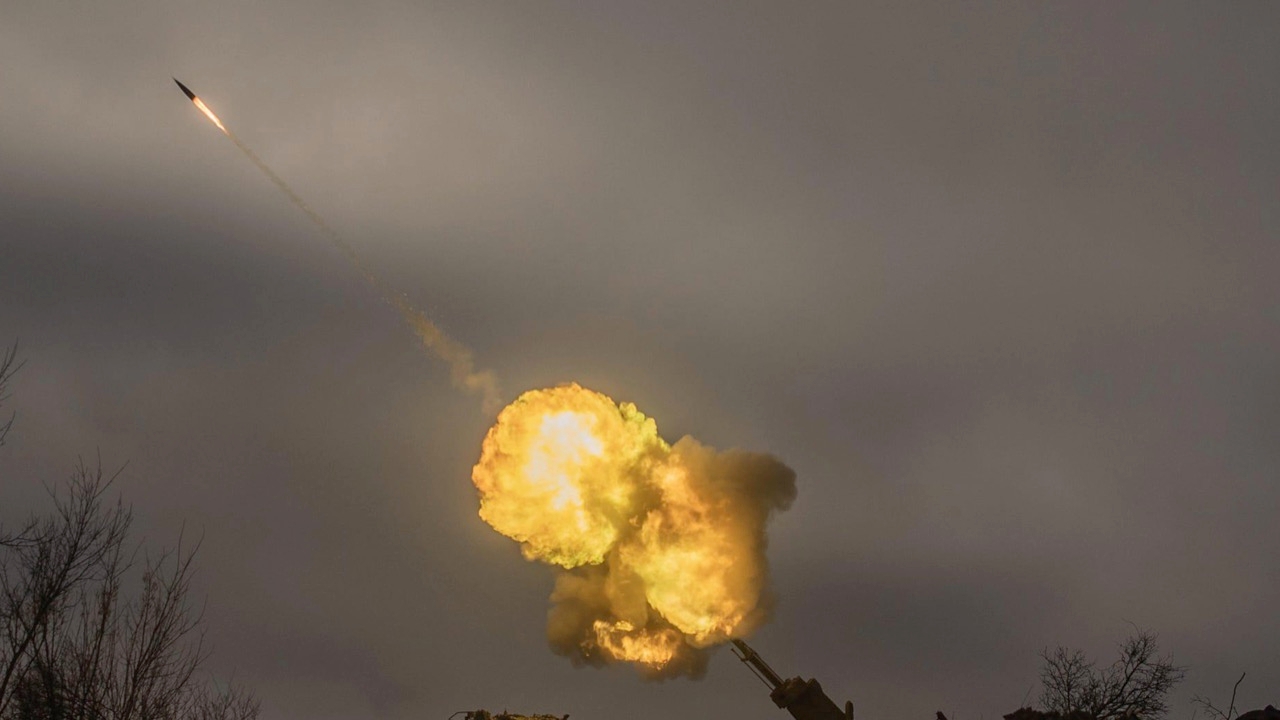
155mm artillery shells cutting through the night air present a stunning sight for villagers living near the border area where clashes occur. From a distance, these 155mm shells appear as small fiery orbs swiftly moving from the Thai side towards Cambodian military bases, clearly visible before the sound of their explosions follows.


The blast from the gun barrel produces a loud boom heard up to 10 kilometers away, especially with high-explosive (HE) shells or smart shells guided by infrared sensors to locate targets. From afar, villagers see small glowing fireballs rapidly traversing the dark sky. The 155mm artillery transforms the night over Chong Bok, Chong An Ma, and eastern border areas of Thailand into an impressive display of technology and military efficiency by all three branches of the Thai armed forces, including the integrated efforts of rangers and border patrol police in defending national sovereignty.

The lights seen on the shells come from Base Bleed technology, which emits gas from the shell’s base to reduce air turbulence and drag, thereby increasing firing range.

Some high-explosive shells feature illuminating guidance, causing their long arcs to glow orange or red as they streak across the sky before detonating in a bright, powerful explosion.
Guided munitions: "Smart" shells like the SMArt 155 use sensors and can create unique patterns. When submunitions are released, sometimes guided by infrared, they produce light patterns or shockwaves as they speed through the air at varying velocities.

The shells themselves are large—about 2 feet long and weighing 100 pounds—and travel at very high speeds (over 1,800 feet per second), equivalent to approximately 548.64 meters per second or about 1,975 kilometers per hour, based on conversions of 1 foot = 0.3048 meters and 1 m/s = 3.6 km/h. Their curved trajectories, followed by thunderous explosions upon impact, make for a powerful and awe-inspiring spectacle even from afar.


The firing range of 155mm artillery shells varies widely by type—from standard high-explosive shells with ranges of about 24–30 kilometers to advanced long-range guided shells (ER-GAP) like the Excalibur, which can reach 40–50 kilometers or more, and the latest technologies achieving 80–110 kilometers. Their explosive power is immense, using high explosives (HE) or submunitions to cause blast and fragmentation effects. Range depends on shell type and gun system; standard 155mm HE shells fired from modern howitzers achieve curved trajectories of approximately 24–30 kilometers, improved by base bleed technology for enhanced range.

HE shells are the most widely used 155mm artillery rounds, filled with TNT or similarly effective explosives, designed to destroy personnel, light vehicles, and structures through powerful blasts and fragmentation.
DPICM (Dual-Purpose Improved Conventional Munition) shells contain dozens of small bomblets or submunitions, known as cluster munitions, to cover a wide area and destroy groups of soldiers or light armored vehicles.
Impact shock: When the shell strikes its target, the explosive charge detonates violently.
Key factors influencing range and impact include:
Gun system: barrel length and design.
Propellant charge: varying amounts of propellant in different shell types provide different energy levels.
Shell design: aerodynamic shaping with streamlined forms, base bleed pressure relief systems, and rocket-assisted propulsion significantly increase range.
Guidance systems: GPS or laser guidance enables precise targeting, reducing the number of shells needed due to high accuracy.

Tactically, the illuminated guidance of 155mm shells allows infantry observers to see the projectile as it accurately strikes targets at night or in GPS-denied areas. This demonstrates the modern artillery capabilities of the Thai military, combining speed, size, and destructive power to create a memorable display of military strength.