

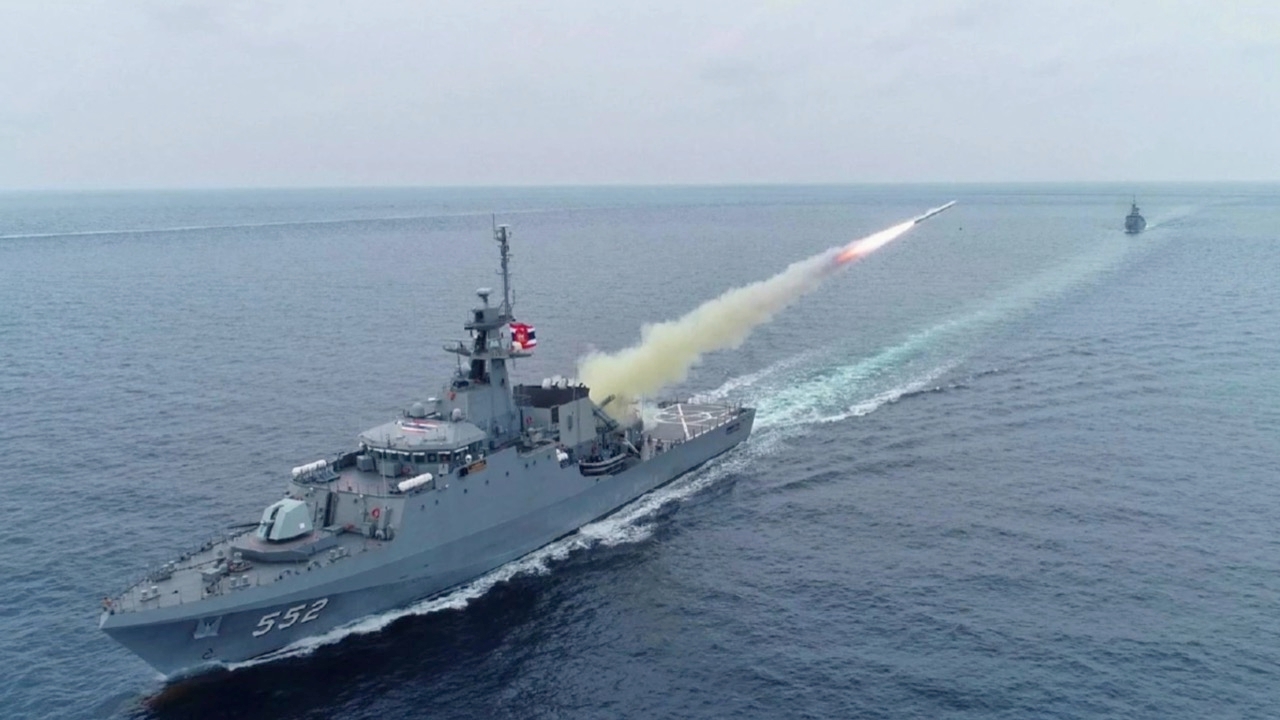
The AGM-/RGM-/UGM-84 Harpoon missile, developed by McDonnell Douglas Astronautics Company in the United States, is a surface-to-surface and air-to-surface guided missile. It is designed to destroy surface ships at a speed of 864 kilometers per hour and is equipped with a high-explosive 500-pound warhead. It can attack visible targets or those beyond the horizon and operates continuously in all weather conditions. The targeting system is highly capable, detecting targets at long range and effectively tracking them in various scenarios. The maximum range of the Harpoon Block 1C missile is 75 nautical miles (138.9 kilometers). It can search for surface ship targets within a circular area covering more than 17,500 square nautical miles (45,324.79 square kilometers). Launching is possible from surface ships using launchers mounted on the ships themselves, either Harpoon-specific or adapted from other weapon systems to fire the Harpoon missile.

The AGM-/RGM-/UGM-84 Harpoon anti-ship missile is a long-range, sea-skimming weapon widely used in the Western world. Originally, the ship-launched Harpoon was designed to attack Soviet Echo-class submarines on the surface. Today, it is employed from surface ships and submarines, coastal defense positions on land, and aircraft to counter surface ships.


The missile features a cylindrical body with a pointed nose; cross-shaped and trapezoidal wings located mid-body; and cross-shaped and trapezoidal control fins at the rear. The wings and control surfaces can be folded for launch and deployed afterward. It has a rocket engine with an air intake beneath a nearly flat underside. The surface-launched variant includes a short booster with cross-shaped fins. All Harpoon missiles up to Block 1C share the same missile body, but different launch platforms use varying wings, fins, and mounting equipment. Harpoons launched from surface ships, submarines, or coastal defense sites require the same booster for all uses. Air-launched Harpoons do not use boosters and have pole-mounted attachment lugs instead of conventional mounts. The Block 1D (AGM/RGM-84F) version includes a 23.2-inch (592 mm) plug for increased fuel capacity, repositioned wings, and a missile guidance unit (MGU) based on the AGM-84E SLAM.

Like the French Exocet missile, the Harpoon is a "fire-and-forget" weapon, meaning it does not receive target updates after launch. Target data is prepared differently depending on the launch platform. Surface ships use the Harpoon Ship Command Launch System (HSCLCS, pronounced "Sickles"), while the Harpoon Coastal Defense System (HCDS) is similar. Large aircraft such as the P-3, F27 Maritime, B-52G, and Nimrod have independent onboard launch control systems (HACLCS or "Hackles"). Other aircraft, including the S-3 Viking and Australia's F-111C "Pig," use hybrid systems partially integrated with the aircraft's weapons control systems.

When the missile reaches a predetermined distance from the predicted target location, an active radar seeker with frequency agility performs a programmed Range and Bearing Launch (RBL) search pattern to locate targets within the designated area. The Block 1C version includes improved Electronic Counter-Countermeasures (ECCM) as part of its upgrade. The circular search pattern is offset from the target in the direction that offers the best chance to detect the intended target. Bearing Only Launch (BOL) mode is used when the exact range to the target is unknown or when target direction or range is imprecise; BOL employs a square search pattern rather than a circular one.
The final attack mode, preselected via the Command Launch System (CLS), involves either popping up to a low altitude or flying just above the sea surface toward the target, depending on sea conditions, target size, and defensive systems. The high-explosive warhead penetrates the superstructure or hull plating and detonates inside the ship, causing severe damage to the vessel's structure.


The Royal Thai Navy first introduced the Harpoon surface-to-surface missile in 1986, installing it on the Ratanakosin-class corvettes. Later, in 1990, the F-27 MK 200 aircraft were upgraded to carry the air-to-surface Harpoon missile for attacking surface ships.

Subsequently, several naval vessels were equipped with the Harpoon missile as their primary weapon, including two Naresuan-class frigates (HTMS Naresuan and HTMS Taksin, currently assigned to the 2nd Frigate Squadron, Naval Fleet Command), two Phutthayotfa Chulalok-class frigates (HTMS Phutthayotfa Chulalok and HTMS Phutthaloetlanlapalai, now retired), and HTMS Prachuap Khiri Khan.


The Fokker 27-MK 400 anti-surface warfare aircraft are armed with the Boeing AGM-84A Harpoon Block IA air-to-surface anti-ship missile, which has a range of 120 kilometers.
HTMS Naresuan (FFG-421), HTMS Taksin (FFG-422), and HTMS Ratanakosin (FS-441) are equipped with the Boeing RGM-84D Harpoon Block 1C surface-to-surface anti-ship missile, with a range of 140 kilometers.
HTMS Bhumibol Adulyadej (FFG-471) and HTMS Prachuap Khiri Khan (OPV-552) carry the Boeing RGM-84L Harpoon Block II surface-to-surface anti-ship missile, with a range of 124 kilometers.
The RGM-84L Harpoon Block II missiles installed on HTMS Bhumibol Adulyadej (FFG-471) and HTMS Prachuap Khiri Khan (OPV-552) represent the most advanced Harpoon Block versions operated by the Royal Thai Navy.

During naval exercises, this missile variant demonstrated precise target destruction at a distance of 101.86 kilometers, showcasing the effectiveness of shipborne guided missiles. Additionally, the firing of the Harpoon missile marked the first time it was launched from an indigenously built vessel. HTMS Prachuap Khiri Khan is the second offshore patrol vessel approved by the Navy through the Ministry of Defense and constructed domestically at the Mahidol Adulyadej Naval Dockyard, Department of Naval Dockyards and Engineering. This project follows the self-reliance philosophy of His Majesty King Bhumibol Adulyadej, using the design of HTMS Krabi, a ship built to honor the King's 84th birthday on 5 December 2011, as the basic model.