

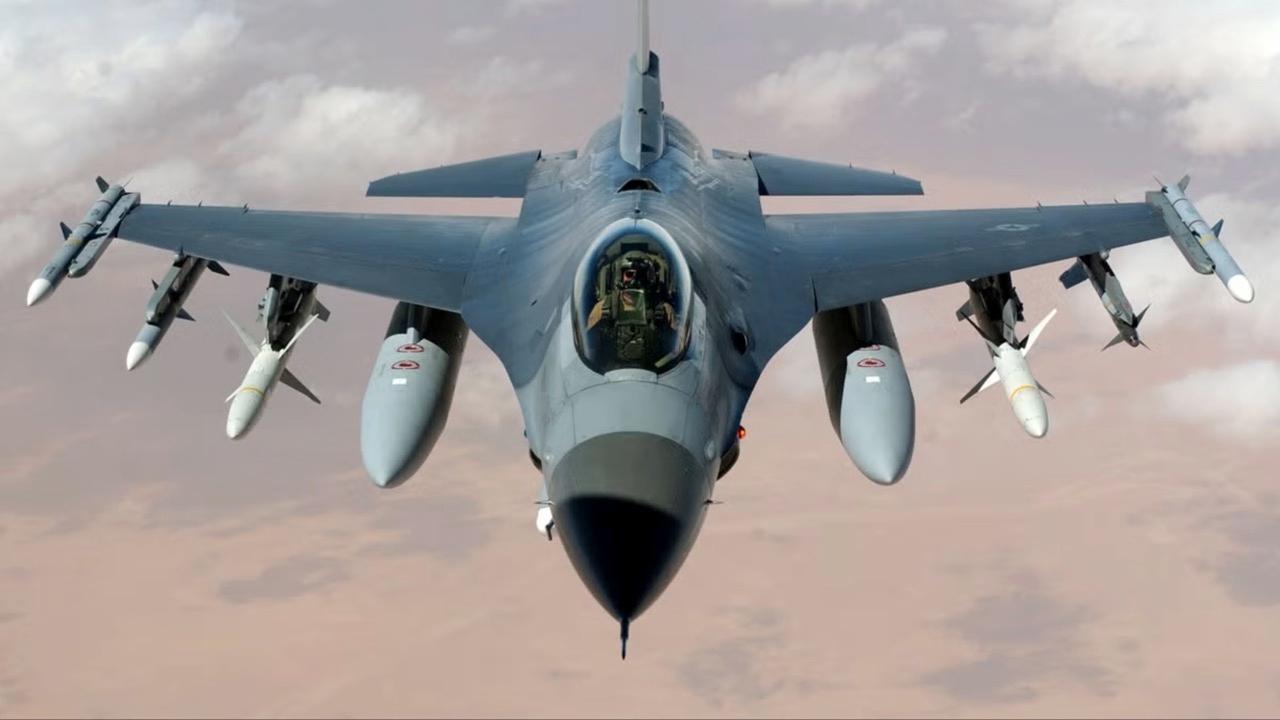
Over the past 20 years, military aviation technology has progressed rapidly. Looking at the capabilities of the 59 F-16A/B aircraft, they may not be sufficient to handle more advanced fighters. However, acquiring new aircraft requires a very high budget. Therefore, the Air Force has a program to upgrade existing F-16s, called the Mid-Life Upgrade (MLU), which upgrades electronic systems to support newer weapons. Additionally, structural improvements have been made under the Falcon Up and Falcon Star projects to extend the aircraft's service life by about 10 more years. The Air Force plans to retire the last F-16 in 2040.

Although in service with the Royal Thai Air Force for over 40 years, the F-16 A/B fighter jets, known as B.Kor.19 by the Air Force, remain the main force protecting Thai airspace today. They operate primarily in the 103rd and 403rd Fighter Squadrons. Throughout their service, the F-16 A/B jets have continuously conducted deterrence, interception, and special missions. During border conflicts with Cambodia, the fight to protect national sovereignty became a stage for the F-16 A/B to demonstrate their might, dominating the air and providing effective ground support. They created turning points in battles by precisely and heavily destroying enemy military targets, breaking the morale and strength of adversaries comprehensively.

With a vision to procure modern weapon systems and perform timely upgrades, alongside continuous training to keep personnel and pilots ready for air combat, the F-16 has played a key role in operations such as the "Operation Century"—a military operation declared by the Thai Army on 10 December 2025 to honor Sgt. Satwat Sujarit, the first Thai soldier to sacrifice his life in clashes with Cambodian forces near the Thailand-Cambodia border in Ubon Ratchathani on 7 December 2025. The F-16 demonstrated its ability to protect national sovereignty by striking enemy military targets decisively, proving the Royal Thai Air Force's full combat capability and readiness to face various threats with modern aerial combat technology, embodying the title of The Unbeatable Air Force.

Air Chief Marshal Praphan Thupatemi, former Commander-in-Chief of the Royal Thai Air Force, decided to procure the first squadron of F-16s despite many obstacles, both political and from the U.S., which initially offered low-performance engines. However, with intelligence, patience, determination, and wisdom, the Air Force acquired F-16s exactly to their specifications. The first pilots trained in the U.S. included two Air Force commanders: Air Chief Marshal Itthaporn Supawong, the first squadron commander, and Air Chief Marshal Prajin Chantong, both of whom later served as Commander-in-Chief of the Air Force.

The upgraded F-16B of the Royal Thai Air Force is equipped with the AN/APG-68(V)9 radar, which has twice the detection range, a new Identification Friend or Foe (IFF) system, integrated electronic warfare management, Link 16 data link, and the JHMCS helmet-mounted display system. This allows the 403rd Fighter Squadron's F-16A/Bs to carry modern weapons such as IRIS-T, AIM-120 missiles, JDAM bombs, and others.

The F-16 ADF was the Air Force's first aircraft capable of using medium-range air-to-air missiles, with beyond-visual-range (BVR) strike capability. The Air Force procured AIM-120 AMRAAM missiles for the F-16 ADFs, which are currently based in the 102nd Squadron, Wing 1, Korat. In 2004, the Singapore Air Force donated seven F-16A/B Block 15OCU aircraft (3 F-16A and 4 F-16B) to the Royal Thai Air Force as part of an agreement allowing Singaporean forces to use training areas in Thailand. These were from Singapore's Peace Carvin I program.

Currently, Thailand operates F-16 fighter jets across three squadrons nationwide:
1- 403rd Squadron, Wing 4, Takli District, with a tail emblem of a King Cobra snake.
2- 103rd Squadron, Wing 1, Korat, with a lightning bolt emblem.
3- 102nd Squadron, Wing 1, Korat, with a star emblem.

The weapons mounted on the F-16, once considered the most advanced electronic warfare fighter jet, are also used by the Royal Thai Air Force, including:
- AIM-9M Sidewinder air-to-air guided missile, used for close-range combat, guided by heat or infrared.
- AGM-65 Maverick air-to-ground missile, used to attack tanks, armored vehicles, bunkers, or enemy command buildings.
- AIM-120C AMRAAM air-to-air missile, used for medium-range air combat, guided by radar.

The F-16 MLU is the most capable version in the Royal Thai Air Force after the eMLU standard upgrade, featuring the AN/APG-66(V)9 radar, Link-16 datalink, and Sniper ATP targeting pod. It includes 17 of the 18 F-16A/B in the 403rd Squadron (one was lost in an accident) plus one transferred from the 103rd Squadron.

This F-16 MLU model enhances performance over earlier F-16s to support new missile types, including Python air-to-air missiles, Harpoon anti-ship missiles, and Maverick air-to-ground missiles. It incorporates beyond-visual-range combat capability, advanced radar for target detection, night operation capability, and tactical data link for real-time combat coordination. Its airframe is specially designed for high-G maneuvers, capable of 9G turns, offering agility in close-range dogfights. It has a maximum ceiling of 50,000 feet (15 km), a top speed of 2,121 km/h, and a maximum range of 4,217 km.

According to the pagethaiarmedforce.com
1. Currently, Thailand operates about 60 F-16s in two squadrons: the 403rd Squadron, Wing 4 at Takli, and the 103rd Squadron, Wing 1 at Korat (the 102nd Squadron, Wing 1 has been retired).
2. The 103rd Squadron has older F-16 A/B Block 15OCU models with structural life-extension upgrades but no avionics upgrades.
- It also operates F-16 A/B ADF (Air Defense Fighter) second-hand aircraft from the U.S., upgraded from 15OCU to support AIM-120 AMRAAM missiles but lacking targeting pods.
- This squadron's F-16s are being phased out to be replaced by 12 newly acquired Gripen E/F aircraft.
3. The 403rd Squadron operates F-16A/B Block 15OCU aircraft with a remaining service life and has undergone an enhanced Mid-Life Upgrade (eMLU) program from 2011 to 2017.
Upgrades include:
Installation of the APG-68(V)9 radar replacing the original one, significantly improving capability.
Installation of the APX-113 Combined Interrogator and Transponder for enhanced Identification Friend or Foe (IFF) capability, supporting beyond-visual-range missile use.
Installation of the ALQ-213 Electronic Warfare Management System replacing the older system.
Installation of the ALE-47 Countermeasures Dispenser System for deploying decoys against missiles.
Additional equipment includes Sniper ATP targeting pods, JHMCS helmet-mounted displays, IRIS-T short-range air-to-air missiles, and Link-16 datalink systems.
Although the engines remain the same, the upgrades bring performance close to the F-16 C/B Block 50 (the last model used by the U.S. Air Force) but still below the F-16 C/D used by the Singapore Air Force.

In summary,
The F-16 was developed based on the Energy Maneuverability Theory, aiming to be a lightweight fighter capable of rapid acceleration and tight turns. Thus, when facing larger fighters, it can be compared to a lightweight boxer fighting heavier opponents. This model has a top speed of 2 Mach or 1,353 mph (2,124 km/h) at 40,000 feet altitude, with an operational ceiling of 50,000 feet.
Importantly, the F-16 can consistently sustain 9G forces. It has an empty weight under 20,000 pounds, making it smaller than many current fighter jets.
In the modern warfare sky, the F-16 was designed for excellence in close-range dogfighting, emphasizing agility. Its control stick is placed on the right with an armrest, reducing pilot fatigue and enabling comfortable flight under high-G turns.
It uses a fully digital fly-by-wire (FBW) flight control system, being the world’s first fighter with this technology. Because the aircraft's aerodynamics are naturally slightly unstable (Flexible Static Stability), computers control stability by adjusting flight control surfaces up to 300 times per second to prevent loss of control.
The F-16 has six main computers: four redundant flight control computers, a mission control computer, and a fire control computer that manages all weapon systems.
Structurally, the F-16 is built from three to four composite materials, including titanium for lightweight parts, carbon fiber/composites for wings and tail, aluminum for internal structures, and steel for high-load areas like the landing gear.
The empty airframe weighs about 9 tons, increasing to over 10 tons when fully loaded with weapons and fuel. Therefore, the F-16's tires are inflated to very high pressures: 275 PSI for the nose wheel and 325 PSI for the main wheels.
Regarding fuel capacity, the F-16 can carry over 5 tons of fuel in one fuselage tank and two external drop tanks under the wings, sufficient for missions lasting just over one hour.
For armaments, the F-16 has an internal rotary cannon on the left side of the fuselage, two weapon hardpoints at wing tips, and six under-wing hardpoints, enabling it to carry various air-to-surface and air-to-air missiles.

The F-16 is not only the most agile interceptor in the sky but has also been continuously upgraded through major Mid-Life Upgrades (MLU) and modern guided weapons procurement to remain a key deterrent in the region. These upgrades have elevated the F-16 from a 4th-generation fighter to a 4.5-generation level, excelling in dogfighting and precision ground attacks.
The service life of the F-16 depends on structural lifespan (flight hours or cycles), upgrades, maintenance, and national policy. General constraints and guidelines include:
Structural lifespan: Initially certified for about 8,000 equivalent flight hours (EFH) for early models. Structural fatigue management now uses flight cycles, damage tolerance analysis, and inspections rather than just flight hours.
Structural modifications (wing box replacement, reinforcement beams) from life extension programs and stricter inspection regimes have increased structural life to 12,000–15,000 flight hours for air forces that upgraded their fleets.
Service life can extend 30–40 years or more if structural life is extended, systems are upgraded, and maintenance is continuously supported.

The U.S. Air Force’s initial F-16s from the late 1970s and early 1980s remain operational. Their programs and upgrades have kept many aircraft flying beyond 30 years. Some F-16s are retired after 25–35 years, depending on fleet management decisions.
Upgrades and life extension programs (SLEP), full fatigue testing, new wing and fuselage components, and structural reinforcements can increase projected service life to 12,000–15,000 flight hours, enabling use for 30-40 years or more.
Many air forces continue operating F-16 squadrons for over 30-40 years by upgrading avionics and structures (e.g., mid-life electronics replacement and structural repairs), while others retire them earlier due to maintenance budgets or new aircraft acquisitions.
Flight profile: High-G combat operations and high sortie rates accelerate structural fatigue, while training flights impose less structural stress.
Maintenance and inspection rigor: Structural inspections and corrosion control help extend lifespan.
Upgrade readiness: Upgrading avionics, radar, engines, and primary structures helps maintain combat capability. If upgrades become unfeasible, early retirement follows.
Spare parts: Long-term maintenance requires spare parts, efficient repair facilities suited for upgrades, and supplier support.
Article and illustration credits
Royal Thai Air Force
Five-Star Generalhttps://pantip.com/topic/43908517
Sukasom Hiranphan
Military Weapons
Many stories as I know them
Sorasak Subongkot, weapons expert
Pacharat Pek
GORDOS DEFENSA
Thai Weapon Channel
Tharit Lohapiyaphan
WHUTCHANUNT PUTCHARINYA
Daren Rose
Hans Rolink