

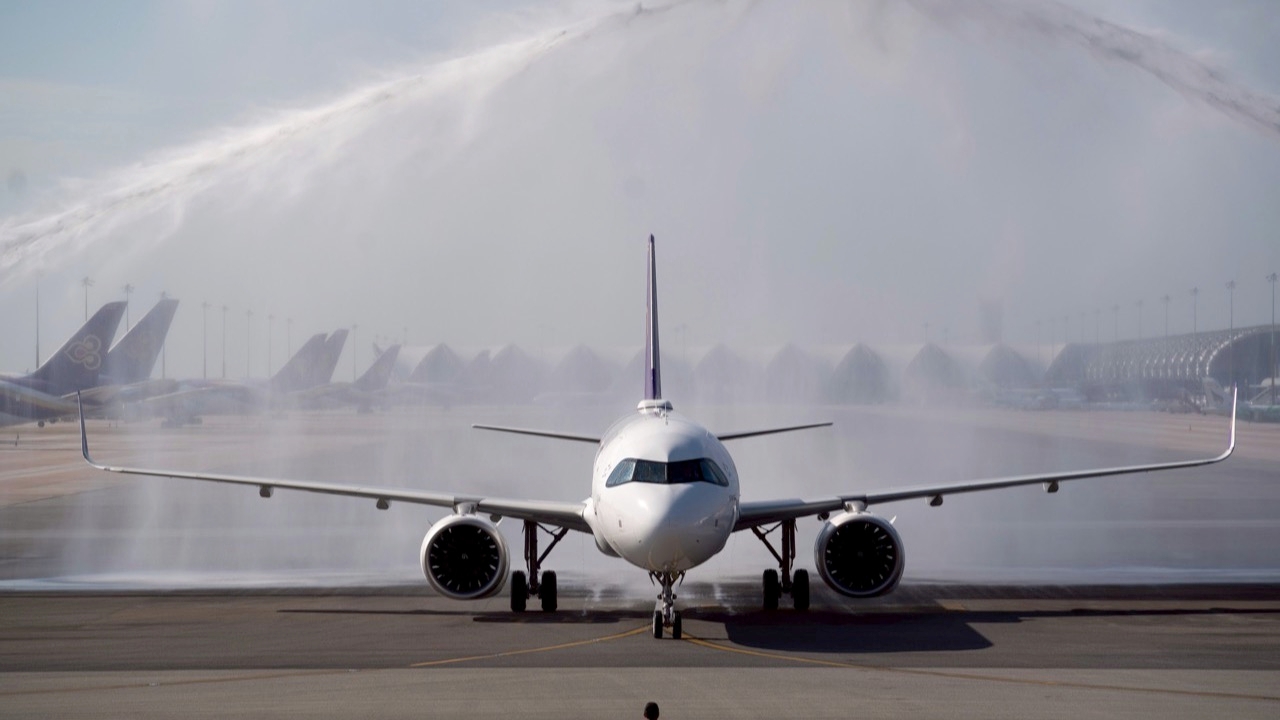
On 25 December 2025, Thai Airways Public Company Limited held a ceremony to welcome its Airbus A321neo aircraft, registration HS-TOA, bestowed the royal name “Bowarangsi,” at Suvarnabhumi Airport. The plane arrived from the Airbus Delivery Center in Hamburg, Germany. The event was attended by Mr. Lawaron Saengsanit, Chairman of the Board, alongside Mr. Chansilp Treenuchakorn, Board Director, Mr. Chai Iamsiri, Chief Executive Officer, company executives, and honored guests.

This aircraft is the first of 32 that the company has received from Airbus and is among the first 10 to be operated under an operating lease from AerCap, a leading global aircraft lessor, demonstrating international fleet management cooperation. Mr. Chai Iamsiri, CEO, stated, “Receiving the first A321neo reflects Thai Airways’ commitment to strengthening fleet capability and network strategy to enhance service quality and support continuous growth in the Asia-Pacific market. The A321neo features advanced technology, energy efficiency, and environmental friendliness.”


“These developments reinforce Thai Airways’ approach to sustainable and responsible business operations. This new aircraft will enable more efficient operations on strategic routes within the Asia-Pacific region.” The Airbus A321neo is a narrow-body, single-aisle aircraft from the A320 family, equipped with CFM LEAP-1A engines that reduce fuel consumption and noise. It lowers CO2 emissions per seat by up to 20% and is certified to use up to 50% Sustainable Aviation Fuel (SAF). The cabin accommodates 175 passengers: 16 business class seats (Royal Silk Class) designed for wide-body comfort with fully flat beds reclining 180 degrees and increased seat pitch; and 159 economy seats ergonomically designed to recline 110 degrees with six-way adjustable headrests.


The cabin interior showcases a distinctive Thai identity blended with contemporary international design, expressed through seating patterns, curtains, and cabin walls. The travel experience is enhanced with 4K resolution touchscreen in-flight entertainment (IFE) at every seat, Bluetooth headphone connectivity, and expanded storage with Airspace XL bins increasing capacity by up to 40%. Additionally, Welcome Ceiling lighting and Cabin Mood Lighting create a pleasant atmosphere throughout the flight. The Airbus A321neo is scheduled for operations on Asia-Pacific routes, with its inaugural flight on 22 January 2026 between Bangkok and Singapore. Thai Airways continues to develop its fleet and elevate service standards to provide the best travel experience worldwide.


The Airbus A321neo offers outstanding flight performance with 20% improved fuel efficiency, extended range (up to 900 km or 500 nautical miles further), and increased payload capacity (up by 2 tons) thanks to fuel-efficient engines and Sharklet wing tips. Variants such as the LR (Long Range) and XLR (Extra Long Range) offer even greater range, enabling routes previously served by wide-body aircraft. It is the world’s longest-range narrow-body aircraft and also features reduced noise impact.
Key features and performance:
Fuel efficiency: Up to 20% reduction in fuel consumption per seat compared to previous models (A320ceo).
Range: Significantly extended, with A321neo LR/XLR variants capable of flying up to 4,700 nautical miles (8,700 km), allowing for transcontinental flights.
Payload: Increased cargo capacity by up to 2 tons.
Wing technology: Equipped with "Sharklet" winglets to enhance aerodynamic efficiency.
Engines: Powered by new, energy-efficient engines.
Capacity: Seats between 180 and 220 passengers depending on configuration.
Cabin improvements: Designed for maximum efficiency, increased space, and enhanced cargo capacity.


Notable variants:
A321neo: Standard model with improved efficiency and extended range.
A321neo LR (Long Range): Features additional fuel tanks for a range around 4,000 nautical miles.
A321neo XLR (Extra Long Range): Longest range in the family at 4,700 nautical miles (8,700 km), making it the longest-range narrow-body aircraft, ideal for long-haul routes.
Overall, the A321neo offers cost-effective options for airlines expanding short to medium-haul routes and launching longer routes using narrow-body aircraft, which are more economical than wide-body planes.