

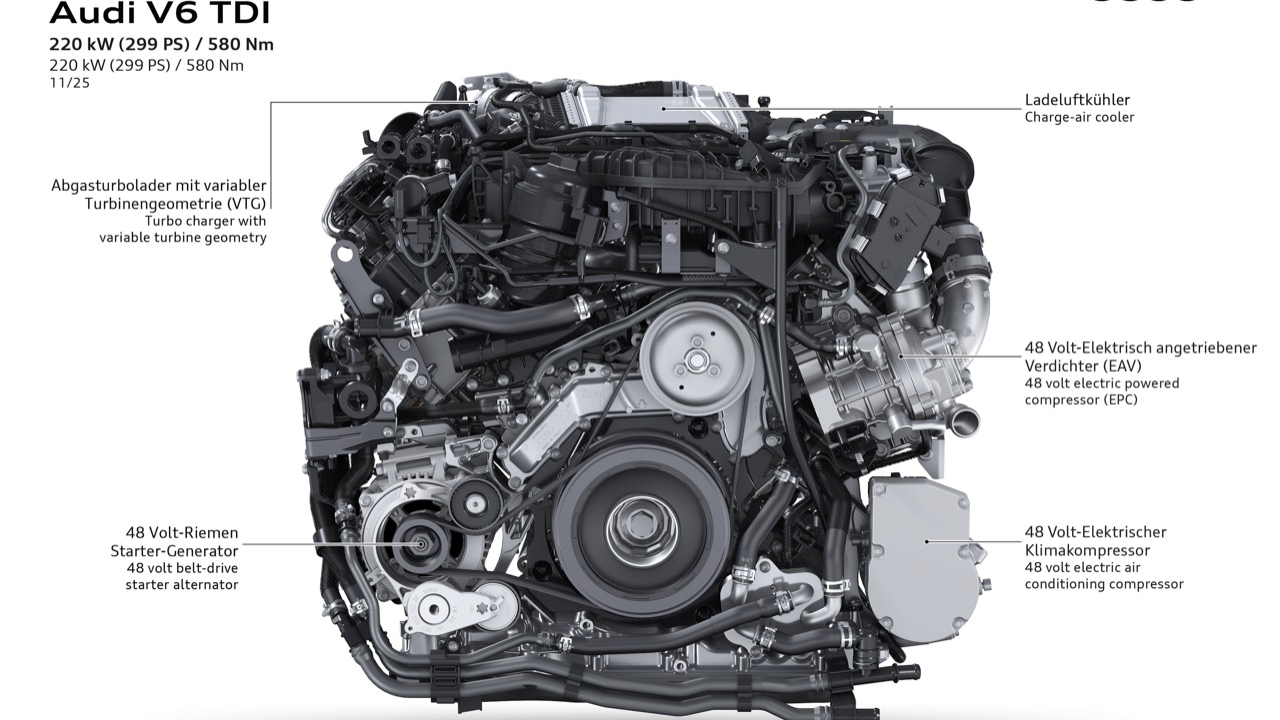
In 2026, the 48-volt Mild Hybrid system plays an increasing role in powertrains. It not only boosts torque but also reduces pollution and improves fuel efficiency. Audi’s MHEV plus technology introduces an electric drive system that enhances performance and driving feel. This technology also lowers CO2 emissions and manages fuel more efficiently (to avoid exaggeration). The basic components of Audi’s MHEV plus include a generator for the drive system, a starter, and a compact lithium phosphate battery supplying power to the MHEV system.

The main function of the belt-driven starter generator is to start the engine smoothly and supply electrical energy to the battery. The generator for the drive system enables short periods of pure electric driving. This means in urban stop-and-go traffic, during turns, reversing to park, or steady traffic flow on highways, the car can run solely on electricity. The drive system generator adds 230 Nm of extra torque, with a motor peak power of 18 kilowatts (24 horsepower), aiding initial acceleration and overtaking. German brands like Audi, BMW, and Mercedes-Benz have excelled in 48V Mild Hybrid systems. During deceleration, regenerative braking returns up to 25 kilowatts of electrical energy to the battery.

The hybrid drive system integrates three electrical components together.
In the newly updated 3-liter V6 TDI engine, the MHEV plus technology extends to include the electric turbocharger (a first for Audi), marking a technological advance that balances exciting driving dynamics with fuel efficiency.

The electric compressor in the turbocharging system is a key part of the engine management, combustion, and new emissions control systems—essential since high diesel emissions would prevent EU sales. The concept uses precise two-stage charging combined with electric power from the MHEV plus system, which includes a belt-driven starter and a drive system generator. This enables the V6 TDI EA897evo4 diesel engine to deliver ample torque in all conditions—starting from rest, accelerating for overtaking, or cruising at high speeds on highways.
The electric compressor reduces turbo lag, provides high torque at low engine speeds, saves fuel, and improves initial acceleration response. In the first 2.5 seconds, the car can travel further than before. The belt-driven starter motor assists in starting the engine and supplements torque when the accelerator is fully pressed, ensuring continuous torque during acceleration. During this process, the electric turbo increases boost pressure, while the generator (electric motor) delivers torque directly to the wheels.

The electric compressor is mounted behind the turbocharger and intercooler, along the intake air path, powered by the 48-volt electrical system. When the accelerator is pressed and turbocharger power is low, intake air is routed to the electric compressor, where it is further compressed before entering the combustion chamber.
Compared to previous V6 TDi engines with electric compressors, such as in the S4, S6, and SQ5, the new compressor provides more power, a wider operating range, and faster boost pressure buildup. The airflow system design in the compressor and the permanent magnet synchronous motor on the same shaft, together with intake distribution to all six cylinders (three per bank), optimizes fuel mixing and ignition to generate torque.
While earlier electric compressors operated only in a narrow range, the new model functions across the entire engine speed range, delivering smooth and quick response, improved mid-range acceleration, enhanced performance, and long-term durability.

The collaboration between the electric compressor and the drive system generator in the MHEV+ powertrain achieves a rapid maximum boost pressure of 3.6 bar—nearly one second faster—resulting in more efficient acceleration without turbo lag. The 3.0-liter V6 TDi turbocharged powertrain feels like driving a dual-motor electric car with similar power. During acceleration, the compressor spins up to 90,000 rpm within just 250 milliseconds, increasing speed by nearly 40%. The V6 TDI EA897evo4 engine delivers strong power to the road by combining electric boost assistance with diesel torque.

Sustainable Fuel: Used Vegetable Oil - HVO 100 Helps Reduce CO2 Emissions
HVO is produced using waste and residues such as leftover cooking oil.
The new V6 TDI engine is tuned to run on HVO fuel, compliant with European standard EN 15940, identified by the XTL sticker on the fuel cap. XTL (X-to-liquid) is a generic term for standard fuels where "X" indicates the feedstock source. HVO stands for hydrotreated vegetable oil. This sustainable fuel reduces CO2 emissions by 70 to 95 percent compared to petroleum diesel. Using used oil from outlets like KFC or McDonald's processed this way results in a scent reminiscent of french fries, fried chicken, or other appetizing smells.

Vegetable oil from the food industry or agricultural byproducts is processed using hydrogen to convert it into saturated aliphatic hydrocarbons. This changes the oil’s properties to make it suitable as diesel engine fuel. It can be blended with conventional diesel to replace fossil components or used as 100% pure HVO fuel. New Audi vehicles from the Ingolstadt and Neckarsulm factories in Germany come filled with HVO fuel. Upon starting the engine, it is no surprise if the appetizing fried aroma is noticeable.
/Note
Audi supports biofuel HVO 100 (Hydrotreated Vegetable Oil) or sustainable diesel in many diesel models, especially the V6 TDI and four-cylinder diesel engines produced after 2021/2026. This reduces CO2 emissions by 70-95% and offers better cold-start performance, marked by the XTL badge on the fuel cap. It can be used either blended or at 100% concentration.
Key Features:
Used Vegetable Oil: Produced from used vegetable oils, waste, or agricultural residues, making it a sustainable fuel.
CO2 Reduction: Cuts carbon dioxide emissions by 70-95% compared to conventional diesel.
High Cetane Value: Has a cetane number 30% higher than regular diesel, improving ignition and cold-start ease.
High Purity: More resistant to microbial contamination (diesel pitting).
Supported Vehicle Models (Examples):
Four-cylinder engines: Audi A3, Q2, Q3 (produced since June 2021).
V6 TDI engines: A4, A5, A6, A7, A8, Q5, Q7, Q8 (models produced after February 2022).
Observation
Look for the XTL (X-to-liquid) badge on the fuel cap.
Status in Thailand
As of January 2026, this remains a trend in Europe (Scandinavia, Germany), but Audi confirms support in new models, indicating a global market trend.