

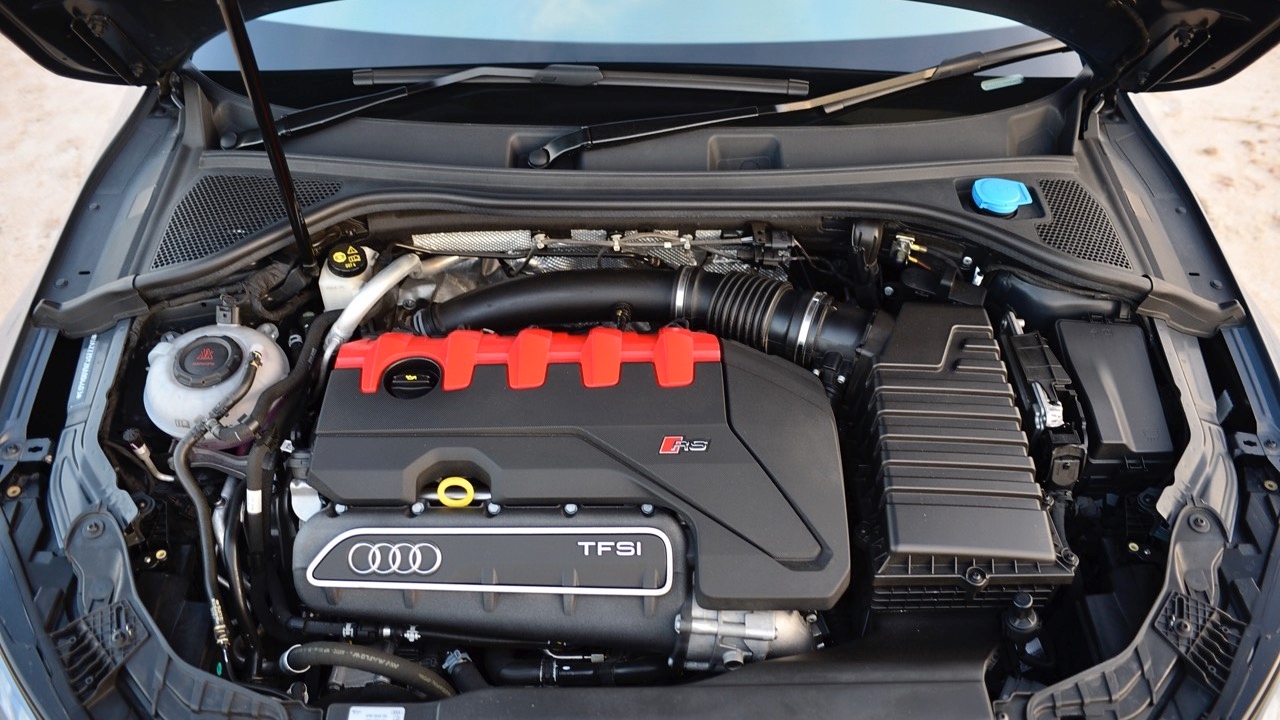
Audi's five-cylinder engine has achieved legendary status and is deeply rooted in the brand's DNA. The 5-cylinder engine has played a key role in shaping technological progress (Vorsprung durch Technik), stemming from motorsport successes and on-road performance in production lines. Even today, the 2.5 TFSI engine offers a distinctive driving experience, notably in responsiveness and its unique sound.
History: 50 years of success in automotive production and motorsport.

The first five-cylinder engine was introduced in the 1976 Audi 100 (C2), internally known by Audi engineers as the Type 43 engine. Audi intended to position this powertrain above its predecessors. At the start, four-cylinder engines lacked sufficient power for development goals, so Audi engineers devised five- and six-cylinder inline engines in the early 1970s. The six-cylinder inline was discarded due to space constraints and unfavorable weight distribution. The five-cylinder inline engine, based on the EA 827 engine, was still in its infancy. The four-cylinder inline engines were used in Volkswagen Group cars of the 1970s, including the Audi 80 and Audi 100. The five-cylinder engine, developed from this four-cylinder, had a displacement of 2,144 cc, producing 100 kW (136 hp) with a modern fuel injection system improving power delivery. Audi began delivering the Audi 100 5E to customers in March 1977.

From the original quattro to the Sport quattro.
Audi launched its first diesel engine in 1978, a naturally aspirated two-liter diesel producing 51 kW (70 hp). One year later, the first turbocharged five-cylinder gasoline engine debuted, marking another pioneering success for Audi, producing 125 kW (170 hp) and 265 Nm of torque, used in the Audi 200 5T.

The five-cylinder gasoline engine in the first Audi quattro in 1980 advanced further with a turbocharger, intercooler, and permanent four-wheel drive (Quattro), resulting in powerful technology for both racing and road use. Initially, the first 5-cylinder engine produced 147 kW (200 hp). After Audi won the WRC championship in 1982, Finnish driver Hannu Mikkola won the WRC title the following year. In 1983, Audi introduced the shorter Sport quattro, with a wheelbase extended by 24 cm, powered by a newly developed lightweight alloy 5-cylinder (4 valves per cylinder) engine producing 225 kW (306 hp). This made the Sport quattro the most powerful road car Audi had produced at that time. The Sport quattro became the basis for the Group B rally car, which featured a 5-cylinder 20-valve engine producing 450 hp (331 kW). This car debuted at the Ivory Coast Rally late in the 1984 season. For the remaining 11 events that year, Swedish driver Stig Blomqvist raced in an Audi quattro A2 Group B with 265 kW (360 hp), securing both the driver and manufacturer world championships.

Walter Röhrl and the fierce Pikes Peak hill climb.
Following frequent severe accidents, Audi withdrew from Group B rallying in 1986 but still achieved notable racing highlights. In 1987, Walter Röhrl piloted the Audi Sport quattro S1 E2 with a five-cylinder engine to victory in the Pikes Peak hill climb in the United States. This race car produced 440 kW (598 hp). Unlike the Audi Sport quattro S1 which used four-valve technology, Audi equipped the 200 Quattro Trans-Am car with an older two-valve per cylinder five-cylinder inline turbocharged 2.1-liter engine generating 375 kW (510 hp).

Hurley Haywood won the 1988 American Trans-Am series with impressive racecar control. In 1989, the IMSA GTO championship-winning car astonished the American touring car scene by producing 530 kW (720 hp) from just five cylinders with a 2.1-liter displacement.

At the 1989 Frankfurt International Motor Show, Audi introduced a significant milestone: the Audi 100 TDI featuring a five-cylinder turbo diesel engine with direct injection and full Bosch electronic engine management. It produced 88 kW (120 hp) from a 2.5-liter displacement. Continuous development of the five-cylinder gasoline engines led to the 1994 Audi Avant RS2, delivering 232 kW (315 hp) as a powerful Avant model, setting the foundation for today's RS4 and RS6. With the 1994 Audi A4 (B5) launch, the five-cylinder engine’s role gradually diminished, replaced by new V6 engines by mid-1990s. The final five-cylinder models, the 2.5 TDI in the Audi A6 and the 2.2-liter 20-valve turbo in the Audi S6, ended production in 1997.


Turbocharging and direct injection in the Audi TT RS.
In 2009—30 years after the debut of the first five-cylinder turbo gasoline engine—the five-cylinder made a grand return in the Audi TT RS. With a 2.5-liter displacement, quattro GmbH engineered 250 kW (340 hp) from this transversely mounted engine.


The turbocharged, direct-injection engine also delivers outstanding performance in the RS 3 Sportback. The 2012 TT RS plus produced 265 kW (360 hp). In 2013, the RS Q3 became the first compact SUV to feature this 2.5-liter five-cylinder engine, like the TT RS and RS 3. In 2016, an updated engine was developed with weight reduction, lowered internal friction, and enhanced power delivery. Engineers increased output by 17% while maintaining the 2,480 cc displacement, achieving 294 kW (400 hp) and 480 Nm of torque.

400 horsepower and 500 Nm torque in the Audi RS 3.
Since 2021, the Audi RS 3 has been equipped with an upgraded 2.5 TFSI engine delivering increased power. This compact sports car accelerates from 0 to 100 km/h in 3.8 seconds. Its top speed is electronically limited to 250 km/h, with options to raise it to 280 km/h via the RS dynamic package and ceramic brakes, reaching up to 290 km/h. The key to these performance figures is a torque increase to 500 Nm, available between 2,250 and 5,600 rpm—20 Nm more than the previous model—allowing quicker acceleration at mid-range engine speeds. Maximum output of 294 kW (400 hp) is accessible from 5,600 to 7,000 rpm. A new engine control unit accelerates drivetrain component response, enhancing driving dynamics further.

Sound: captivating and unique.
The deep, low tone of the five-cylinder engine offers a highly captivating driving experience. This unique sound stems from the odd number of cylinders and its distinctive 1-2-4-5-3 firing order, which alternates between adjacent cylinder pairs and those spaced 144 degrees apart on the crankshaft rotation. This gives the 2.5 TFSI a special rhythm and sound character. The geometry of the exhaust manifold further contributes to this signature sound by varying exhaust gas flow timing between exhaust valves and the turbocharger.


The fully adjustable exhaust flap system introduced in the 2021 third-generation RS 3 Sportback and second-generation RS 3 Sedan enhances the sound range and sensory experience. The flaps open at different positions depending on the selected Audi drive select mode: in dynamic, RS Performance, and RS Torque Rear modes, the flaps open more quickly than in other driving modes, creating a noticeably more thrilling sound. The five-cylinder engine’s distinctive sound is further enhanced by the optional RS sport exhaust system.
Which produces an even sportier sound.

Technology of the 2.5 TFSI with turbocharger.
The current five-cylinder engine, launched in 2016, focuses on high efficiency and lightweight construction. In the Audi RS 3 (average fuel consumption: 9.6–9.1 liters/100 km; CO2 emissions: 217–207 g/km; CO2 class: G), internally known as the EA855 Evo Sport, it delivers 400 hp and 500 Nm of torque. The 2.5 TFSI engine offers excellent mid-range acceleration and impressive power: this compact sports car accelerates from 0 to 100 km/h in 3.8 seconds and achieves a top speed of 290 km/h.

TFSI stands for Turbocharging and Direct Injection. The 2.5 TFSI uses a dual injection system—injecting fuel into both the intake manifold and directly into the combustion chamber—along with Audi valvelift for variable exhaust valve control. This system allows more precise fuel-air mixture control, optimizing power delivery and reducing unnecessary fuel consumption. Fuel injection pressure reaches 250 bar. The large turbocharger produces a maximum boost pressure of 1.5 bar (relative) or 2.5 bar (absolute).

The cylinder head, bearings, pistons, and crankshaft are highly durable. Lightweight materials are used in many engine components, benefiting throttle response and acceleration agility. Overall, the five-cylinder engine weighs about 160 kilograms and is less than 50 centimeters long, making it very compact. Its long-stroke design (82.5 mm bore x 92.8 mm stroke) makes it especially suitable for transverse installation.

The 2.5 TFSI's cylinder block is made of aluminum, significantly reducing weight compared to traditional gray cast iron parts. The crankshaft is hollow, further reducing the engine's weight compared to a solid crankshaft. This lower rotating mass improves engine responsiveness. Audi also employs other lightweight materials such as a magnesium oil pan cover and aluminum belt pulleys.
Numerous measures reduce internal friction, wear, and fuel consumption.
Powertrain optimization includes plasma-coated cylinder liners and special oil channels at the base of the aluminum pistons to improve cooling. Thermal management innovations include a variable water pump that reduces friction and enhances fuel efficiency: during the brief warm-up after a cold start, the pump does not circulate coolant through the cylinder head, allowing the 2.5 TFSI engine to reach operating temperature faster. The aluminum oil pump adjusts oil pressure based on engine demand and works with Audi’s valve lift control system to improve five-cylinder engine efficiency.


The oil pump adapts oil pressure to engine requirements, while Audi's exhaust valve lift system adjusts valve timing in two stages depending on throttle input and speed—optimizing fuel efficiency at low load and delivering quick response under full acceleration. Engine testing occurs across all European climates, from northern to southern regions. Beyond cold and hot weather testing, the program includes altitude performance evaluations and durability tests involving sustained high-speed operation on the Nürburgring North Loop circuit. Thousands of kilometers of testing ensure maximum performance under all conditions.

Manufacturing process: hand assembly.
The five-cylinder engine is assembled at the Győr plant in Hungary, in the Bock assembly area covering more than 1,000 square meters. The engine is hand-assembled by highly skilled specialists without robots. The 2.5 TFSI engine undergoes a 21-step assembly process. Key components such as connecting rods, cylinder sleeves, and plasma-coated liners are produced separately in specialized production areas within the same Győr facility.

Assembly begins with mounting the aluminum cylinder block on the assembly stand. After engine numbering, bearings are lubricated and the crankshaft installed. Pistons are then attached to connecting rods and inserted into the block. Torque is checked to ensure smooth crankshaft rotation. Each step undergoes inspection to confirm proper assembly. Next, flange seals and the oil pan are installed. The oil pan’s upper part is made of lightweight magnesium, lighter than the aluminum lower section. The process continues with installing injectors, speed sensors, and the timing chain, which connects the crankshaft to the camshaft and ensures precise valve timing.

One of the most critical steps follows: tightening the cylinder head bolts and installing spark plugs. The spark ignites the fuel-air mixture, moving the pistons and creating the distinctive sound of the five-cylinder engine. The intake manifold, essential for air supply, is mounted along with a large turbocharger that compresses air to increase oxygen in the combustion chamber, enhancing combustion and engine performance. Finally, engine wiring and the flywheel—positioned between the engine and the 7-speed S tronic transmission to reduce vibration and drivetrain oscillation—are installed.


The final step involves mechanical and electronic testing to ensure all functions operate correctly. This includes cold tests where necessary fluids are filled and systems checked, as well as hot tests involving initial engine start and load testing. Upon passing all inspections and tests, the five-cylinder engine is lifted by crane, placed on a pallet, and transported by rail from Győr to Ingolstadt, where the Audi RS 3 is assembled. This is where the "marriage" occurs—the 2.5 TFSI engine is installed into the engine bay of the Audi RS 3, available in both four- and five-door versions.