

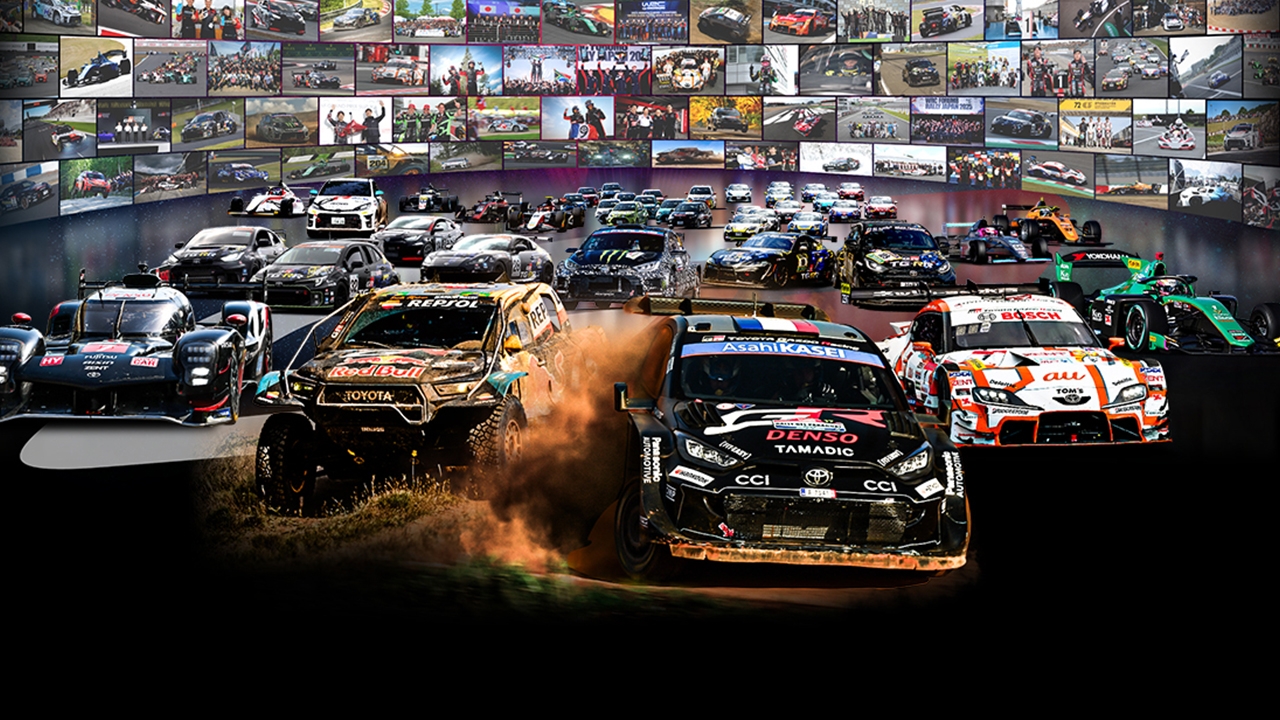
TOYOTA GAZOO Racing has announced it will officially return to the name "GAZOO Racing" and participate in top-level motorsport competitions such as the World Rally Championship (WRC) and customer motorsport events, using production cars manufactured for sale.
GAZOO Racing: a challenge born from disdain.
Looking back to the year 2007. Akio Toyoda. At that time serving as Executive Vice President of Toyota, he took part in the Nürburgring 24 Hours endurance race alongside Hiromu Naruse, a master driver for Toyota Motor Corporation (TMC) and Toyoda’s driving instructor, as well as other colleagues.
Because participation in that race was not officially recognized by TMC as a company activity, the team was not permitted to use the "TOYOTA" name. "TOYOTA" and had to compete under the name "Team GAZOO."
At the same time, Toyoda’s intention to drive in the race was not widely understood, leaving him no choice but to use the driver name "Morizo."

Although the team managed to finish the race successfully, this achievement came with a feeling of being looked down upon. This was because while most competitors, mainly European manufacturers, entered prototype cars still under development to test their performance in the race,
Toyota had no such prototype cars, let alone sports cars in their lineup, and was at risk of losing the ability to pass on automotive skills and expertise.
When overtaken on the track by development cars from other manufacturers, Toyoda felt as if he heard competitors say, "There’s no way you from Toyota could build a car like this!" This sparked a deep sense of disdain that Toyoda vividly remembers to this day.

Shikinen Sengu: the faith-driven tradition of car building.
Developing a sports car requires a production approach that not only enhances specific features and basic performance but also aims to prevent failures under harsh driving conditions.
These efforts also impact mass-production vehicle development. At the same time, competing at the forefront of motorsport offers many opportunities to refine vehicle-building skills and cultivate personnel.
At Ise Shrine in Mie Prefecture, Japan, traditions and skills are passed down through a ritual called Shikinen Sengu, which involves completely rebuilding the shrine every 20 years. Similarly, the tradition and skills involved in producing sports cars, if lost, cannot be passed on. Feeling the crisis that TMC might become a company unable to build sports cars, Toyoda initiated the Lexus LFA development project, choosing Nürburgring as the primary development site.

The LFA, launched in 2010, was TMC’s first true in-house sports car in about 20 years. The project faced immense challenges, including a lack of full internal support, as building a car seen as unprofitable was restricted to only 500 units.
Shortly before the LFA’s launch, an unexpected tragedy occurred: Naruse suffered a fatal accident near Nürburgring. This sorrow came soon after the completion of the LFA development.
After Naruse, as a master driver, endorsed the car with the phrase "Let’s go with this," Toyoda experienced profound loss with the sudden death of his driving instructor and TMC’s master driver.
Nonetheless, Toyoda remained committed to the belief that cars and personnel are honed on motorsport’s front lines and continued developing sports cars. This led to the revival of the 86 model in 2012 and the GR Supra in 2019.
Both models were developed with cooperation from Subaru and BMW, respectively, indicating that TMC had yet to fully achieve entirely in-house sports car development.

The founding of TOYOTA GAZOO Racing.
In April 2015, TMC decided to consolidate all in-house motorsport activities—including those under TOYOTA Racing, LEXUS Racing, and GAZOO Racing—into a single entity named GAZOO, adopting the TOYOTA GAZOO Racing logo.
This development reflected the fact that activities once prohibited from using the "TOYOTA" name in 2007 could now officially bear the company name. However, though under the umbrella of a large organization, the original feelings of disdain that motivated Toyoda and Naruse began to fade.

An endless pursuit of building better cars.
Toyoda, then President of the company, decided to re-enter the FIA World Rally Championship (WRC) to continuously elevate and improve car manufacturing activities. Returning to WRC, where competition cars are based on production models, marked a key turning point in TMC’s motorsport efforts.
Previously, TMC developed race cars from completed production models. After rejoining WRC, the company adopted a new approach: first building cars capable of winning in WRC, then developing those into production cars.
This concept led to the 2020 launch of the GR Yaris, a sports car developed entirely in-house, embodying the philosophy of continuous improvement with motorsport as its foundation. The GR Yaris debuted at the Tokyo Auto Salon in January and won its first victory at the Super Taikyu Series 24-hour race in September.

It also began appearing in motorsport events worldwide, leading to the development and launch of the GR Corolla. This success marked the start of reviving in-house production of TMC sports cars capable of winning motorsport competitions.
In 2025, Toyota returned to the Nürburgring 24 Hours after a six-year absence, entering the GR Yaris. Behind the wheel was Mr. Toyoda, a current TMC master driver, who said he had a private conversation with Naruse, known only to the two master drivers.
For Toyoda, the next challenge is to truly embody "Shikinen Sengu" in creating ultimate sports cars. Thus, the GR GT, GR GT3, and LFA Concept debuted in 2025.
TGR’s journey in building better cars through motorsport and cultivating personnel continues, soon approaching 20 years since Team GAZOO’s founding in 2007.
"There’s no way you from Toyota could build a car like this!" The shame once felt by Hiromu Naruse and Akio Toyoda was the starting point of it all.

TGR sincerely thanks everyone in the motorsport world, partners, and fans for their unwavering support, along with all involved parties. TGR—under the name GAZOO Racing—intends to continuously build better cars inspired by motorsport and nurture drivers, engineers, and mechanics. TGR hopes for continued support from all.
Additionally, TMC’s research and development center in Cologne, Germany (TOYOTA GAZOO Racing Europe) will operate under the new name TOYOTA RACING, focusing on motorsport activities through advanced technology development to promote long-term technological progress.
This includes engine development and other areas, with technologies developed being applied in diverse motorsport contexts, from top-tier circuit races to rallies, aiming for continuous performance enhancement.
TOYOTA GAZOO ROOKIE Racing (TGRR) will continue activities under its current framework. As an organization featuring the letters T from TOYOTA Racing and G from GAZOO Racing, TGRR aims to serve as a bridge between these entities.
It refines products and technologies developed by both sides through motorsport competition as a racing team, while also acting as a practical training ground (dojo) to nurture and develop talented personnel.
.Illustration byTOYOTA GAZOO Racing