

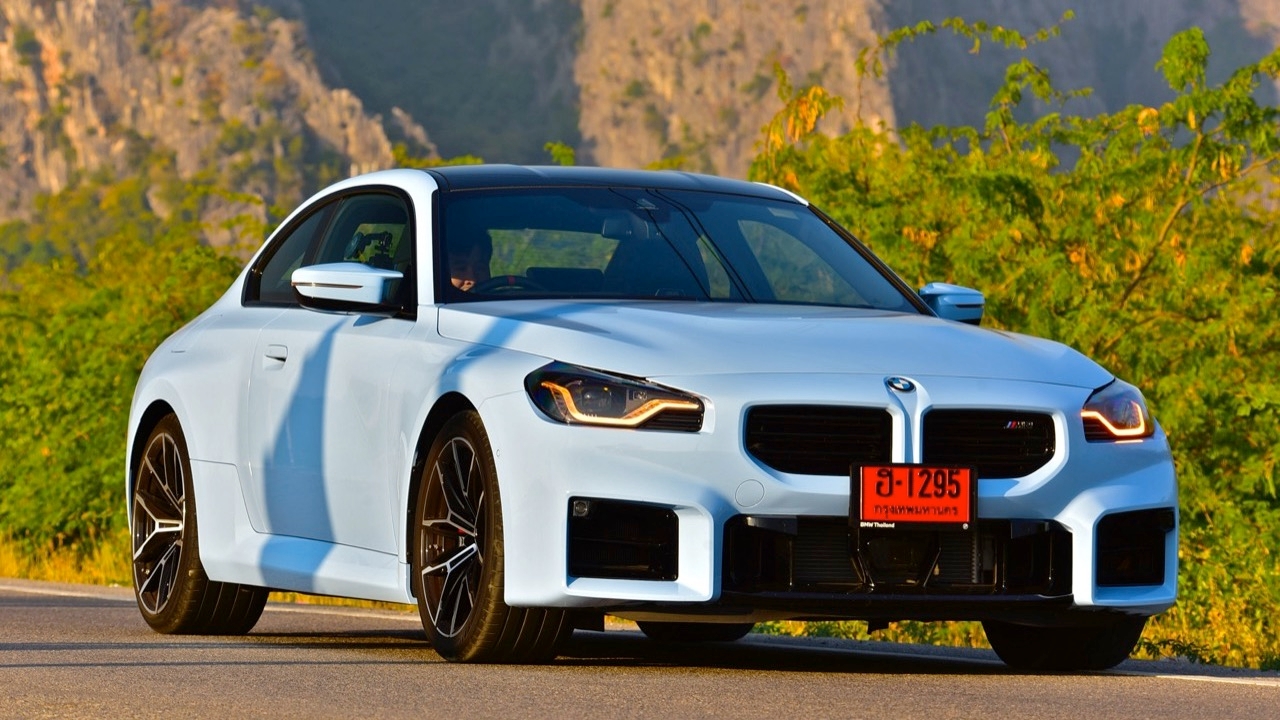
Like its predecessor, the F87, the new M2 drives much better (less aggressive and easier to control than the first generation). Now it's time for an update that barely alters the M2's appearance. The 2025-2026 M2 LCI comes with an 8-speed ZF automatic and a 6-speed manual. The M2 G87 LCI 2025 remains an eternal favorite among true driving enthusiasts. For manual gear lovers, the G87 M2 Competition and the upcoming 2025 M2 CS still offer an 8-speed automatic, with manual available on request. Naturally, any sharp M2 sells out immediately, especially the facelifted versions. BMW fans have speculated endlessly on the G87 LCI's changes, but in the end, almost nothing changed except an increase to 480 horsepower and 30 Nm more torque (making it even more spirited), a new flat-bottom M steering wheel, and an upgraded operating system from 8.0 to BMW OS 8.5.
BMW M2 Coupe AT priced at 6,649,000 baht (test car).
BMW M2 Coupe M Race Track priced at 7,349,000 baht.


Since the car was already well-made and nearly perfect, BMW made only minor tweaks, which is why this coupe remains excellent. The M2 facelift (LCI) fully preserves the original aggressive M Car spirit. The ECU has been retuned for a slight power boost. Increased torque allows the rear to slide out more easily, requiring careful control. The M2 LCI also updates its interior design and infotainment to OS 8.5, which operates faster with more features. Maintaining the raw early torque feel makes this smallest M Car the best sports car for drivers BMW has ever made: raw, wild, yet easy to control and proudly classic despite the digital age, making the M2 a dream car for both veteran and new drivers.

The exterior remains unchanged because the aggressive look was already well-balanced. The M2 LCI has no external part changes. The M design team aimed to create attraction with the 6-cylinder inline turbocharged gasoline engine S58, now producing 480 horsepower, rear-wheel drive with advanced electronic aids, and a luxurious interior featuring M Car style and increasingly complex driver assist features—though these can be fully disabled if undesired.


The compact M2 LCI coupe is built to be tough and muscular, with short overhangs, wide wheel arches, and a longer wheelbase than the previous F87 M2. It is larger in every dimension. The G87 remains the ideal sports car for drivers worldwide, with a compact yet comfortable modern design (though tall rear passengers still struggle to get in and out). The small M Car coupe concept may not look better than the original and might not suit everyone's taste, which seems a bit arrogant, but the M2 LCI is hotter, more modern, and intriguingly strange, requiring a longer look to appreciate. Its simple aerodynamic styling avoids flashiness, seen in the grille and headlights recessed into the body. LED headlights with automatic illumination don’t make the front look sharp. Overall, it’s a bulky two-door that has completely changed compared to past beautiful BMW M models. The kidney grille is square-shaped with boxy air intakes and double lower vents, all trimmed in thick, heavy black plastic. It doesn’t look bad but could be smoother.


The M2 LCI’s body dimensions are 4,579 mm long, 1,887 mm wide, and 1,402 mm high, with a ground clearance of 121 mm and a 2,745 mm wheelbase. It weighs 1,730 kg. Front wheels are 19 inches; rear wheels are 20 inches, which drive the car. The tire and wheel setup is similar to the M3 G80 and M4 G82: Yokohama Advan tires, front size 275/35 ZR19 100Y, rear 285/30 ZR20 109Y. The carbon fiber roof is an optional lightweight feature usually reserved for more hardcore M models, now offered as a factory option on the new M2. No official weight reduction is specified, but it reportedly saves about 2 kg. BMW Thailand includes this option without extra charge.


The M2 LCI’s cabin impresses with the latest M steering wheel and electrically adjustable M Sport seats. The M seats are comfortable, with side bolsters that provide a snug, race-car-like feel without discomfort. Rear legroom is limited, better suited for children than tall adults. Door panels feature M-style graphics with ambient lighting at night. The dashboard is made of flexible synthetic foam, offering good sound insulation and vibration damping, wrapped in high-quality vinyl. The center dashboard is finished with glossy carbon fiber. Air vents are rectangular. Climate controls have moved to the touchscreen, requiring some adaptation during driving.


The brand-new iDrive 8.5 (upgraded from BMW Operating System 8.0 in 2024 to 8.5 in the 2026 M2 LCI) features a display positioned above the dashboard, making the car feel more futuristic, even if the interior content is less sporty. BMW also introduced selective interior updates, including two M mode buttons on the steering wheel and two on the center console. The illuminated M logo on the door panel is standard on the M2 LCI.
BMW integrates new technologies carried over from the M3/M4. The standout feature is an adjustable traction control system with up to 10 levels. Brake pedal responsiveness can be set to 2 levels, allowing drivers greater dynamic control. Particularly, the factory-tuned dynamic traction control is designed to enable controlled drifting. The M Drift Analyzer remains a signature BMW M feature.


A deliberately curved display sits on the dashboard. The instrument cluster is a 12.3-inch TFT LCD linked to a 14.9-inch touchscreen infotainment system. Both displays run on the new iDrive 8.5 software. M Car touches distinguish the M2 from non-M models, including carbon fiber trim on the center console, red gearshift paddles, and a carbon dashboard. BMW M also offers optional carbon seats at a high price, similar to the M3 G80 and M4 G82; installing these seats reduces weight by 10 kg. The M steering wheel is leather-wrapped, like other M models, and the M carbon seat option costs about 400,000 baht.


The BMW M2 G87 uses Adaptive M suspension. This update brings the M2's engineering closer to other new M models than the previous F87. M division insiders say Adaptive M suspension allows the second-generation M2 to deliver higher grip and a sharper, more aggressive feel (with occasional slippage at full throttle), while maintaining dynamic excellence by sharing key components with the M4 G82.

The engine is more powerful, and despite increased torque, it’s sharper than its bigger sibling. The G87 is a driver’s car with a larger size that better separates comfort from sportiness compared to the F87. The new Series 2 CLAR platform improves body rigidity by 40% over the old M2 structure. The G87 enhances this with a unique steel strut front suspension dome and a new rear suspension brace. The M2’s front MacPherson strut and rear multi-link suspensions have been heavily revised. BMW M engineers note the setup allows for increased front camber and uses variable dampers.

The 2026 BMW M2 LCI continues to use the powerful M3/M4 heart: the M TwinPower Turbo S58 engine tuned to motorsport specs, hailed as an M Car masterpiece. Its internals resemble the M4 GT3 competing in the 24 Hours of Le Mans. A strut bar reinforces the engine bay to add rigidity and resist torque, improving control and predictability. The M2 Coupe G87 shares the same drivetrain as the M3 G80 and M4 G82: a 3.0-liter inline 6-cylinder twin-turbo engine delivering 490 horsepower, with torque increased from 550 to 600 Nm, powering rear wheels in classic M Car style. The S58 offers two transmissions: a 6-speed manual for those who like shifting themselves, with tight ratios, or an 8-speed ZF torque converter automatic M Steptronic with Drivelogic, ideal for traffic and comfort. The automatic accelerates 0–100 km/h faster and is more fuel-efficient.

The S58 twin-turbo straight-six engine is deliberately detuned to keep power manageable. The LCI version raises horsepower and torque slightly. Other parts borrowed from the M4 include the exhaust, suspension components, and brakes. The twin-turbo S58 redlines at 6,250 rpm, delivering 600 Nm of torque from 2,650 to 5,870 rpm, making it one of the most powerful engines in small M Cars. It accelerates 0–100 km/h in 4.1 seconds using the quick-shifting 8-speed ZF automatic. Top speed is electronically limited to 250 km/h, but the optional M Driver’s Package raises it to 285 km/h.

The S58 engine features two mono-scroll turbochargers upgraded for better efficiency, an intercooler controlling intake air temperature, and a new intake system optimized for airflow to reduce pressure loss. Electronically controlled wastegates have improved responsiveness. High-pressure fuel injectors increased from 200 to 350 bar use new precision injection technology to boost efficiency and reduce emissions under full throttle. Variable valve timing (Valvetronic) and Double-Vanos camshaft technology increase power and lower emissions.
A more powerful M engine requires improved cooling. BMW designed larger radiators, added a new oil cooler, and a separate transmission oil cooler. An electronically controlled fuel pump ensures internal components work optimally during acceleration. A new two-chamber fuel tank with integrated intake ports supports these enhancements.

The engine’s lightweight forged crankshaft is an engineering masterpiece. Reduced mass allows freer high-revving, responding precisely to driver throttle input at all times. The crankshaft is exceptionally strong to handle high power and torque, enabling easy tuning upgrades. The S58 cylinder head showcases BMW M's innovation, produced by 3D printing to create complex geometries impossible with traditional casting, reducing weight and improving coolant flow for superior temperature management.
The S58 also features an advanced cooling circuit with electric and mechanical water pumps. This complex system ensures optimal cooling for the cylinder block and turbochargers. After engine shutdown, the additional electric pump continues cooling the turbos, demonstrating attention to detail and engine longevity.
All this technology reflects BMW M's mission to refine the S58 powertrain, proving its capability and reliability in the X3M, X4M, M3/M4, and now the newest M2 G87 LCI.

The M2 is a fun-to-drive BMW you can buy today. Leaving driver aids on helps you take corners beautifully, but turning them off reveals the car’s hidden potential. It suits professional track drivers best. The ideal way to experience it is by partially disabling driver aids on a test track or race circuit, allowing the system to still rescue you from disaster’s edge.

The 2026 BMW M2 LCI is one of the laziest BMW facelifts ever. It features new body colors, wheels, and dark exhaust tips. Inside, the test car from BMW Thailand sports a new flat-bottom M steering wheel wrapped in genuine leather with a red center stripe—a common feature on performance cars to help the driver gauge steering angle.


The LCI upgrades add 20 horsepower to 480 and increase torque from 550 to 600 Nm. These numbers bring both fun and risk. Only automatic models get the faster M2. You might not feel the power increase immediately—I didn’t, having not driven an M2 for a while—but swapping between both versions clearly shows the boost. This car struggles to transfer power fully to the road in low gears on uneven or slippery asphalt, so caution is advised when accelerating quickly.


Most owners don’t buy the M2 to flaunt wealth. They buy it for pure driving passion, and the M2’s character perfectly fits that. Especially the high-powered M badge control delivers weekend excitement. The M2 offers thrills unmatched by any car in its price range. It’s not as fast as the Porsche 718 Spyder RS (982), which is closer to a race car, but it’s equally exhilarating when the rear oversteers and you must countersteer to control the sliding tail.


The 2026 BMW M2’s steering is very sharp, compensating for the vague steering feel common in current BMWs. The steering may not clearly communicate front wheel behavior, but whenever you feel understeer, a slight throttle application fixes it. The BMW M Servotronic electric steering is tuned for M performance, varying steering weight by speed and drive mode. It’s light and easy at low speeds for parking, tightening up for precise, sporty feel at high speed, adjustable via the M Setup menu.


The facelifted M2’s charm lies in its fun driving and easy rear-end drifting without feeling out of control. The tested facelift model felt harder to control than the M2 G87 I drove two years ago. This car had about 2,300 km on the odometer, with rear Yokohama Advan 285 tires still in excellent condition. Mid-corner throttle application won’t cause the rear to snap out wildly; it just sways, giving a thrilling spine-tingling sensation. Whether traction control is fully on or partly off, the rear slides out easily and quickly but with good balance, making oversteer corrections manageable. This shows serious chassis tuning. On dry, hot days, inducing tail sway is harder due to the high grip tires, but the increased torque and suspension setup make the M2 LCI easy to play with. Overall, I think this car is tuned more for straight-line grip than playful drifting in corners.


The M2 feels faster and fiercer when pushing full torque. There’s a clear torque gap below 4,000 rpm compared to the M3’s powerband, but it’s not a flaw. In fact, the M2’s drivetrain has unique features compared to its larger M3 sibling. The M2’s agility means the driver doesn’t have to work harder to extract maximum power on the track. BMW says the M2’s personality changes respond to customer feedback, with growth driven by the Series 2, which offers the M240i at a lower price. BMW’s smart solution was to build a new model without using the Series 4 platform, providing a large engine bay for the inline six, adaptive suspension (absent from the old, stiff M2), and a much more modern interior.


In Road mode, the S58 engine and M exhaust are quiet. The relentless surge of torque remains, peaking at 5,870 rpm. Overtaking in default mode is effortless. Despite immense power and torque, grip is greater, and the rear slides out more easily and feels younger and more restless than the original M car. In Road mode, the M2 G87 becomes a smaller, more comfortable, quieter, and friendlier city car than the M4. The 8-speed automatic gearbox, shared with the M4, is nearly as good as the M4 CS’s dual-clutch M DCT, especially for downshifts, though it’s not as sharp as Porsche’s PDK or Mercedes’ MCT.


The longer wheelbase combined with wider track, sporty tires, Adaptive M suspension, and M Servotronic steering make the M2 LCI manageable as long as you don’t push it over the limit. The coupe understeers slightly entering corners, depending on throttle control. Body control is very professional—not a Civic Type R aimed at young Thai drivers or Porsche 911’s excellent shifting—but worth the 6.9 million baht price for a small, fun M car. The suspension layout helps, despite some changes: stiffer front springs and softer rear springs than the M4 improve turn-in and maintain the M2’s neutral cornering balance. Reinforcements on the C-pillar and rear improve chassis rigidity. The ride is firm but never harsh, with chassis strength comparable to carbon monocoque materials. Luckily, suspension tuning reduces bounce from the short wheelbase. Even with the softest adaptive suspension setting, bumps transmit into the cabin. Remember, this is a true M car, not a soft luxury cruiser.


The ZF 8-speed transmission is excellent. Compared to AMG SL43’s 9G Tronic, the M2’s gearbox feels smoother and more enjoyable to use. The ZF8 replaces the F87 M2’s M-DCT dual-clutch system, shifting smoothly from gears one to three and fast enough in mid-range settings. You can keep both hands on the wheel using carbon-finished paddle shifters or push the gear selector forward and backward like a DTM race car.


The new M2 comes standard with adaptive dampers, developed from the same unit as the M3 Touring. In Road mode, the suspension feels softest yet remains firm and stable. Some harshness appears on uneven roads, but the Adaptive M Suspension naturally offers greater stability in Sport and Track modes. The body control is excellent, avoiding excessive bounce or harshness. During the first few hours on Rama II Highway and Nong Ya Plong, with no corners to test, the ride was stable.
In summary, the engine, transmission, suspension, and steering are stars on the road. The S58 shines with peak torque from 2,650 to 5,870 rpm and maximum power at 6,250 rpm, delivering flexible yet aggressive performance. In Road mode, unless you push hard, the S58 engine noise is mild, but in Track mode, the 6-cylinder transforms into a deep, resonant, aggressive racing sound, especially at high revs. It feels like controlling a powerful machine, thanks to M Car's exhaust tuning. This is nearly the most perfect M car in 30 years.
The M2 LCI is available in 8 colors:
Zandvoort Blue Solid, Alpine White Solid, Sao Paulo Yellow Solid, Fire Red Metallic, Skyscraper Grey Metallic, Brooklyn Grey Metallic, Portimao Blue Metallic, and Black Sapphire Metallic. The special M2 LCI M Racetrack edition comes in five colors: Zandvoort Blue Solid, Alpine White Solid, Sao Paulo Yellow Solid, Fire Red Metallic, and Skyscraper Grey Metallic, with exclusive black-highlighted Merino leather seats.
Exterior body colors are offered in 8 options.
Sao Paulo Yellow (new color).
Fire Red Metallic (new color).
Skyscraper Grey Metallic (new color).
Portimao Blue Metallic (new color).
Zandvoort Blue Solid.
Alpine White Solid.
Brooklyn Grey Metallic.
Black Sapphire Metallic.
Interior options come in 3 colors.
Black with silver stitching (Black / Exclusive Highlight).
Black with blue stitching (Black / Contrast Stitching Blue).
Black with red stitching (Black / Red Highlight).
Seat materials are available in two types: Leather Vernasca Alcantara and Sensatec Combination.
Technical specifications.
BMW M2 G87 engine and performance.
6-cylinder gasoline M TwinPower Turbo engine.
Displacement: 2,993 cc.
Maximum power: 338 kW / 480 hp at 6,250 rpm.
Maximum torque: 600 Nm at 2,650–5,870 rpm.
Top speed: 250 km/h.
Acceleration 0–100 km/h: 4.1 seconds.
Fuel consumption and CO2 emissions.
Average fuel consumption (ECO Sticker reference): 10.4 km/l.
Average CO2 emissions: 217 g/km.
Wheels and tires: M alloy wheels sized 19 and 20 inches with double-spoke design.
Front tires: 9.5 J × 19 with 275/35 R19 tires.
Rear tires: 10.5 J × 20 with 285/30 R20 tires.
Vehicle dimensions.
Length: 4,580 mm.
Width: 1,887 mm.
Height: 1,403 mm.
Cargo capacity: 390 liters.
Weight: 1,800 kg.
Drivetrain and technology.
8-speed Sport Steptronic automatic transmission with gearshift paddles.
M Drive Professional driving modes.
M Sport limited-slip rear differential.
Adaptive M suspension.
Active cruise control with Stop&Go function.
Driving Assistant system.
Automatic parking assistant.
M Compound brakes with red calipers.
Black accent front headlights (M Lights Shadowline).
Exterior trim with black glossy materials and M Carbon roof.
Automatic high-beam assist.
Smart keyless entry and Adaptive LED headlights.
Interior M design with carbon fiber materials.
Auto-dimming side and rearview mirrors.
Ambient lighting inside and outside the cabin.
Latest M design leather-wrapped steering wheel.
M design seat belts.
M Sport front seats.
Electrically adjustable front seats with driver memory function.
Illuminated M design door sills.
Anthracite M headliner.
BMW Individual leather-covered upper console.
BMW OS 8.5 infotainment and communication system.
BMW ConnectedDrive system.
BMW Connected Package Professional.
Smartphone connectivity.
Harman Kardon surround sound system.
Safety features.
Driver and front passenger airbags.
Side airbags for driver and front passenger.
Head airbags for front and rear passengers (except rear center passenger).
Teleservices system.
Intelligent Emergency Call button.
Dynamic Stability Control (DSC).
Dynamic Brake Control (DBC).
Cornering Brake Control (CBC).
Anti-lock Braking System (ABS).
Brake Assist system.
Front and rear parking distance sensors.
Crash sensor safety system.
Tire pressure monitoring system.
Emergency tire repair kit.
Special trim packages.