

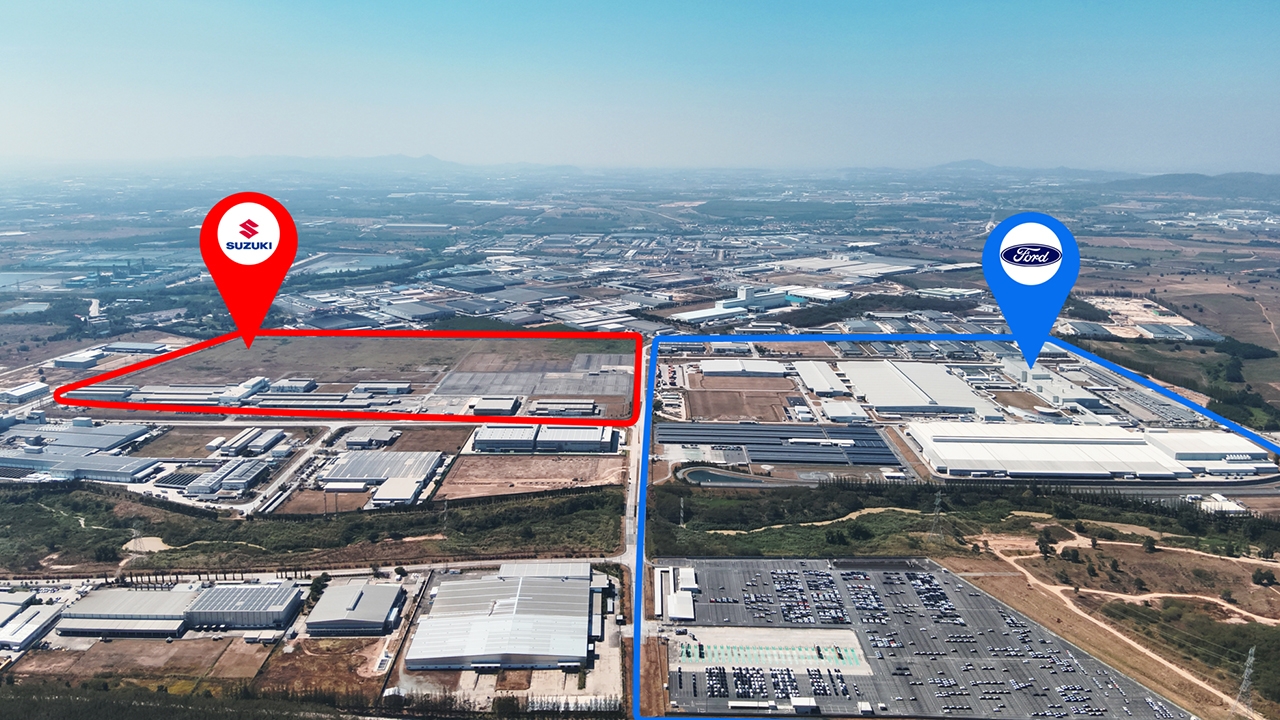
Ford has acquired the Suzuki factory in Rayong, located adjacent to Ford Thailand Manufacturing, to elevate its production capabilities and support sustainable long-term growth strategies in the region.
On 22 Jan 2026, Ford Motor Company Thailand signed an agreement to purchase the former Suzuki vehicle assembly plant in Rayong province, situated next to Ford Thailand Manufacturing (FTM), aiming to enhance its production base and support sustainable long-term regional growth strategies.
Currently, the FTM plant and Auto Alliance Thailand (AAT) are key components of Ford's regional production network, serving as centers for manufacturing and exporting Ford Ranger pickup trucks and Ford Everest SUVs both within Thailand and to other markets in the region. Over more than three decades, Ford has reaffirmed its confidence in Thailand’s potential with cumulative investments exceeding 133 billion baht (3.9 billion U.S. dollars).

The new project covers an area of more than 412.5 rai (66 hectares) with a total building space of 65,000 square meters. The original factory was built in 2012, with a key advantage being its location adjacent to the FTM plant and within a duty-free zone.
This acquisition will significantly improve operational efficiency and agility. The production base expansion enhances Ford's flexibility to meet vehicle demand across various segments throughout the region and boosts Thailand’s manufacturing capabilities over the long term.

Andre Cavallaro, Director of Operations for the International Market Group, stated that this investment confirms Thailand’s important role within Ford’s global manufacturing network.
He added, "We take pride in the capabilities of our team and the world-class vehicles produced at this manufacturing base. Acquiring the factory will substantially strengthen our production capabilities and flexibility to effectively meet the needs of customers both domestically and across the region."
Rattakarn Jutasen, Managing Director of Ford Thailand, added that as Ford approaches its 30th year in Thailand, acquiring this advanced and capable factory is clear evidence of Ford’s strong commitment to the country.
He further noted that it reaffirms Ford’s intention to be a key driver of the Thai automotive industry and economy in the long term, while elevating Thailand’s role as a strategic center for Ford’s manufacturing and export operations in the region.

Ford plays a vital role in driving and developing Thailand’s automotive industry towards sustainability by creating an industrial ecosystem both inside and outside the Eastern Economic Corridor (EEC). Ford supports government policies that facilitate long-term investment and manufacturing with advanced, high-value technology.
At the same time, Ford prioritizes upgrading workforce skills with modern technology to align with national goals of promoting domestic production, reinforcing Thailand’s status as a key export base, and sustainably developing Thai labor potential.