

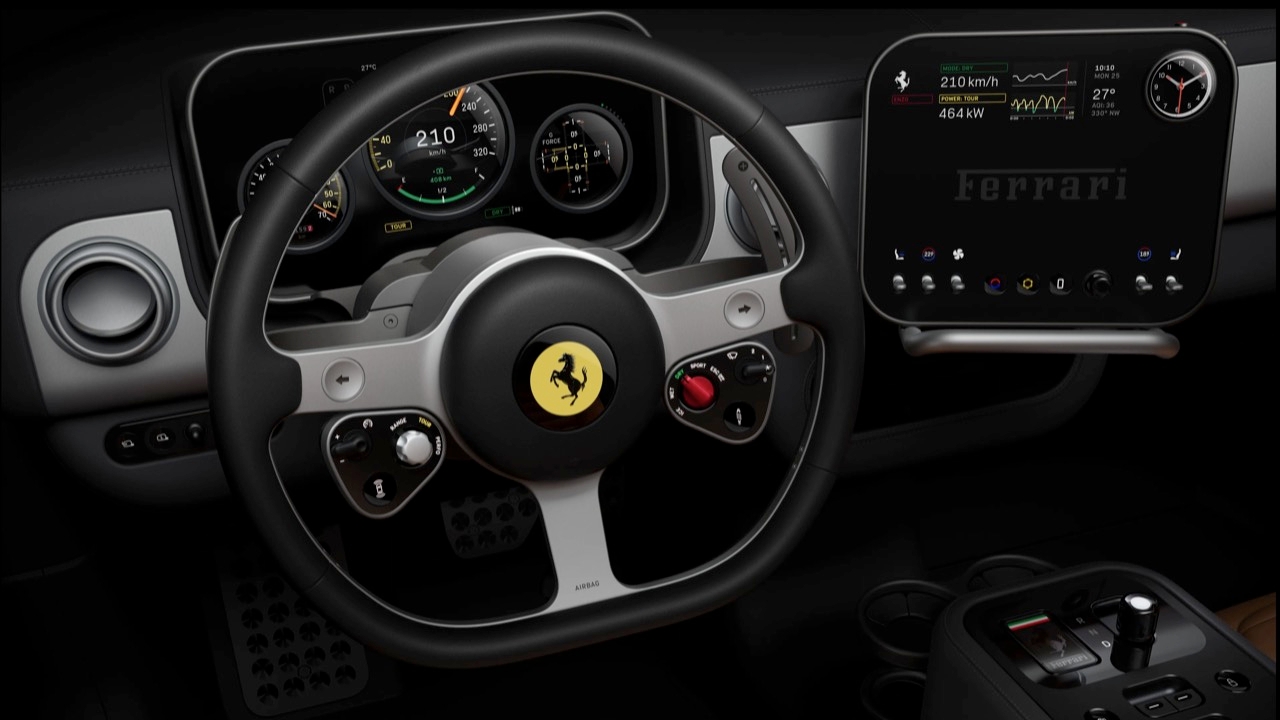
The interior equipment that Thairath automotive fans are currently viewing can be said to be the most important car interior design ever created. It is meticulously designed and installed in the Ferrari Luce, the brand's first electric vehicle. This unveiling of the ultra-cool interior is the second of three stages in launching Italy's first electric car. Why is the retro-style interior so crucial for the Prancing Horse brand? Because it is the design work of Sir Jonathan Ive, the man who directed Apple's design, working alongside Steve Jobs. In terms of design influence on broader culture, it is undeniable that both are among the most influential figures of the past 50 years.

Apple realized that their electric car project might not compete well against Chinese brands like Xiaomi, leading to the cancellation of their long-planned entry into the automotive market. This event sparked questions about Ive's departure from Apple to co-found a new design group called LoveFrom. Since 2019, Sir Jonathan Ive has freely explored new creative territories. As a close friend of John Elkann, Ferrari's chairman, the opportunity to collaborate with Ive—a car enthusiast—and Mark Newson, a visionary business partner, was irresistible. Ferrari's leadership could not refuse such talented collaborators, essential for transforming a drivetrain system that most customers have been reluctant to accept. Imagine what would happen if Sir Jonathan Ive were assigned to design Ferrari Electric No.1!

Five years later, the super sports world has reached a point of change. The Ferrari Luce's exterior will be revealed in May, but in some respects, LoveFrom's complete redefinition applied fully to the interior design and excellent usability is far more important. If you enjoy Apple products—MacBook Air, iPhone, Apple Watch—this car is for Apple fans. The team introduced a new perspective on automotive design with touchscreens shaped by past forms, showing how an electric Ferrari should be designed.
Certainly, in automotive design, small details are crucial. The main dashboard, three-spoke steering wheel, modular infotainment display, and Luce's human-machine interface (HMI) are simplified. The rear panel is aluminum, adorned with four beautiful ventilation outlets. Everyone who has driven modern cars knows that simplicity in this context is the hardest achievement.


"We wanted to explore tactile and attractive interfaces," Ive said at the Luce interior launch near LoveFrom's headquarters in San Francisco. "The most powerful aspects of analog displays were combined with digital screens. The fundamental understanding and architecture of the interface, the organization method, all make it much easier to use than before."
The dashboard and steering wheel are connected, a necessity for driving. The dashboard represents the outcome, while the steering wheel represents input. All controls are physical and mechanical, reminiscent of 1970s-1980s cars. The ergonomic design follows basic principles, excellence in materials, imagination, and creativity. Components were disassembled to show meticulous design and production, including seats (not cheap ones). The steering wheel's feel and the 12.86-inch dashboard of Ferrari Luce resemble a sculpture, with rounded edges and no plastic surrounding the steering shaft—indeed, no plastic is visible anywhere.


The main parts are made of anodized aluminum, precisely shaped and machined from solid metal blocks using advanced 3-axis and 5-axis CNC cutting technology. According to Ferrari, the result is a hexagonal cell structure on a thin surface with a microstructure that is both durable and visually appealing. Security screws are an unavoidable part of the manufacturing process, similar to Apple's use of Pentalobe screws. Even the screws appear beautiful and purposeful.


The steering wheel is made from specially developed aluminum alloy and is 100 percent recyclable. It consists of 19 CNC-machined parts. Beneath the main shaft are two small control buttons: on the right, a rotary dial adjusts Luce's powerful drivetrain system, estimated to exceed 1,000 horsepower (with Range, Tour, and Performance modes). On the left is a redesigned traditional Manettino dial for chassis settings, along with a button controlling rain-sensing wipers. Each button's tactile response is carefully tuned and user-friendly. Paddle shifters: the right paddle controls Luce's Torque Shift Engagement system to boost acceleration, while the left controls the regenerative braking system, which is also elegantly tuned and installed.


The dashboard design draws inspiration from aviation, especially old helicopter control panels from the Korean and Vietnam wars. There are three main dials; the center dial displays critical information. LoveFrom and Ferrari contracted Samsung to install ultra-thin OLED (organic light-emitting diode) technology with numerous pixels that can independently turn on or off. This provides true blacks, infinite contrast ratio, and parallax effects, allowing clear viewing from various cabin angles.

The graphics on the dashboard are inspired by the Veglia and Jaeger gauges found in classic Ferrari cars. The clock hands are real parts made from anodized aluminum, with 15 LED lights illuminating them from behind, reducing driver cognitive load. Naturally, the whole setup looks stylish. Additional control buttons are located on the upper panel near the rearview mirror, including a launch control button—another aviation-inspired design touch.

The central control screen, measuring 10.12 inches, is mounted on a ball-and-socket joint allowing rotation toward either driver or passenger. Operation is smooth, with a palm rest preventing accidental screen touches. The traditional-style air conditioning switches link to classic car interiors like the Bentley Continental S3, Bugatti Type 59, and Ferrari 250 GT Europa. The preference for old-style switches is not mere nostalgia but a functional choice superior to modern cars that cram all controls into screens, often compromising safety.

On the upper right of the screen, the multifunction display shows four functions: clock, stopwatch, compass, and launch control data. All use proprietary mechanisms with three independent motors and multiple complex gear sets, a remarkable achievement.
"We treated every element as if it were a film camera or an automatic chronograph watch," Ive said. "Nothing is vague or ambiguous. You can see how committed the entire team was. It’s like designing hundreds of products, but the overall feeling is unified and coherent. Over time, acceptance and admiration from the automotive industry will only grow."

The gear lever and center console are meticulously designed, using glass deliberately chosen by the design team. This is one reason the iPhone performs so well and is highly durable (using Gorilla Glass strengthened chemically by soaking in hot potassium salt baths). Corning, a longtime Apple supplier, created wonders inside Luce by developing techniques never before used in cars, producing a material called Fusion5® (Note: Corning, a historic glass and lighting manufacturer founded in 1851, originally made glass bulbs for Thomas Edison’s light bulbs).

Lasers were used to drill 13,000 tiny holes in the glass panel, into which graphic ink was injected. That area has a semi-matte surface to prevent fingerprints. The car key resembles current Ferrari keys, featuring the Prancing Horse logo on a yellow background. When the phone is placed on the magnetic pad beside the gear lever, the screen changes from yellow to black (using 'e-ink' technology). The control panel and main display light up, ensuring Ferrari Luce’s standout, superstar appeal is fully maintained.
Ferrari has not revealed the car’s price. Debate continues fiercely about the market size for extremely expensive, high-performance electric vehicles. Most customers already understand the advanced engineering behind Luce; only the car’s shape remains to be unveiled. Recently, the interior on display added highlights not seen for over 50 years—a very smart and courageous move by Ferrari, considered a pioneer in reviving classic design elements with perfect harmony.


The 1960s and early 1970s were Italy’s golden era.Luce is the era’s automotive icon for the globally renowned brand. Initially,it was expected to be called Elettrica, but that seemed outdated. The name Luce gives the car a unique identity. Today, in the consumer electronics world, obsolescence is something to be eliminated, but this car features timeless elements that will endure. That is key to Ferrari instilling spirit into its new electric car. As customers age, they recognize that change may be irreversible, yet Luce magnificently revives memories of the past.