

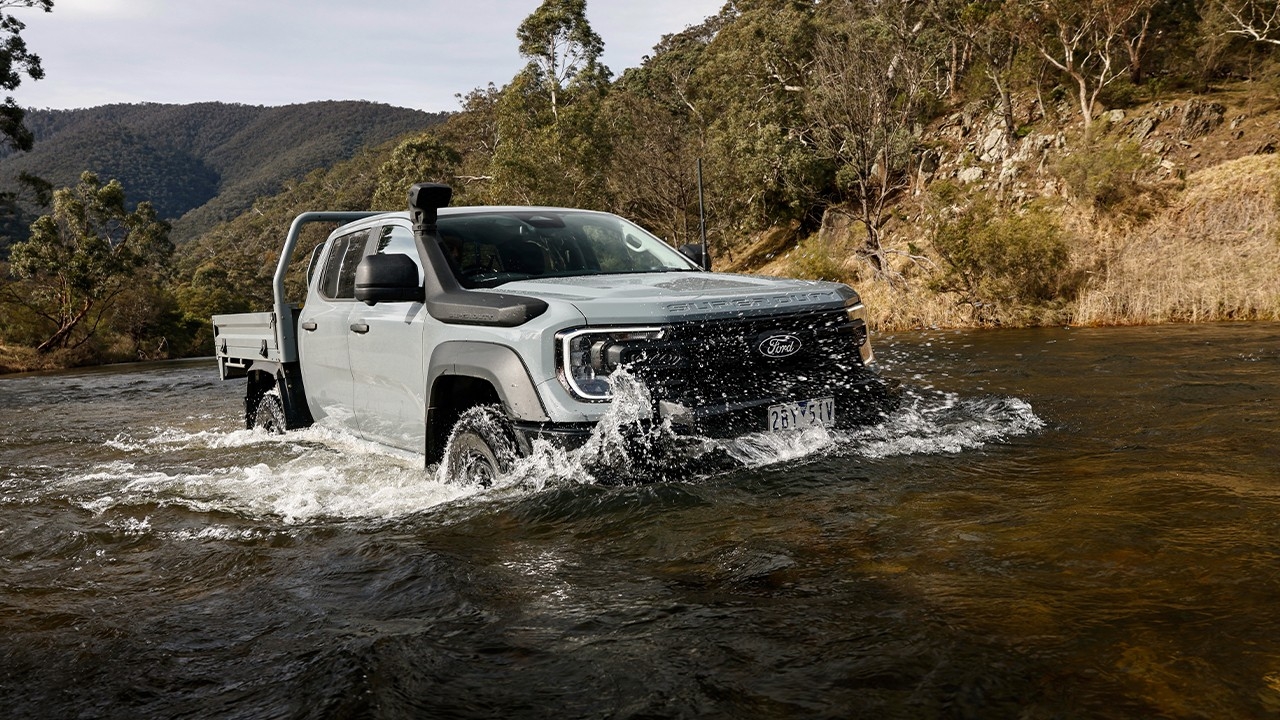
An inside look at the design of the Ford Ranger Super Duty, crafted to be a fierce load-carrying pickup as strong as a horse yet as nimble as a mountain goat.
Jeremy Welsh, Special Projects Manager for Heavy-Duty Automotive Engineering at Ford Australia, who has been involved since the start, recalled users saying many were stuck with the idea that they always had to compromise. Vehicles capable of carrying heavy loads were often too big and bulky to navigate narrow routes, while those that could go further lacked sufficient load capacity for real work.
The clear goal was to develop a vehicle that could carry heavy loads while delivering driving performance capable of tackling rugged terrain efficiently.
Drew O’Shannassy, Project Engineer for the Ford Ranger Super Duty, said, "We set the design engineering target for this pickup to handle loads up to 1,982 kilograms. But what good is that strength if it can’t get you where you need to go? We had to build a truck tough enough to carry the load and reach every location, delivering on heavy missions wherever needed."

Compared to the standard Ford Ranger, the Ford Ranger Super Duty stands out with a thicker, stronger chassis structure, reinforced axles, and the toughest rear differential ever used in a Ford Ranger. It also features a more durable drivetrain for better low-speed driving. Additionally, it adopts an 8-bolt wheel hub design from the F-Series Super Duty line for more efficient load distribution and capacity.
The Super Duty’s wheelbase width was extended by 90 millimeters, matching the Ford Ranger Raptor, and it comes with 33-inch All-Terrain tires that raise ground clearance to 299 millimeters. It includes long-travel suspension front and rear to improve off-road performance, and to boost confidence in all conditions, engineers installed locking differentials front and rear plus 4-millimeter-thick steel skid plates for underbody protection.

However, the true test wasn’t in the parts but in Ford’s grueling testing program. The Ford Ranger Super Duty endured longer and harsher off-road trials than ever before, including repeated high-speed mud runs accumulating over 600 kilograms of mud on the vehicle, as well as scenarios designed to push it to its limits.
These tests aimed to fully exercise the off-road steering assist features, extend travel over speed bumps under heavy loads, and many other trials—all designed to prove maximum strength and durability for real-life use, which often involves facing off-road challenges throughout the vehicle’s lifespan.
Beyond Ford’s U-Yangs Proving Ground, engineers sought out extreme adventure routes across Australia for severe testing. One such route is known as Rocky Track, a punishing path so narrow it barely fits the vehicle, strewn with steep, jagged rocks.
Rob Hugo, Automotive Engineering Supervisor, said, "Rocky Track isn’t a route typical four-wheel drives can tackle, but the Ford Ranger Super Duty isn’t an ordinary vehicle. We didn’t just drive it up Rocky Track; we conquered it while carrying over 1,000 kilograms of payload in the bed."

"We fully understand that owners will take their vehicles on such rugged routes, so it was vital for us to personally conduct testing on these terrains," he added.
Moreover, engineers took the Ford Ranger Super Duty to harsh desert environments in remote Australia, stayed on cattle farms in Queensland’s rugged outback, and worked alongside rural fence teams—handling towing, heavy load carrying, and enduring strong, continuous impacts from speed bumps.
"We traveled thousands of kilometers and endured tens of thousands of speed bumps," the team reported.
O’Shannassy added that it wasn’t only Ford engineers who experienced and tested the Ranger Super Duty’s performance. They spent weeks with groups Ford designed the vehicle for, closely monitoring their usage and operating the pickups exactly as the users did.

With superior capability, the vehicle could access routes those users couldn’t and carry loads they couldn’t manage. "This is a true source of pride—to deliver a pickup truck that precisely meets their needs, just as they told us," he said.
All this was not merely about ticking off test checklists but a further proof of toughness. It confirmed that the team developed a heavy-duty, rugged pickup to provide customers with a vehicle ready for real situations and capable of completing their missions as intended.