

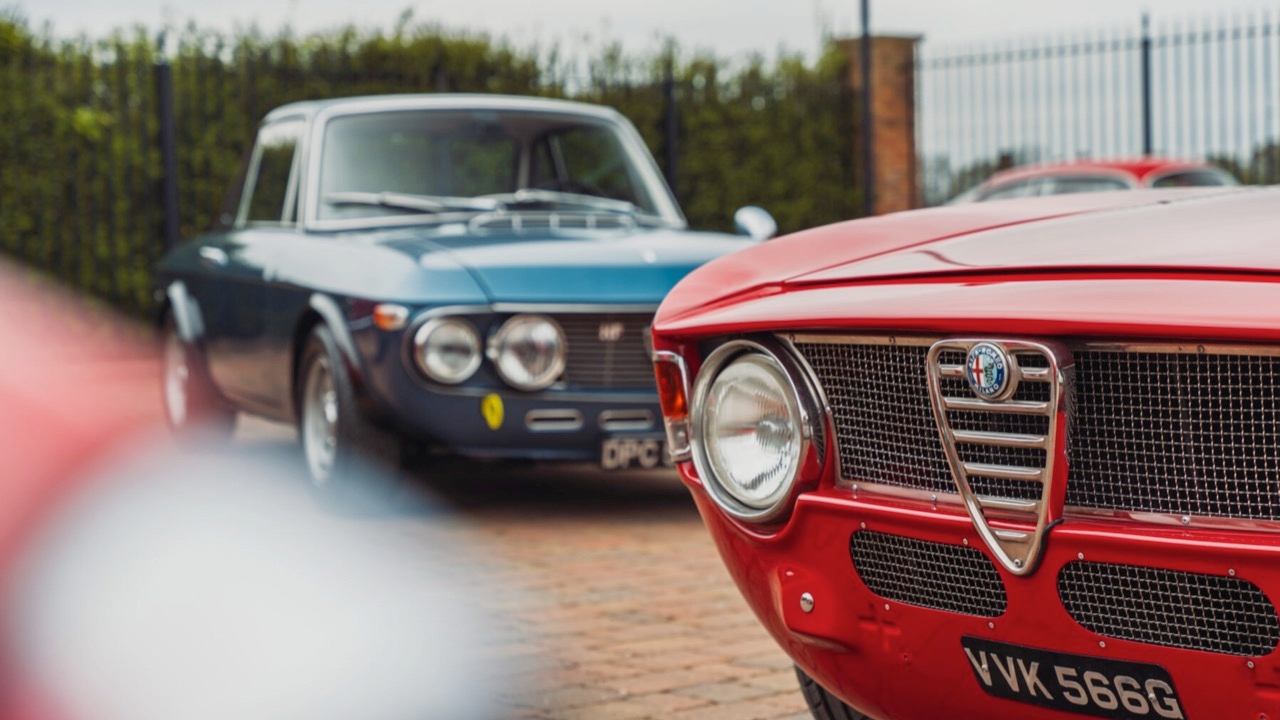
Collecting classic cars is not merely about owning old vehicles but a passion rooted in profound reasons. Here are five main reasons collectors fall in love with these cars.
1. Timeless artistic and design value: Classic cars often feature unique looks reflecting craftsmanship and design from an era before strict aerodynamics or safety regulations. Many regard them as "moving works of art."
2. Emotional attachment and nostalgia: Some models may have been childhood dream cars or hold personal memories linked to family and past moments. Owning and driving them feels like traveling back to those times.
3. Analog driving experience: Classic cars offer a raw, direct feel without complex ECUs or electronics interfering. Engine sounds, carburetor intake noise, exposed air filters, vibrations, and the need for full driving skill create a charm modern cars lack.
4. Pride in maintenance and restoration: For collectors, sourcing rare parts and restoring a car to its original beauty brings joy and challenge, forging a strong bond between owner and vehicle.
5. Investment appreciating over time: Many classic cars are rare with limited supply, causing their value to rise over time. Collectors see them as tangible assets that offer good returns alongside ownership pleasure.
Passion for cars since childhood is not merely about "machines" but tangible memories that deeply influence current preferences through these factors.
Symbol of imagined success: Cars seen in ads, posters, or films like Fast & Furious were "dream cars" once out of reach. Owning them as adults fulfills promises made to oneself long ago.
Emotional anchor: Cars serve as "memory vessels." The unique scent of leather seats or engine start sounds can evoke holidays with family or feelings of safety from childhood back seats.
Heritage inheritance: For many, classic cars are heirlooms connecting generations, such as repairing the same car once driven by fathers or grandfathers, creating bonds through care and skill transfer.
Yearning for simplicity: In a world of complex modern cars, older vehicles offer a "real" and "controllable" feel. Manually rolling windows or shifting gears gives a simple freedom reminiscent of the past.
Distinct identity: Older cars have standout designs and strong personalities. Collecting models ingrained from early brand recognition reflects personal identity and taste shaped since childhood.


Volkswagen Beetle
The "Beetle" is a timelessly popular car in Thailand, with enthusiasts mainly divided into two groups: those focusing on vintage classic style and those favoring modern designs like the New Beetle and The Beetle.


The classic Beetle (Type 1) is highly sought after by collectors, with popular sub-models in the used market and car shows. The "Sweet-eye" model (1960-1967) is the most favored in Thailand, known for its soft, angled headlights, especially the 1962 model often restored. The "Straight-eye" model (from 1968) has upright headlights complying with safety laws, less popular but still in demand. Beetle 1300/1500/1600 are common engine codes in Thailand; the 1300 is noted for fuel economy and easy-to-find parts.


Prices vary by originality and restoration level. Project cars needing work start around 350,000-450,000 baht. Well-restored "Straight-eye" models range from 498,000 to 650,000 baht. Popular "Sweet-eye" models in show or collectible condition can reach 800,000 to over 1,200,000 baht, depending on seller and buyer satisfaction.


MINI Classic
Classic Minis popular in Thailand span several production eras. The most commonly seen and used today is the Rover Mini, being more modern. Legendary collector models include the Austin Mini and various special editions.


Popular and collectible models in Thailand include the Rover MINI (1969–1986/2000), favored for daily use with added comforts like air conditioning and inward door hinges. Engine-wise, models from 1997–2000 use easier-to-maintain single- or multi-point fuel injection instead of carburetors. The Austin Mini (especially 1959–1969) is the original MINI highly valued by Thai collectors, particularly the Austin Seven or Morris Mini-Minor, famously known as Mr. Bean's car with its distinctive compact design.


Classic Mini prices in Thailand vary widely depending on condition and registration type. Popular Rover and Austin Minis typically trade in the mid-hundreds of thousands to nearly two million baht on the used market.


Estimated secondhand MINI prices in Thailand (2025-2026): Austin Mini (1960s–1970s) general models range from 600,000 to 1,200,000 baht depending on restoration extent. Rare variants like Mark 1 in good collectible condition with original registration can reach 1,690,000 baht or more. Budget older MINIs needing repair or parts replacement, repainting, or rewiring can be found as low as about 158,000 baht, awaiting restoration.


BMW 2002
The 2-door 02 Series sports sedan made a significant name between 1968-1976, laying the foundation for BMW's performance and driving pleasure legacy. The BMW 2002 model popular in Thailand was a stylish coupe favored by affluent young professionals for its design, durability, performance, and safety. Common models are grouped by production years and engine development.
BMW 2002 (base model): Produced from 1968, equipped with a single carburetor engine delivering 100 horsepower.
BMW 2002 ti: A higher-performance version with twin carburetors producing 120 horsepower.
BMW 2002 tii: Introduced in 1971, featuring mechanical Kugelfischer fuel injection with 130 horsepower, highly popular among collectors.
BMW 2002 Turbo: Launched in 1973, Europe’s first factory turbocharged car, delivering up to 170 horsepower.


Engines and performance: All use the M10 2.0-liter (1,991 cc) SOHC inline-4 engine, known for durability and tuning ease. Top speed: the 2002 tii reaches about 185-186 km/h; the Turbo up to 211 km/h.
Acceleration 0-100 km/h: The base 2002 with carburetor does it in 10.9 seconds; the tii with injection in 9.4 seconds; the Turbo in 8.6 seconds.
Transmission: Mostly 4-speed manual; optional 3-speed automatic introduced in 1969; special editions have 5-speed manuals. The car’s handling, suspension, and control distinguish it from contemporaries, featuring independent front MacPherson struts with anti-roll bars and rear semi-trailing arms for excellent grip and precise cornering. Front brakes are disc, rear drums; tii and Turbo have upgraded larger discs and calipers.


BMW 2002's appeal lies in its light weight (around 940-1,030 kg) giving a good power-to-weight ratio. Its three-box design with thin roof pillars provides excellent all-around visibility. In Thailand, a dedicated BMW 2002 Club gathers enthusiasts and collectors.
Current BMW 2002 prices in Thailand depend on vehicle condition and parts authenticity rather than standard market pricing. According to the Facebook BMW 2002 Thailand group and used car websites, prices can be grouped as follows:
Project cars needing work: Around 150,000–350,000 baht, often with incomplete engines or bodies requiring restoration.
Driveable or partially restored: Approximately 400,000–700,000 baht, mostly carburetor models with exterior detailing done but some non-original parts.
Collector grade/tii models: Starting from 800,000 baht up to over 1,500,000 baht. Well-preserved 2002 tii models with matching numbers and rust-free bodies command high prices.
The rare BMW 2002 Turbo commands prices often exceeding 3,000,000 to 5,000,000 baht, depending on auctions and buyer-seller agreement, as it is a globally coveted rare item.
Price check precautions:


Alfa Romeo GTA (Gran Turismo Alleggerita)
The 1965 Alfa Romeo Giulia Sprint GTA is one of Alfa’s most beautiful cars, originating from the small tuning firm Autodelta, founded in 1963 by two former Ferrari engineers, Carlo Chiti and Ludovico Chizzola. Autodelta began as an independent racing car tuning company. Thanks to Chiti’s good relations with Alfa Romeo’s top management, Autodelta was entrusted with developing Alfa’s racing cars. It became a registered company in 1964, moving from Udine in northeast Italy to Milan, near Alfa Romeo’s headquarters. Alfa Romeo acquired Autodelta in 1965, integrating it into the Alfa Romeo Works Racing team.
A standout classic Alfa Romeo coupe from 1971, highly sought after by Thai classic car enthusiasts, is the GTA family (Gran Turismo Alleggerita), especially the 1971 GTA 1300 Junior model featuring an aluminum body.
In 1971, most Alfa Romeos in the 105/115 series (like the 1750 GTV or 2000 GTV) had steel bodies, but models designed for racing or exceptional lightness used aluminum.
Alfa Romeo Giulia GTA 1300 Junior (1968–1975): This model perfectly fits the profile as a coupe still produced in 1971. The "A" stands for Alleggerita in Italian, meaning "lightened," achieved by replacing steel body panels with aluminum, reducing the car’s weight to about 760–920 kilograms.
Alfa Romeo 1750 GTAm: A racing car developed from the 1750 GTV. Though mainly steel-bodied, it used aluminum and plastic parts in some areas to reduce weight per 1970-1971 racing regulations.


In Thailand, the Bertone Coupe series (named after its designer) is highly popular among European classic car collectors due to rarity. Genuine aluminum-bodied GTA cars are very rare and mostly imported, commanding high prices and strong demand. Because aluminum-bodied GTAs are expensive and scarce, many Thai enthusiasts modify 1971 steel-bodied GT 1300 Junior or 1750 GTV cars into GTA replicas by replacing parts with aluminum or lightweight materials, emulating race car styles of that era. The 1971 engine is a distinctive Twin Cam aluminum head engine, known for its sweet sound and high revving, especially when well maintained.


The 1971 Alfa Romeo coupe with an aluminum body (or whose panels sound different than steel when tapped) is the GTA 1300 Junior or a GTAm-style modified car, a legendary icon in Thailand.
Current Thai market prices for Alfa Romeo GT 1300 Junior and 1750 GTV (2024–2026) are rising steadily with the global classic car trend, categorized by condition as follows:
Alfa Romeo GT 1300 Junior is the most popular base model for restoration or GTA-style modification.
Project car needing restoration: Approximately 1,200,000–1,500,000 baht (very rare and mostly kept for personal restoration).
Good/fair condition, drivable: About 1,800,000–2,500,000 baht.
Excellent/restored condition: Prices can reach 2,800,000–3,500,000 baht, depending on paint quality and use of original parts. Price fluctuations in Thailand are influenced by registration authenticity; cars with genuine transferable registration command higher prices than "assembled" or unregistered vehicles.


BMW 3.0 CSL (1972–1975) – The Legendary "Batmobile"
The 3.0 CSL was developed for the European Touring Car Championship, emphasizing weight reduction (CSL stands for Coupe Sport Lightweight). Production started in 1972, with engine upgrades from 3.0 liters to 3.2 liters in 1973. The 1973 model uses a 3,153 cc inline-6 engine producing around 206 horsepower. A distinctive feature is its aggressive aerodynamic kit, earning it the nickname "Batmobile," including a large rear spoiler and roof fin to increase downforce. Aluminum was used for the hood, doors, and trunk, reducing curb weight to about 1,270 kilograms.


Engine development: The 6-cylinder M30 engine evolved through three main stages:
First generation (1971–1972): 2,985 cc with twin Zenith carburetors, producing 180 horsepower.
Second generation (1972–1973): Slightly enlarged to 3,003 cc with Bosch D-Jetronic fuel injection, delivering 200 horsepower.
Final "Batmobile" version (1973–1975): Enlarged to 3,153 cc, producing 206 horsepower and 286 Nm of torque.

Transmission: Standard 4-speed manual Getrag gearbox for road versions, with variable final drive ratios by engine type. Racing versions featured 5-speed dogleg manuals. Suspension and brakes: Front MacPherson struts with coil springs; rear semi-trailing arms. The 3.0 CSL had 20 mm shorter springs and Bilstein gas shocks for improved handling. Brakes are four-wheel vented discs.


Performance: Top speed around 220 km/h. Acceleration 0-100 km/h in about 6.9–7.1 seconds. Weight ranges between 1,165–1,270 kg (approximately 200 kg lighter than the standard 3.0 CS) due to aluminum body panels and plexiglass windows in some areas.
The BMW 3.0 CSL is a foundational model for the BMW M series and remains one of the most sought-after collector cars worldwide.


Prices for the BMW 3.0 CSL (1972–1975) E9 classic in Thailand are not standard like new cars but depend on condition and authenticity. Globally, pristine cars trade between $200,000 and $400,000 (7-14 million baht) depending on history and chassis codes. In Thailand, transactions are rare; asking prices often exceed 10-15 million baht for genuine, well-preserved examples.