

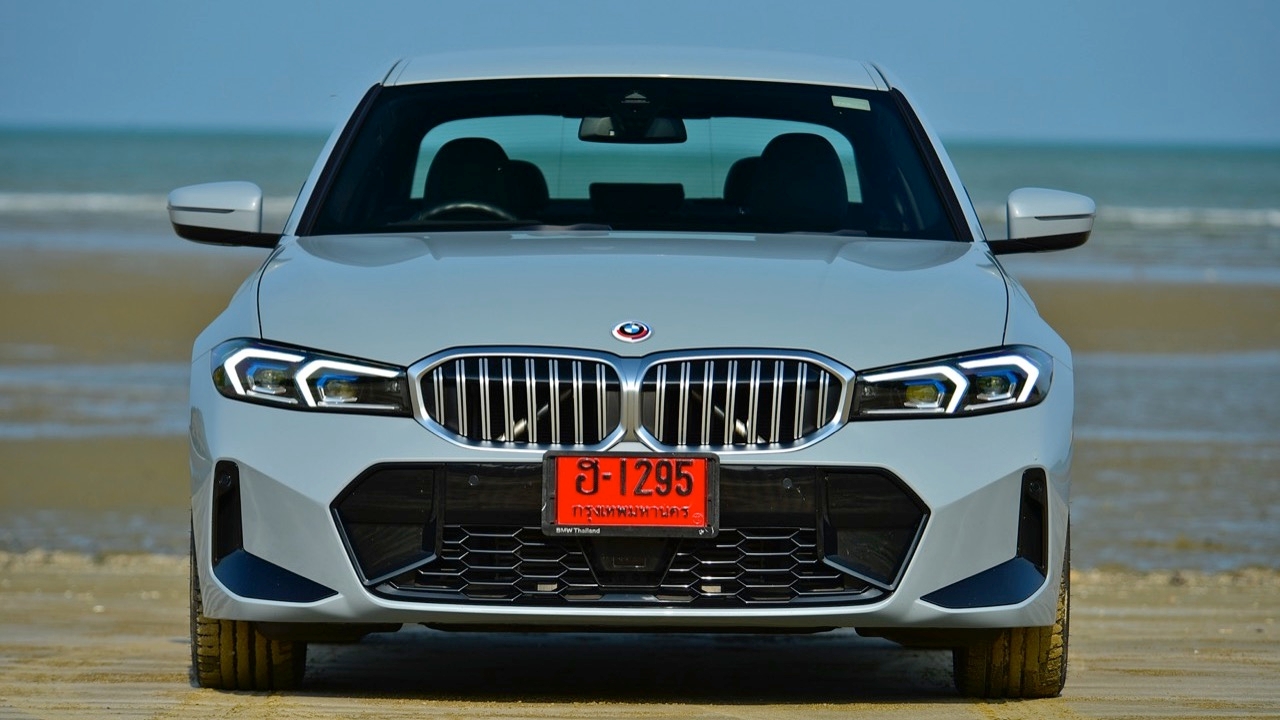
The Life Cycle Impulse (LCI) BMW 320d M Sport comes fully equipped with appealing looks, advanced drivetrain technology, and complete Series-3 convenience features. This final facelift before an upcoming redesign includes a full set of equipment. Being domestically assembled, the 320d M Sport LCI is priced at 2,699,000 baht. Calling it the best falls short, and calling it excellent doesn't quite fit either. Simply put, the Series-3 320d M Sport LCI stands unmatched among competitors. The diesel engine can cover nearly 1,000 kilometers on a single tank. BMW Series-3’s illustrious history ensures this latest sedan drives as well as rivals, enhanced by sporty styling, suspension, and diesel powertrain designed to outmatch competitors in its segment.


The facelifted BMW 320d Sport G20 is an exciting sedan with a serious appearance, featuring a new grille and well-proportioned headlights. The new grille includes an automatic open-close system that keeps it closed to reduce air resistance when the engine is cold, then opens automatically as the engine warms to cool the radiator. This automatic grille operation, combined with electric fans, helps lower engine temperature and improves aerodynamic drag coefficient. The new elongated LED taillights complement the clean rear design. The 320d M Sport is refined into a sportier sedan with a unique driving character, embracing a new era of environmental consciousness alongside the latest infotainment system. Its 2.0-liter turbo diesel engine emits low pollution, delivers decent torque, and offers reliable durability. This car delivers spirited driving, fuel efficiency, and a cleaner profile than before.


Customers upgrading from Japanese cars to the Series-3 naturally have high expectations. The car’s size balances well with its body dimensions, which have grown larger — a common engineering challenge for modern vehicles. The BMW 320d M Sport measures 4,709 millimeters long, 1,827 millimeters wide, and 1,435 millimeters high, weighing 1,530 kilograms. Its larger body compared to the F30 Series-3, combined with a longer wheelbase, means the interior space nearly matches that of the Series-5 G30, especially in the front seats. The 320d M Sport LCI rolls on new 18-inch 5-spoke M alloy wheels sized 7.5Jx18, paired with Michelin Pilot Sport 4ZP tires—225/45R18 95Y front and 255/40R18 89Y rear.


Powered by a 2.0-liter inline four-cylinder diesel with BMW TwinPower Turbo, paired with an 8-speed ZF automatic transmission, the suspension offers a sporty feel reminiscent of excellent 1990s handling cars. In Eco Pro mode, fuel consumption reaches 15.7 km/l, while in Sport mode, it drops to 11.7 km/l. The B47D20 2.0L I4 turbo diesel engine produces 190 horsepower and 400 Nm torque, with clean emissions of just 122 grams CO2 per kilometer. The Series-3 facelift is meticulously assembled by BMW technicians at the Rayong factory, meeting brand standards. This factory has been assembling Series-7 cars for over 30 years. The 320d M Sport’s interior and exterior trims are similar to the 330e, except for alloy wheels. It boasts a fully equipped M styling package refined for the facelift. The sporty suspension pairs well with the Servotronic electric steering, which has variable ratios. There are three driving modes—ECO PRO, COMFORT, SPORT—with an INDIVIDUAL setting allowing customized engine, steering, and transmission responses.


The 320d LCI’s interior retains BMW’s signature style, despite competitors like the C-Class C220d W206 offering highly tech-focused cabins. BMW continues to provide a snug, driver-focused seating position. Interior controls are designed for ease of use. The leather seats are well-padded, and the front seats offer electric adjustments with smooth downward movement. The instrument cluster and central monitor have a simple layout reminiscent of some Chinese cars. The modern TFT display features sharp graphics and a multi-information display (MID) positioned well. The M leather steering wheel includes paddle shifters, but the short, stubby gear lever resembles a switch, prompting some to prefer the previous gear lever design.


Sharp aluminum mesh-effect trim adorns the dashboard and door panels. The new gear lever is a tiny, oddly shaped switch used to toggle through R, N, D/S positions. BMW acknowledges traditional customer needs by retaining the iDRIVE controller, though button layouts have changed. The engine start button is now located next to the gear lever. The 320d M Sport’s interior feels luxurious and special, thanks to quality materials and craftsmanship—leather, aluminum, and premium plastics. This modern BMW interior departs from the brand’s traditional heritage, embracing a high-tech, digital world.


The LCI version of the 320d Sport G20 features a high-tech monitor integrated with the instrument cluster, offering more functions than before (OS 8.0). It includes a new satellite navigation system and enhanced connectivity options. Fuel consumption data, vehicle settings, and other systems are newly accessible. The infotainment screen supports Bluetooth music streaming and USB connections. It also displays controls for exterior and interior lighting, including ambient lighting with 11 color options. Tire pressure monitoring for all four wheels, weather and temperature alerts are shown. The monitor can be operated via the iDRIVE controller or light touchscreen input. The 320d M Sport includes a rearview camera and proximity sensors for obstacle warnings during reversing. The BMW HiFi speaker system delivers clear sound but remains less powerful than the Harman Kardon system found in the 330e M Sport and M340i.
The new three-zone climate control in the New Series-3 has a smaller footprint and simplified controls. Air vents are rectangular with silver rotary knobs to open or close them. The center console behind the gear lever includes rear passenger air vents and a digital control panel for the rear air conditioning system.

The facelifted BMW 320d M Sport upgrades its operating system from 7.0 to 8.0, marking a major overhaul of the car’s infotainment. It features a 12.3-inch instrument cluster display and a 14.9-inch central touchscreen, merged into a single curved panel angled toward the driver for easier use. Screen resolution increases to 200 ppi, and the software is fully upgraded for better connectivity and more natural voice control. The familiar 5-way iDrive rotary controller remains, facilitating easy selection and adjustment of vehicle functions, though users will need to adapt to the completely redesigned graphics.


The new panoramic curved display combines the instrument cluster and central monitor into one unit with three customizable display modes. Graphics include hybrid energy meters that switch to a tachometer on the right, or centralize navigation, infotainment, or safety system alerts, including driver assistance information. The instrument cluster changes color based on driving mode—for example, blue for Electric/Hybrid, red for Sport. This digital display shows driving data with tachometer and speedometer readings that may be somewhat challenging to read due to graphic style. The TFT LCD cluster works seamlessly with the central monitor, controllable via the iDrive controller, touch input, or voice commands. BMW Operating System 8 and later versions are installed in new models sold in Thailand, including the New Series 3, Series 7, X7, iX, XM, and M2, M3, M4.
The redesigned gear selector is a small rectangular switch operated by finger movement to toggle through R, N, D/S positions. Though stylish and modern, it can feel unusual to use. This ZF-8HP gear lever design is found in nearly all new BMW models except M cars. To the left of the gear lever are numerous controls: traction control, a large silver engine start button, an automatic reverse assist button with camera, driving mode selectors (SPORT/COMFORT/ECO), Auto Brake Hold, and electronic parking brake. Also on the left is the new multifunction iDRIVE 8 controller linked to BMW’s Live Cockpit Professional, featuring Thai language menus and a vast array of functions. The improved Thai voice command system responds well to spoken instructions.


The performance and efficiency of the 320d G20 deliver strong value, especially the impressive fuel economy, allowing nearly 900 kilometers on a full tank. The 3-Series G20 is a sleek four-door sedan with excellent driving dynamics, blending German engineering focused on handling with modern design. As a significant revenue generator for BMW Group, management strives for its success. In city driving, the 2.0-liter turbo diesel 190-hp engine doesn’t shine due to heavy traffic, and noise insulation is standard. The spacious cabin, akin to a Series-5, helps occupants feel comfortable during stop-and-go traffic. Music lovers can use audio to ease stress caused by chaotic traffic. The new iDRIVE system simplifies menu navigation and controls, featuring a touchscreen. Three driving modes (ECO PRO, COMFORT, SPORT, plus INDIVIDUAL) are easily selected via a switch beside the gear lever.


The 2.0-liter turbo diesel engine runs smoothly with minimal noise. Maintaining a steady speed between 110-120 km/h, engine revs hover around 1,600-1,800 rpm thanks to the ECO mode transmission, which shifts to higher gears to lower revs. The B47D20 2.0L I4 turbo engine delivers 140 kW (190 hp) at 4,000 rpm and 400 Nm torque from 1,750 to 2,500 rpm, sufficient for normal use. The 8-speed ZF automatic transmission shifts seamlessly without jerks. The BMW 320d M Sport LCI accelerates 0-100 km/h in 6.8 seconds with a top speed of 240 km/h. At cruising speeds, the Series-3 remains stable and composed. The steering gains weight in Sport mode, and throttle response sharpens with aggressive acceleration to match higher-speed driving dynamics.


The 2.0-liter diesel engine’s multi-stage turbocharging outperforms older 6-cylinder diesel engines. Turbo lag is barely noticeable during extensive testing, making the 320d Sport G20 feel like a powerful naturally aspirated sedan thanks to excellent engine response. Imported models sold by BMW Thailand all have 190 hp and 0-100 km/h acceleration in 6.8 seconds. The Thai-assembled version is priced reasonably, offering ample power and comprehensive performance for BMW enthusiasts.


The diesel engine’s 400 Nm torque matches the previous 320d F30 model. The stiffer suspension revives the classic Series-3 driving feel in the New 3-Series, paired with new electric steering that is precise, sharp, and well weighted. The firmer suspension and steering may surprise female drivers, especially after criticism that the F30’s setup was tailored for women. The latest 3-Series models have slightly firmer suspensions for improved grip. The G20 LCI’s dynamic tuning addresses past complaints: at higher speeds, steering feels heavier and suspension slightly stiffens to boost confidence in cornering. The suspension won’t soften; it prioritizes stability with firm, composed handling. This dynamic character exists across the 3-Series and 4-Series lineup, from 320d, 330e, M340i to 430i and M440i.


The 3-Series LCI’s 4-cylinder diesel engine responds directly in selected modes. COMFORT is the default mode for city and highway driving, engaged each time the car starts. The electronic throttle responds smoothly to pedal input. The ZF transmission shifts up smoothly to reduce engine revs. The electric steering offers precise handling with good weight. The diesel’s 400 Nm torque delivers smooth yet ample power for overtaking. Engine revs tend to hang at diesel-characteristic levels when driving fast. German engineering’s hallmark stable ride emerges above 150 km/h. Strong torque, sporty suspension feel, and sharp steering make the 320d ideal for varied driving needs of European car enthusiasts (though I can only afford Japanese cars).


The sport suspension and low-profile Pilot Sport 4ZP tires absorb road joints well without overly large wheels. The sport suspension transmits noticeable vibrations over rough roads. The 8-speed ZF transmission operates smoothly even at high speeds. In Sport mode, it holds 4th gear longer to maintain torque. Manual shifting via the gear lever remains smooth, though it’s advisable to use brakes when downshifting rather than relying solely on the transmission. The 8-speed gearbox features revised gear ratios that feel natural and smooth, with precise gear engagement tuned to engine speed.


The facelifted 3-Series delivers solid performance as a sedan designed for mixed driving styles. It can be quick or steady and is economical in city traffic. The suspension feels stiff, a typical trait of past Series-3 models focused on performance, carried into the present. The steering is precise and quite heavy but turns sharply. Excellent steering weight across speeds aids directional control. Adaptive LED headlights feature automatic mechanisms to adjust beam direction freely, enhancing visibility on unlit roads and improving nighttime safety. Fuel efficiency is satisfactory; cruising gently yields 15.7 km/l, reducing fuel stops on long trips.


The 2025 BMW 320d M Sport LCI uses the B47 engine, regarded as one of BMW’s "most durable and reliable" diesel engines currently. The B47 improved on previous weaknesses, especially timing chain issues found in the N47, enhancing stability and durability. With proper maintenance, this engine can last over 250,000 to 300,000 kilometers. Changing the transmission oil and filter every 40,000-50,000 km is crucial to prolong the costly transmission's life. Diesel engines generally outlast plug-in hybrids over 7-10 years, with more predictable maintenance and no high-voltage battery risks. However, certain common issues require attention over time, such as EGR valve clogging and DPF blockage from excessive city driving without long-distance regeneration. Key maintenance is timely oil changes with the specified grade to protect the turbo and internal parts. With this care, you’ll enjoy a superb German diesel that performs excellently and lasts long. In brief: it’s a worthwhile investment.