

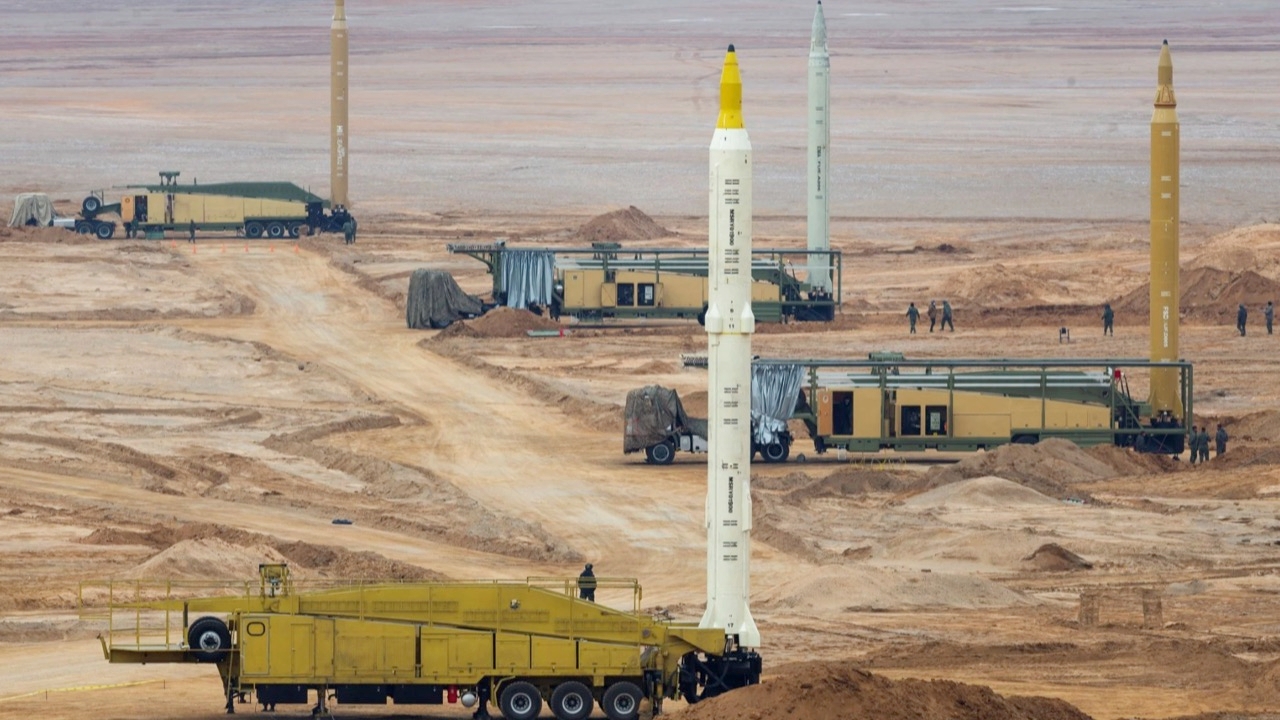
History shows Iran strives to carefully balance demonstrating resolve to maintain face while avoiding escalation that could threaten the regime's interests. If U.S. attacks are limited in scope, Iran's responses tend to be measured and restrained, sometimes using proxies to ease tensions. Tehran is aware that the U.S. possesses stealth aircraft and ground-attack missiles ready to target its missile bases, necessitating launches from multiple sites combined with drone swarms and storing many missiles in underground bunkers safe from attack. During the 12-day war with Israel in June 2025, Iran fired about 550 missiles alongside over 1,000 one-way attack drones, averaging 45 missiles and 83 drones daily. This represents a reasonable planning assumption for the current crisis. U.S. military interception rates are likely similar to Israel's at 85–90 percent. Iran may integrate such attacks with efforts to jam U.S. drone signals. Iran regards its missiles as a key bargaining chip and essential for deterrence, meaning hypersonic missiles must be reserved for full-scale confrontations, as occurred on 28 February 2026.


Before the attack, Western media speculated that regional dynamics would limit Iran's attack size, making it unlikely Iran would strike U.S. bases in Saudi Arabia. However, this was not the case. Iran has support from China, Russia, and North Korea. The widespread strikes on American bases across the Middle East demonstrate Iran's lack of fear toward regional powers like Saudi Arabia, the UAE, and Jordan, who could be drawn into the conflict. This implies that Iranian retaliation is likely to target all locations hosting American military bases.
Iran possesses the largest missile arsenal in the Middle East. According to the U.S. National Intelligence Directorate, Iran's military fields dozens of missile types with ranges of 2,000 kilometers, which Iranian officials say are sufficient to protect the country, as they can comfortably reach Israel.
The Iranian Revolutionary Guard's weapons stockpile includes a variety of long-range missiles, both indigenously developed and acquired from Russia and China, capable of striking Israel with ease. According to the Center for Strategic and International Studies, these include:


Sejil missile with a range of 2,000 kilometers.
The Sejil is a two-stage solid-fuel medium to intermediate-range ballistic missile (MRBM), approximately 18 meters long with a diameter of 1.25 meters. It has a launch weight of 23,600 kg (23.6 tons) and carries a warhead payload of 700 kg for maximum range of 2,000 km, or up to 1,000 kg for shorter ranges of 1,000 km. Its range can potentially reach 2,200–2,500 km in the Sejjil-1/2 variants. It has been in service since about 2012 and was actively used in the 2025 operations against Israel.


Emad missile with a range of 1,700 kilometers.
The Emad missile features a redesigned and improved reentry vehicle (RV) with fins that enhance stability, maneuverability, and accuracy. Its RV is larger than previous models, allowing it to carry heavier warheads. Emad has a 1,700 km range, 500-meter accuracy, and can carry a 750 kg warhead. Due to its range, it is classified as an MRBM rather than an IRBM or ICBM. Its warhead capacity is slightly less than the Ghadr missile when not fitted with the Emad RV.
In January 2021, Iran launched Emad anti-ship missiles targeting sea targets over 1,800 kilometers away in the Indian Ocean during the Great Prophet 15 military exercise. Multiple missiles were fired, including Sejjil and Ghadr, with several landing about 160 kilometers from a U.S. aircraft carrier in the ocean.


Ghadr missile with a range of 2,000 kilometers.
The Ghadr-1, or Ghadr, is a medium-range missile under development with an approximate 2,000 km range. It is a modified version of the Shahab missile. First revealed during a military parade marking the Iran-Iraq war anniversary, three types were produced: "Qadr S" with a 1,350 km range, "Qadr H" with 1,650 km, and "Qadr F" with 1,950 km. The Qadr-110 series carries warheads weighing 650 to 1,000 kg, measures 15.5 to 16.58 meters in length, and weighs 15 to 17.48 tons, making it about two tons heavier than the Shahab-3 basic model.
The Ghadr-110 is more maneuverable and requires only 30 minutes to prepare for launch, compared to several hours for the older Shahab-3. It is produced at Iran's highly secret Hemmat missile factory. In November 2015 and January 2017, Iran reportedly test-fired Ghadr-110 missiles. The U.S. views this as violating UN Security Council Resolution 2231, which calls on Iran to cease activities related to nuclear-capable missiles, including test launches.


Shahab-3 missile with a range of 1,300 kilometers.
The Shahab-3 missile is 15.6 to 16.58 meters long, with a diameter of 1.25 to 1.38 meters, and a range between 800 to 1,300 kilometers. Its warhead payload varies from 760 to 1,200 kilograms depending on the range. The estimated effective range is around 1,300 km but varies with warhead size and weight. Heavier, more powerful warheads, such as early nuclear types, have shorter ranges compared to smaller high-explosive warheads. The Shahab-3 can easily carry nuclear warheads, with a total launch weight around 17,410 kg.
The Shahab-3 uses a larger propulsion engine than the Scud missile, significantly extending its range without making it too large for its Transporter-Erector-Launcher (TEL). It employs a single-stage liquid-fuel engine. Iran's ability to build single-stage missiles with separable warheads marks a key advancement between short-range missiles with low payloads and multi-stage long-range missiles capable of heavier warheads.
The Shahab-3 uses a basic inertial navigation system similar to that of the 'Scud' missile, yielding an accuracy of about 2,500 meters (CEP). Early versions were effective against large targets such as cities. Later models incorporated Chinese navigation technology, greatly improving strike precision.


Khorramshahr missile with a range of 2,000 kilometers.
The Khorramshahr missile is about 13 meters long with a body diameter between 1.5 and 2.0 meters, and a launch weight ranging from 19,000 to 26,000 kilograms. Iranian officials state it has a 2,000 km range and can carry various warheads weighing up to 1,800 kg. Its actual range may exceed estimates, potentially reaching around 2,500 km. Multiple warheads refer to submunitions rather than independently targetable multiple warheads (MIRVs). It uses a two-stage liquid-fuel engine. Iranian media report that this missile can evade radar and advanced terminal guidance systems. If relying on older inertial navigation, Khorramshahr's accuracy may be relatively low, around 1,500 meters.


Hoveyzeh missile with a range of 1,350 to 2,500 kilometers.
The Soumar, or Hoveyzeh, is based on Russia's Kh-55 cruise missile design, but differs in that Hoveyzeh uses a solid-fuel rocket and is ground-launched rather than air-launched like the Kh-55. Initially, Iran claimed this new cruise missile could reach 3,000 kilometers. To achieve such range, Hoveyzeh would require external fuel tanks, reducing its effective range to about 2,500 kilometers. Russian missiles use turbofan engines. Analysts believe Iran cannot produce its own engine for the Soumar and is developing a turbojet engine named Tolou-4, similar to the French Microturbo TRI 60-2. Technically, sufficient turbojet thrust combined with more fuel, smaller warheads, and aerodynamic design could match turbofan performance, so it is reasonable to estimate Soumar's range between 1,350 and 2,500 kilometers.