

The important role of grease (Grease) is not only to help reduce friction but also plays a vital role in machinery and automotive systems as follows:
Most grease colors are added to help distinguish types and facilitate maintenance. In industry, colors symbolize basic properties and uses as follows.

1. General meanings of each color
Red: Usually multipurpose high-quality grease or lithium grease that resists heat and rust, suitable for wheel bearings and vehicle chassis.
Blue: Known for thermal stability, often used in parts operating at continuous high temperatures, such as electric motor bearings or high-speed machinery.
Green: Emphasizes excellent water resistance and washout protection, ideal for agricultural equipment, machinery operating in wet conditions, or marine equipment.
⚪ White: Typically white lithium grease that is clean and non-staining, or food-grade grease used in machinery that contacts food.
⚫ Black/Grey: Indicates molybdenum (Moly) or graphite additives for applications requiring extreme pressure resistance, such as heavy machinery in construction or mining.
Yellow/Amber: Generally basic grease for light lubrication tasks, like door hinges or cables.


Grease Color Indicates Its "Condition"
Color changes during use are important warning signs:
Darkening to black: Caused by aging (oxidation) or operation under excessive heat.
Milky white or cloudy: Indicates contamination by water.
Precautions
Do not rely solely on grease color to judge quality because manufacturers may use different color standards. Always check the Spec Sheet or look for NLGI symbols for accuracy.


Grease for specific parts like wheel bearings or bicycle chains
Selecting grease for specialized parts such as wheel bearings and bicycle chains requires entirely different considerations due to varying heat, pressure, and dust exposure conditions.
Grease for wheel bearings
Wheel bearings face high heat from braking and extreme pressure, so they require grease with a high dropping point and good pressure resistance.
Lithium Complex Grease: The most popular choice due to high heat resistance (up to 180-200°C) and excellent mechanical stability.
Synthetic Grease: Provides excellent performance at extreme temperatures and extends maintenance intervals.
Recommended brands:
SKF LGWA 2: High-quality grease specially designed for automotive and truck wheel bearings.
TIMKEN Wheel Bearing Grease: Popular red formula from the U.S., resistant to heat and heavy loads.
TOP1 Synthetic Hi-Temp Grease: Synthetic grease with heat resistance up to 280°C.

Proper grease selection is crucial for machinery lifespan, based on four main factors:
1. Consistency (NLGI Grade)
The grease grade number defined by the National Lubricating Grease Institute (NLGI) indicates thickness and flow.
Grades 000 to 0: Semi-fluid, suitable for automatic centralized grease systems or gearboxes requiring high flow.
Grades 1 to 2: The most common multipurpose grades, suitable for general bearings in factories and vehicles.
Grade 3 and above: Harder and shape-retentive, ideal for high-vibration applications or manual application to prevent dripping.
2. Thickener Type
Thickeners act like sponges holding lubricant oil, each with distinct properties: tms.in.th +1
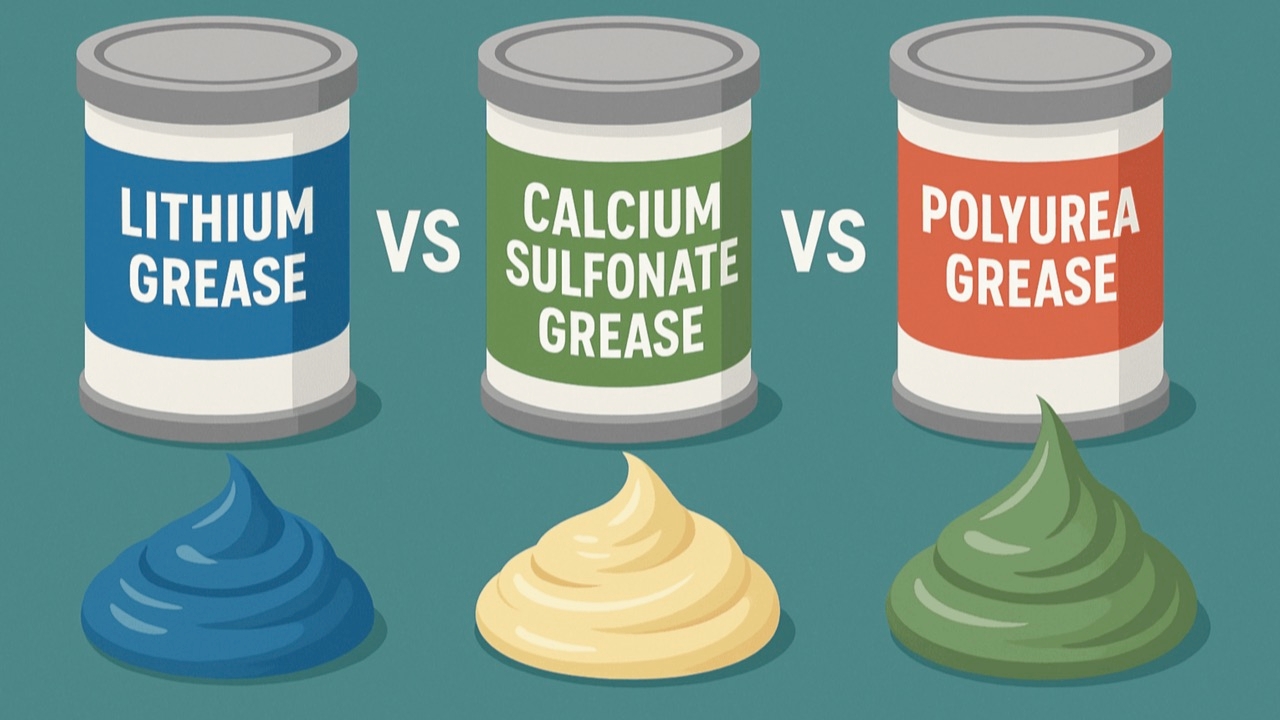
Lithium: Popular multipurpose grease with standard heat and water resistance.
Lithium Complex: Higher temperature tolerance (dropping point above 250°C) and longer service life.
Calcium Sulfonate: Water-resistant and rust-preventive, suitable for environments exposed to moisture or direct water.
Polyurea: Very high heat resistance and high-speed rotation, commonly used in electric motors.
Valvoline™ Global +3
3. Base Oil Viscosity
The most critical factor in forming a lubricating film.
Low viscosity (ISO VG 15-100): Suitable for high-speed, low-load applications to reduce friction and heat buildup.
High viscosity (ISO VG 150-460): Suitable for slow-speed, heavy-load applications to prevent oil film breakdown under pressure.
4. Additives
Choose according to the operating conditions faced by the machinery.
EP (Extreme Pressure): For high-impact pressure applications (e.g., excavators, crushers).
Anti-Wear: To prevent wear under normal conditions.
Solid Lubricants (e.g., Moly or Graphite): Black grease with solid lubricants offers excellent metal surface protection under heavy impact.
Caution: Do not mix different greases without checking compatibility, as they may separate or liquefy, causing severe machinery damage.