

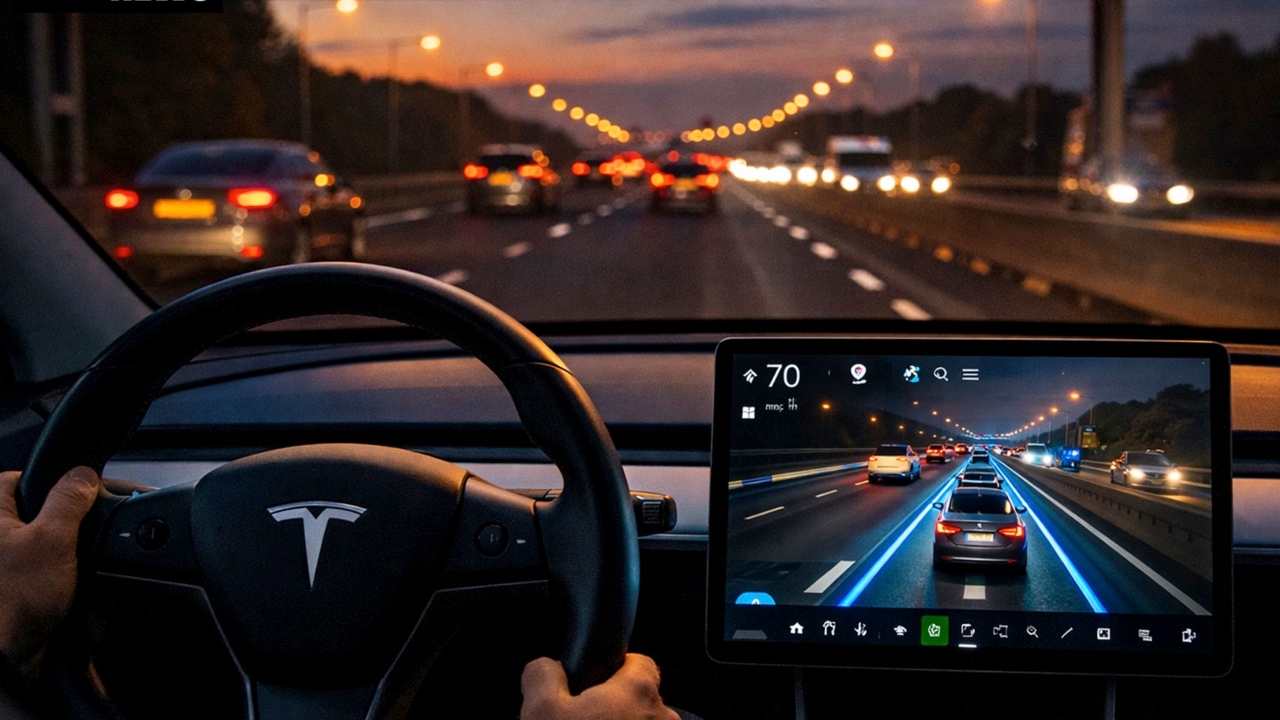
As of 2026, the electric vehicle industry is fiercely competitive in driver assistance technology. The term "best" depends on whether you value hands-free capability or safety under supervised self-driving with safety systems in the background. Although new cars’ autonomous systems are advanced, nearly all remain assistance systems. Marketing terms like Full Self-Driving or "Autopilot" do not mean the car is 100% responsible for your life in all situations. Drivers must remain focused and ready to take control in an instant.


In 2026, prices for autonomous driving systems vary greatly depending on sophistication and brand value. They can be grouped into three main price categories by budget:
1. Premium Group (Mercedes-Benz)
Level 3 systems (Drive Pilot) that truly allow drivers to take their eyes off the road are usually available only on top-tier models:
Mercedes-Benz EQS / S-Class: Starting prices in Thailand range from about 5,950,000 to over 10,000,000 baht.
Software fees: In some countries, Drive Pilot requires an annual or optional fee of about $2,500 to $5,000 (roughly 90,000 to 180,000 baht) to activate Level 3 features.
2. Chinese Tech-Leader Group (Huawei, Xiaomi, Zeekr)
This group emphasizes top-level AI intelligence (Level 2.5++ to Level 3 in the future) at more accessible prices.
Xiaomi SU7 (2026 model) in China starts at approximately 1,100,000 to 1,500,000 baht (229,900 - 309,900 yuan), offering full autonomous driving (Xiaomi Pilot) as standard on Max trims.
Huawei Stelato S9 / AITO M9 use Huawei ADS 3.0/4.0 systems with four LiDAR sensors, priced around 1,600,000 to 2,500,000 baht in China, considered the smartest among current Chinese cars.
3. Mass-Market Group (BYD and entry-level models)
By 2026, this technology has become much more affordable for the general public.
BYD Seal 07 / Atto 3 Evo prices in Thailand (2026) are expected between 800,000 and 1,300,000 baht, with top models featuring LiDAR.
The "Intelligent Driving for All" strategy sees BYD incorporating basic driver assistance (God's Eye) into budget cars under 500,000 baht, offering only lane keeping and automatic braking.
To clarify, here is a summary based on standout technology levels in today's market.

1. Advanced Level: Mercedes-Benz (Drive Pilot - Level 3)
If "best" means a car truly controlling itself without driver responsibility for certain periods, Mercedes-Benz leads autonomous driving. In 2017, the E-Class W213 could park safely if the driver lost consciousness. The system intervenes when the driver is unresponsive to steering, speed, or any control that could cause danger. Currently, Mercedes-Benz's Drive Pilot is a Level 3 system certified and operational in select areas (e.g., designated highways under traffic conditions), allowing drivers to temporarily "look away" from the road while the car is in motion.
It suits those prioritizing premium comfort and legally backed safety.

Intelligence and Software Level: Tesla (Full Self-Driving - FSD)
Technically still Level 2 (drivers must remain vigilant), Tesla's system is widespread with vast learning data worldwide. Its FSD (Supervised) v14 excels at city street navigation, automatic lane changes, and traffic light responses using vision-based cameras and AI learned from global user data. It appeals to those who want cutting-edge technology and continuous over-the-air updates that progressively improve vehicle capability.

Smoothness and Ease of Use: GM (Super Cruise) and Ford (BlueCruise)
These Level 2+ systems focus on the smoothest, most relaxing highway experience. Both GM's Super Cruise and Ford's BlueCruise receive praise for gentle lane-centering and accurate driver eye monitoring, enabling confident and safe hands-free highway driving on designated routes.
Ideal for frequent long-distance travelers seeking reliable, calm systems.
Choosing the most suitable "autonomous driving system" depends primarily on usage patterns, as current technologies vary in strengths. Here are recommendations based on safety-focused contexts.
For urban commuting
In cities, key features are close-range object detection, stop-and-go traffic following, and preventive safety systems. Intelligent driver assistance helps reduce fatigue amid congestion.

Recommended systems
Tesla (FSD/Autopilot) offers comprehensive vision-based detection of pedestrians, bicycles, and motorcycles with high accuracy. However, bad news: Tesla in North America announced removing Autosteer from standard equipment on 2026 Model 3 and Model Y, effective immediately. Previously, all Tesla cars included Basic Autopilot free, comprising Adaptive Cruise Control and Autosteer to keep the car centered. In 2026, Tesla will retain only Cruise Control, cutting lane-keeping, their key feature for nearly seven years.
New Chinese ADAS systems (e.g., BYD "God's Eye", XPENG) have advanced greatly by 2026, especially with LiDAR-assisted urban navigation, enabling smooth and safe lane changes and turning in complex intersections.
For long-distance highway driving (Highway Cruiser)
Critical factors include gentle lane centering, stable speed maintenance, and driver monitoring systems.
On highways, drivers want relaxation, not thrills. Systems that avoid harsh steering reduce fatigue.
GM (Super Cruise) and Ford (BlueCruise) are top choices for trustworthy long-distance driving, with very smooth steering and reliable eye-tracking that minimally disturbs the driver.

Mercedes-Benz (Drive Pilot), where supported and legally allowed, offers the most relaxed experience since drivers can genuinely take their eyes off the road.
For technology enthusiasts
If the goal is to experience AI advancements and receive constant feature updates, seeking a car that "gets smarter over time."
Tesla is the clearest choice with its business model of regular over-the-air software updates, where owners may wake up to improved driving features compared to the previous month.
NIO / XPENG / Afeela: These brands pack vehicles with numerous sensors (LiDAR, Radar, many cameras) to support future upgrades to higher-level (L3) autonomous driving, suited for early adopters.
For residents mostly in Bangkok, cars with precise all-around ADAS (such as Tesla or top models with LiDAR) are recommended.
For road trips, trying brands with smooth long-distance assist like BMW or Audi, or cars with gentle Lane Keeping Assist, is advisable.
Comparing Chinese electric vehicle brands (BYD, Xiaomi, Huawei/AITO) with Mercedes-Benz in 2026 reflects a clash between speed and innovation versus strict safety standards, differing in three main dimensions.

1. Development Philosophy
Mercedes-Benz prioritizes responsibility and insurance law. It is the first to officially approve Level 3 (Drive Pilot) in many countries. Crucially, when active, the car assumes legal responsibility instead of the driver (under specified conditions, e.g., highway traffic jams). Chinese brands emphasize versatility and user experience. Systems like Huawei ADS 3.0 or Xiaomi Pilot are designed for broad use, from city driving to parking lots (Park-to-Park), focusing on AI’s ability to handle complex scenarios but mostly remain Level 2.5+, requiring driver readiness at all times.
Mercedes-Benz’s Drive Pilot (Level 3) in 2026 clearly puts safety first, resulting in stricter operational limits in adverse weather compared to Chinese or Tesla systems.


Drive Pilot (Level 3) operation details under unfavorable weather conditions
1. Moisture Detection Sensor (Road Wetness Sensor)
Mercedes installs special sensors near the wheel arches to detect water spray from the road surface. If excessive wetness or standing water is detected, the system alerts the driver to resume control immediately and disables Drive Pilot to prevent slipping.
2. Operational Design Domain (ODD) Limitations
Even in 2026, Mercedes holds that Level 3 works only in near-perfect conditions.
Heavy rain or snow that obscures lane markings or covers LiDAR sensors causes immediate system shutdown.
In dense fog, although LiDAR and radar see better than cameras, if visibility drops below legal thresholds, the system signals the driver to take control within 10 seconds.
Glare: Direct sunlight into cameras may cause errors; Mercedes prefers shutting down the system rather than forcing continued driving.
3. Self-Cleaning Sensor System
To maximize operation in variable weather, Mercedes equips LiDAR and front cameras with washer jets and heating systems to clean and defrost lenses.
Redundancy: If a camera is blinded by mud, the system cross-checks radar and LiDAR data to safely bring the vehicle to a stop if the driver is unresponsive.

If Drive Pilot must stop suddenly (due to worsening weather or leaving supported roads) and the driver fails to take control within about 10 seconds, the car enters an "Emergency Stop Maneuver," a safety sequence as follows:
1. Stepwise warning signals
Before stopping, the system attempts to "wake" the driver with increasingly intense alerts.
Visibility: The driver display flashes dark red with commands to hold the steering wheel.
Sound: Warning tones grow louder and more frequent.
Touch: The seat belts tighten and brief, strong braking pulses may be applied to alert the driver.
2. Controlled vehicle stop within lane
If the driver remains unresponsive, the car initiates automatic stopping.
Lane keeping: The steering maintains the car precisely centered to avoid collisions with adjacent lanes.
Speed reduction: The vehicle gradually slows to a complete stop, calculating braking distance to prevent rear-end collisions.
Signals: Hazard lights activate automatically as speed drops below a threshold to warn trailing vehicles.
3. Post-stop safety measures
Once stopped, the system assumes the driver may be unconscious or facing a medical emergency.
Lock: The electronic parking brake engages automatically to prevent vehicle roll.
Door unlock: All doors unlock to allow emergency personnel access.
Emergency call: The system automatically contacts Mercedes-Benz Emergency Call center, sending GPS coordinates for ambulance dispatch.
While Chinese brands strive for all-condition smart driving, Mercedes chooses to honor limits to uphold the highest safety standards and avoid legal issues.