

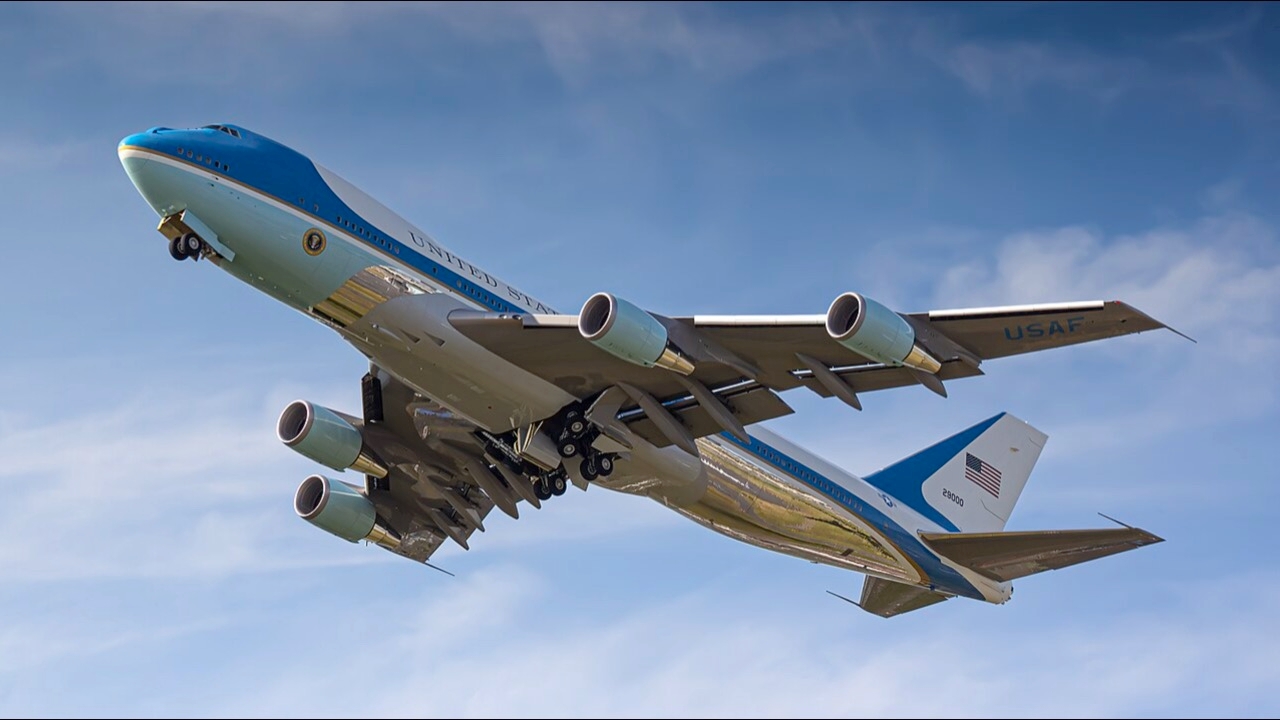
Air Force One is not the name of a specific airplane model but a "radio call sign" used by any U.S. Air Force aircraft carrying the President of the United States. Currently, the most recognized aircraft serving this role is the Boeing VC-25A, a modified version of the Boeing 747-200B, with two planes in service.

Originally, the latest Air Force One was scheduled for delivery by 2021, but significant delays and soaring upgrade costs for the project, initially estimated at about 4 billion U.S. dollars (approximately 135.7 billion Thai baht), have made it unlikely that the two new Boeing 747 aircraft ordered will be operational during President Trump's second term, which ends in January 2029.

Trump assigned technology billionaire Elon Musk to accelerate the modification process of this new aircraft. Reports indicate Trump expressed embarrassment traveling on the older 747 models, which explains his desire to change his air travel vehicle. This led to Qatar, a wealthy Persian Gulf nation, offering a luxury 747-8 aircraft valued at 400 million U.S. dollars (about 13.35 billion baht). This gift had been in progress for months, with Trump secretly visiting the plane in mid-February, just weeks after starting his second term.


The Boeing 747 Air Force One is as tall as a six-story building and as long as a football field. It outperforms standard 747s with a maximum cruising altitude of 14,000 meters (about 46,000 feet), top speed of 1,000 kilometers per hour, and can accelerate somewhat faster. Unlike regular Boeing planes, the 747 VC-25A is equipped with specially designed communications resistant to nuclear blast waves that could disrupt radio signals, missile defense systems, and a modern emergency medical laboratory onboard. Its three decks include dedicated office space, bedrooms, and bathrooms for the U.S. leader.

.
Air Force One does not carry "offensive weapons" but focuses on "advanced defensive systems" for survival in crises. It features missile countermeasures, including electronic countermeasures to jam radar signals, flare dispensers, and chaff to divert guided missiles. The aircraft is armored and its electronics shielded against electromagnetic pulses (EMP) from nuclear explosions, ensuring military command capability even in apocalyptic scenarios.
Its communications system serves as a mobile command center with the highest security technology, allowing global communication under all conditions.
Tactical measures include fighter jet escorts and secret flight path planning.
.
Pricing is complex due to the aircraft's specialized modifications:
Historical value: The first two VC-25A planes, entering service in 1990, had upgrade and system installation costs nearing a billion U.S. dollars.
Future project (VC-25B): The U.S. is procuring new Boeing 747-8 aircraft to replace the older models, with the program estimated to cost several billion dollars, including research, advanced technology customization, and special defense systems.

The U.S. President travels on Air Force One accompanied by cargo planes and advance vehicles. Soon, the transition to the newer VC-25B model will occur, featuring the latest 747 design that is safer and more modern. Understanding the operations and layout of such aircraft reveals the complexity of this "flying White House."
Aerial Refueling System (Aerial Refueling)
Air Force One uses the U.S. Air Force standard Flying Boom system, which functions as follows:
Principle: Tanker aircraft (such as KC-135 or KC-46) extend a rigid boom from beneath the fuselage.
Connection: The boom operator on the tanker maneuvers the boom to lock into the refueling receptacle located on the upper front fuselage of Air Force One.
Importance: This system allows Air Force One to fly continuously as long as the crew and engines remain operational, enabling the President to command or escape crisis zones without landing for fuel.

Interior Layout: The Boeing VC-25A’s interior is designed as a workspace, residence, and command center. The upper deck houses the flight deck, communications area, and crew quarters. The main deck’s front section contains the President’s private office, bedroom, and bathroom. The midsection includes a large conference room suitable for high-level meetings during flight and a dining area. The rear section is allocated for senior staff, Secret Service agents, accompanying media, and a galley capable of preparing meals for many people simultaneously.

The transition from the VC-25A (in use since 1990) to the VC-25B (in development) is not just a new aircraft replacement but a complete technological overhaul to meet 21st-century needs, marking a significant technological evolution between the two models.
VC-25A (Current)
Based on the Boeing 747-200B airframe.
Older engine performance, high fuel consumption, and increasingly scarce spare parts. Communication systems use early analog/digital technology.
VC-25B (New Model)
Boeing 747-8I (newer and larger model).
Improved engine efficiency (GEnx), fuel savings, quieter operation. Upgraded high-power electrical systems support modern equipment. Advanced mission communication systems enable high-speed, simultaneous video communication.
Operational independence includes basic automated systems for boarding, disembarking, and cargo handling, reducing reliance on ground support equipment.

The VC-25A, based on 1970s-80s commercial airframes, faces spare parts shortages and high maintenance costs. The VC-25B uses the latest Boeing 747-8I, with a longer fuselage, about 4,000 square feet of interior space, and greatly improved flight performance.

Mission Communication System: The core advancement in VC-25B is its design as a far more stable "command center," supporting multiple high-resolution video teleconferences simultaneously and high data throughput to enable the President to command military and government operations as if physically present in the White House. Autonomous Operations: VC-25B offers greater self-reliance with automated boarding, disembarking, and cargo loading systems, reducing dependency on ground support at remote or unfamiliar airports, thereby enhancing security.
Backup and Power Systems: VC-25B features upgraded electrical systems and dual Auxiliary Power Units (APUs) operable during flight, critical for continuous power to communications and defense systems. The VC-25B functions as a high-speed, modern, and secure mobile data center better suited for future missions. The project is currently in a complex deep customization phase with adjustments to meet safety standards.