

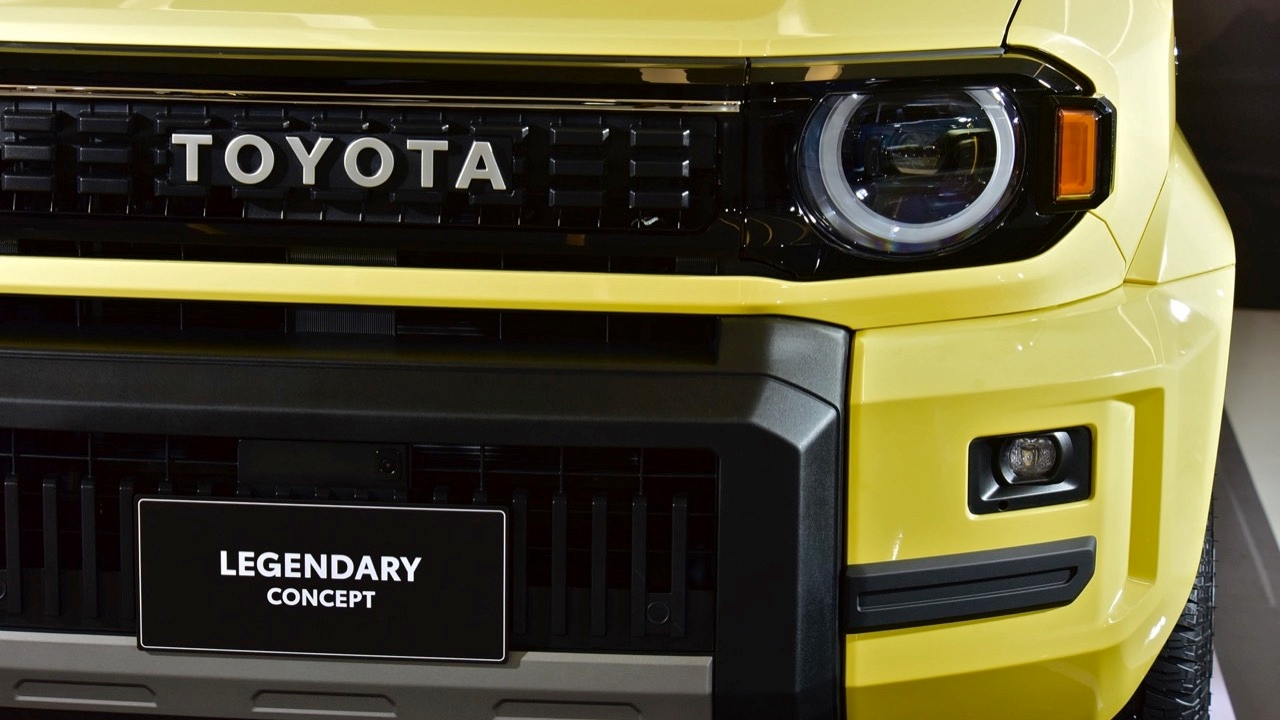
Toyota's choice to build the Land Cruiser FJ 2026 on the Hilux Champ (IMV 0) platform may seem unusual and mismatched, since classic Land Cruisers are SUVs distinct from pickup trucks (although some Land Cruiser pickups exist). However, from a strategic and automotive engineering perspective, there are several important reasons why these two off-road models are more closely related than they appeared at the launch.
Toyota Land Cruiser FJ 2026 model priced at 1,269,000 baht.


The ladder frame chassis—a key feature of all Land Cruiser models—offers durability and a body-on-frame design. The Hilux Champ is built on the IMV 0 platform, designed for maximum toughness to handle heavy loads and commercial use. This foundation matches the Land Cruiser FJ's DNA for off-road capability better than the sedan-based TNGA platform used in typical SUVs.
Toyota's Japanese executives envisioned an affordable Land Cruiser to make it accessible to the general public during the global economic downturn, focusing on affordability. This marketing approach leverages an existing platform enhanced to offer versatile use. Since most of the world's terrain remains off-road, the Cruiser FJ serves well both for city driving and off-road adventures.


New Land Cruiser 300 or 250 (Prado) models are expensive imports and too large for urban use or for novice off-roaders who enjoy outdoor lifestyles but cannot afford 4WD off-road vehicles with 4L/4H or 2W modes, which typically cost over 1.2 million baht.


Toyota chose a cost-cutting strategy that some may dislike but is reasonable: using the Hilux Champ's IMV 0 platform with added mounting points and chassis reinforcements for strength and to support the transfer case and rear drive axle. Most modifications use parts produced domestically alongside the Champ and Travo, helping Toyota keep the Land Cruiser FJ's price within reach.
Production base in Thailand helps reduce costs.
Manufacturing at the Ban Pho factory in Chachoengsao, which already produces the Hilux Champ, optimizes supply chain management efficiency.


Short Wheelbase (SWB)
Hilux Champ offers a short wheelbase version that is easily modified, aligning with the FJ40's historical character. Using this chassis with a compact five-door SUV body makes the Land Cruiser FJ 2026 highly maneuverable, with excellent approach and departure angles ideal for true off-road driving.

The older engine has been updated to meet EURO6 emission standards for export to Japan and global off-road markets. The Toyota brand has proven that its vehicles are tougher and more durable than most competitors, especially regarding longevity, after-sales service, and reasonably priced spare parts and accessories.
Why does the Land Cruiser FJ 2026 use the 2.7-liter 2TR-FE gasoline engine, the same as in the standard Hilux Champ and Fortuner models? Because this engine is known for its durability, easy maintenance, and widely available parts—perfectly matching the Land Cruiser philosophy of going anywhere and always returning.


The "Freedom & Joy" philosophy: The Hilux Champ was designed as a "modular pickup" that Toyota applies to the Land Cruiser FJ as well, emphasizing owner customization for off-road or camping gear to suit lifestyles, much like the FJ40's past versatility. Toyota does not view this as a budget off-road vehicle but sees the IMV 0 platform as the toughest and rawest, ideal for a smaller, affordable Land Cruiser focused on fun and ruggedness rather than luxury.


On-road performance and driving experience.
The Land Cruiser FJ benefits from the 2.7-liter gasoline engine’s ample power reserve, enabling better highway overtaking. Its suspension borrowed from the Hilux/Prado family offers stability and confidence at higher speeds. Although the engine is older, continuous improvements have brought emissions to EURO-6 standards. While long-distance fuel consumption tests are pending, Toyota states fuel economy ranges between 9 and 10.5 kilometers per liter.


Off-road capability and interior space.
The Land Cruiser FJ emphasizes toughness and 245 Nm torque, sufficient for most uses. However, the 2.8-liter 1GD-FTV diesel engine with 500 Nm torque might be more appropriate for some. The 245 Nm torque allows the vehicle to handle tough obstacles and towing well. Based on the Hilux Champ, aftermarket accessories like bumpers and suspension parts are easy to find. The Land Cruiser FJ's cabin is wider (about 15–20 cm wider than a Jimny), offering more usable passenger and cargo space, suitable as a primary family vehicle.
The 2.7-liter 2TR-FE gasoline engine is one of Toyota's "immortal" engines, long used in Hilux (Vigo, Revo, Champ), Fortuner, and now the Land Cruiser FJ.

Technical Specifications.
Engine code: 2TR-FE.
Engine type: 4-cylinder inline gasoline DOHC 16-valve.
Valve system: Dual VVT-i (variable timing on both intake and exhaust), enhancing combustion efficiency over earlier versions.
Displacement: 2,694 cc.
Maximum power: approximately 163–166 hp at 5,200 rpm.
Maximum torque: approximately 245 Nm at 4,000 rpm.
Fuel delivery: Electronic Fuel Injection (EFI).
Fuel compatibility: Gasohol E20 (for models sold in Thailand).
Key strengths making it suitable for the Land Cruiser FJ.
Durability (Bulletproof Reliability): This engine is designed for heavy-duty use with very robust internal parts, low maintenance needs, and excellent tolerance to hot climates.
Low-end torque: Although naturally aspirated, it is tuned to deliver good torque at low to mid RPMs, essential for off-road driving and hill climbing.
Easy maintenance and abundant parts: Being used in popular models like the Hilux and Fortuner for over 15 years means mechanics nationwide and worldwide are highly familiar with it, and spare parts are widely available.
Gas compatibility: For those concerned about fuel costs, the 2TR-FE is renowned as one of the most LPG/CNG-tolerant engines, with durable valve lifters that resist wear.

Points to consider: Currently, rising fuel prices are a concern. This engine's fuel consumption may not be as efficient as smaller or turbocharged engines, since it is a large naturally aspirated engine carrying a heavy ladder frame chassis weighing about 2 tons. City fuel consumption is estimated around 7–9 km/l. Compared to newer engines, it may seem "old-fashioned" in features related to fuel economy or throttle response.
Why this engine for the Land Cruiser FJ?
Toyota chose this engine over smaller turbocharged or hybrid options in the base Land Cruiser FJ 2026 to "keep costs low" and "focus on real-world rugged use". Simplicity is key to reliability.
Many see the 2.7-liter 2TR-FE as old and thirsty, which is true numerically, but Toyota’s use of it in the Land Cruiser FJ 2026 is a well-calculated strategy focusing on three pillars: price, durability, and global market.
Cost management: Land Cruiser 250 (Prado) or 300 models are expensive due to hybrid or turbo diesel engines. The 2TR-FE's development costs have long been recovered, so continuing production drastically reduces vehicle cost. To compete with Suzuki Jimny and Chinese SUVs, Toyota needed a reliable, low-cost engine. The Land Cruiser's "Simple is Best" philosophy promises to get you anywhere and back safely. The 2TR-FE’s simplicity means less heat buildup during tough off-road use.


Toyota’s approach ensures that after long use, if the vehicle breaks down anywhere—from Thai forests to Middle Eastern deserts—it can be repaired globally. Mechanics everywhere know this engine, and parts are widely accessible. This guarantees the reliability that is the brand’s hallmark.
Global market strategy: Although Thai buyers prefer diesel, the Land Cruiser FJ targets global markets. In regions like the Middle East, South America, and parts of Asia, gasoline is more available and cheaper than diesel. The 2.7 engine is a widely accepted standard. It is also highly LPG/CNG compatible, offering a fuel-saving option that does not damage the engine, unlike some newer models.
Modern updates (Dual VVT-i): Although an old code, Toyota has continuously improved this engine. The current Dual VVT-i version enhances combustion and meets stricter Euro 6 emission standards in some markets. While fuel economy is not outstanding, it meets regulatory requirements.
Analytical perspective: Toyota does not position the FJ as a high-power or fuel-efficient vehicle but as a trustworthy travel tool. The old 2TR-FE engine is like a favorite pair of jeans—though less modern than new synthetic fabrics, you know it won’t tear when you venture into the wilderness.