

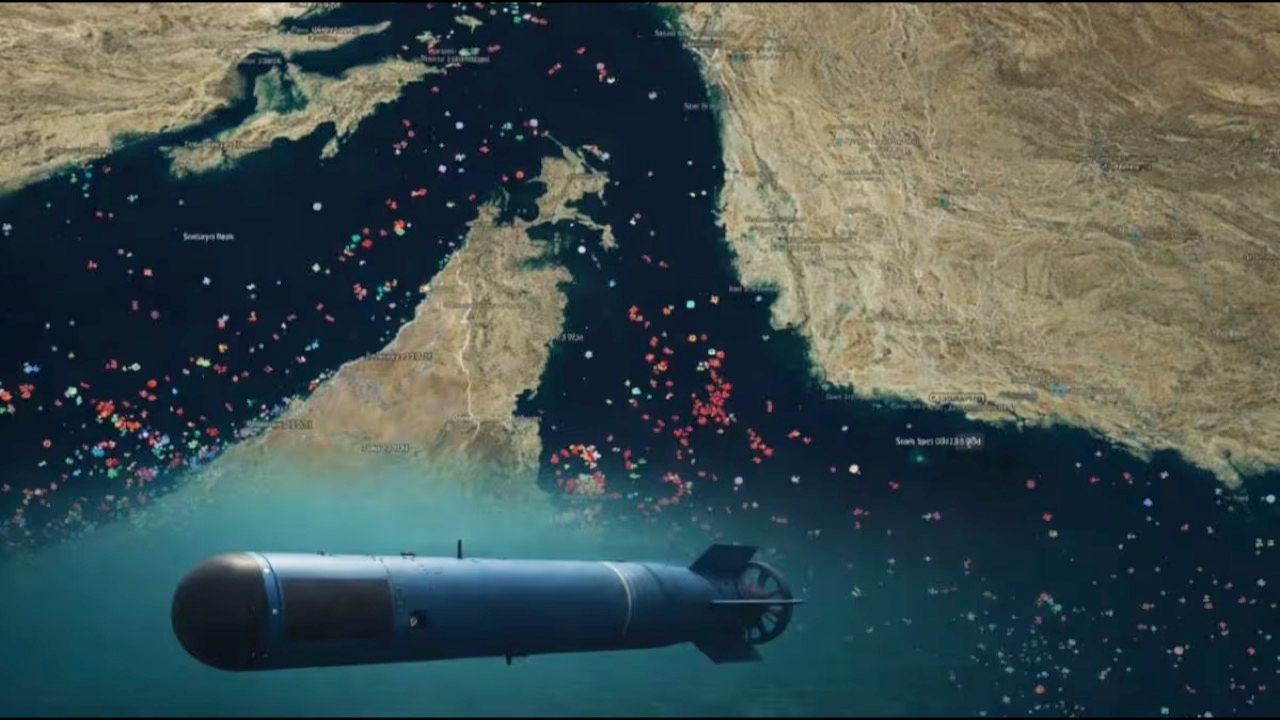
Iran's military use of underwater drones (UUVs), particularly under the control of the Islamic Revolutionary Guard Corps Navy (IRGC Navy), primarily aligns with an asymmetric warfare strategy to compensate for technological and large warship numerical disadvantages compared to the U.S. Navy or its allies.
Key tactical and strategic objectives
Maritime area denial (Area Denial - A2/AD)
Iran aims to control and block access to strategic areas such as the Strait of Hormuz, the world's most important oil transit route.
UUV ambushes can remain submerged for days, waiting to attack warships or oil tankers passing through.
Mobile mines use underwater drones functioning as smart mines that can reposition themselves, making enemy mine clearance significantly more difficult.
2. Swarm attacks
Iran has developed inexpensive, mass-producible underwater drones for its 'Mosquito Fleet' strategy.
Deploying numerous UUVs alongside fast boats and aerial drones creates confusion, overwhelming opposing warships' defense systems.
Kamikaze attacks involve small underwater drones designed to carry explosives and strike a ship’s most vulnerable point—the hull beneath the waterline.
Intelligence, surveillance, and reconnaissance (ISR)
UUVs serve as underwater eyes and ears in areas inaccessible to surface vessels.
Sonar detection capabilities allow tracking of aircraft carrier groups or enemy submarines covertly.
Some drone models can surface to transmit real-time target coordinates via satellite, enabling precise shore-based missile strikes.
Economic and psychological warfare
Just the news of underwater drones in shipping lanes can drive up freight rates and insurance premiums, pressuring the global economy.
Proxy warfare involves Iran supplying UUV technology to allied groups like the Houthis in Yemen, who use them to attack vessels in the Red Sea, extending Iran’s influence without direct involvement.
Defense of islands and key bases
Iran possesses strategic islands in the Persian Gulf (e.g., Kish, Abu Musa) where underwater drone defense shields are deployed to prevent amphibious assaults or infiltration by enemy special forces such as Navy SEALs. In 2026, Iran began using the Smart Control of Hormuz system, integrating underwater drone data with artificial intelligence to automatically screen vessels passing through the strait. Iran’s 2026 advances in Unmanned Underwater Vehicles represent a major turning point in asymmetric naval warfare, focusing on stealth and destructive capability at far lower costs than conventional warships. Latest details include:
Key drone models and technical capabilities

Iran has introduced several underwater drone families designed for distinct missions.
Nazir Series (Stealth UUV)
Stealth capability uses high-capacity battery propulsion, resulting in near-silent operation that is difficult to detect by sonar (near-zero acoustic signature).
Depth and endurance allow operations at about 200 meters depth with continuous stealth patrols lasting up to 24 hours.
Mission defined as 'Invisible Killer,' focusing on ambushes in shallow waters like the Persian Gulf.

Azhdar (Heavyweight UUV)
Range exceeds 600 kilometers with speeds between 18-25 knots (next generation may reach 45-50 knots).
Durability permits missions lasting up to 4 days, enabling surveillance of the Strait of Hormuz without constant mothership support.

Extra-Large UUV (XLUUV)
Iran is developing large underwater drones (carrying about 120 tons) capable of deploying mines or launching torpedoes from a distance.
Hybrid UUV/Torpedo (One-Way Attack)
Iran has developed weapons that combine features of torpedoes and drones.
Unlike conventional torpedoes that prioritize high speed but short range, these drones move slower (around 3-10 knots) to conserve energy and reduce noise.
Technology often includes collapsible masts for GPS signal reception or electro-optical camera transmission when surfacing near the target before striking.
Houthi connection
Small UUV technology has been detected being transferred from Iran to Houthi forces in Yemen, used to attack commercial ships in the Red Sea. These compact drones can be launched from fishing boats and are difficult to detect with standard sonar on merchant vessels.

Operational strategies
Both the Iranian Navy (IRIN) and the IRGC employ these drones in ways such as:
Mobile mines: drones act as self-repositioning mines to ambush oil tankers or enemy warships.
Swarm tactics: underwater drones used alongside surface drones (USVs) and aerial drones (UAVs) to overwhelm enemy defense systems with sheer numbers.
Intelligence and surveillance: covert information gathering in restricted zones or near enemy naval bases.

Current situation (March 2026)
In March 2026, Iranian underwater drones were reportedly used in missions to intercept and attack cargo ships in conflict zones, raising concerns within the U.S. Fifth Fleet. In response, the fleet deployed systems like the Global Autonomous Reconnaissance Craft (GARC) and mine-hunting drones such as the Ocean Aero Triton.
These UUV developments coincide with the launch of the drone carrier ship Shahid Bahman Bagheri, capable of carrying and deploying unmanned vehicles by air, surface, and underwater, extending operational reach beyond the coastline.