

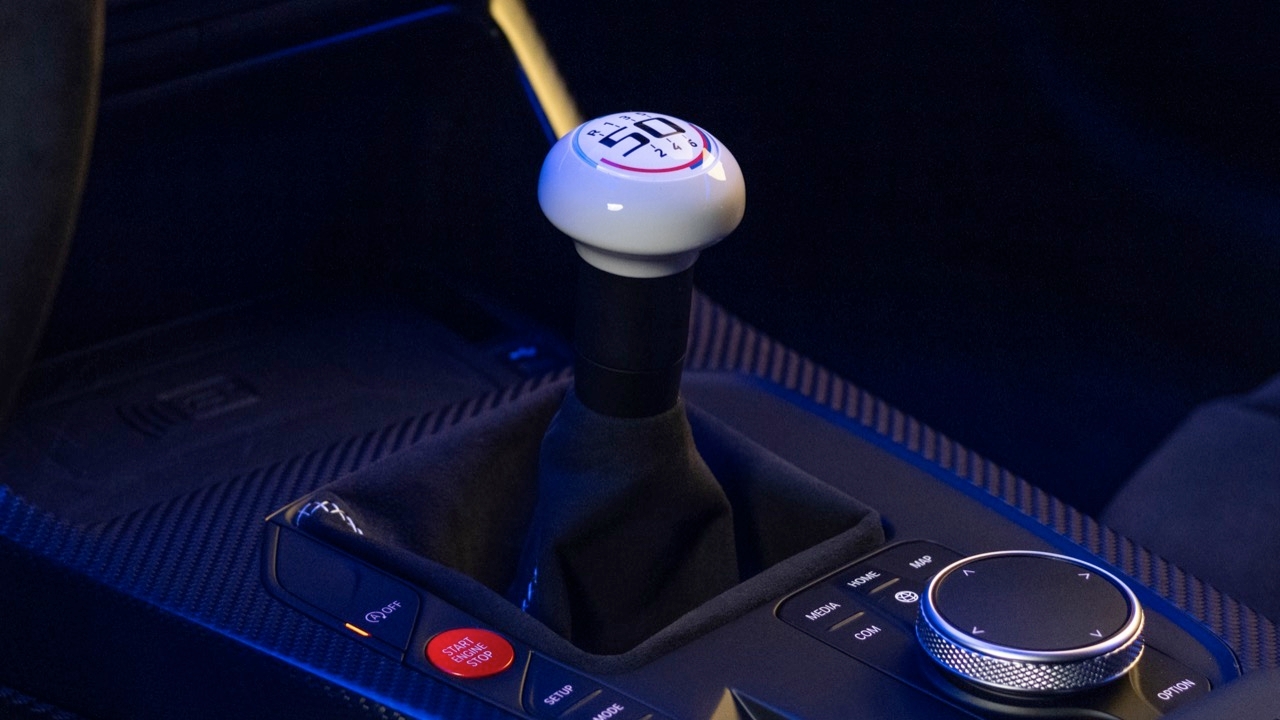
The heyday of manual transmissions seems to have passed, as most high-performance cars now use just two pedals (automatic transmissions). Only a few models still allow drivers to shift gears themselves, and many believe manual transmissions will eventually disappear over time. However, for BMW's M division, especially special editions from Munich, the 6-speed manual gearbox remains firmly embraced because customer demand is still strong enough to justify its continuation.

Although upcoming M models are increasingly electric (EV), the manual gearbox is not disappearing anytime soon. A senior BMW M executive told German business media that the brand is not ready to abandon the manual. Sylvia Neubauer, Vice President of Customer and Brand at M, confirmed that engineers are working hard to make manual transmissions capable of handling the growing power of future internal combustion engines. This is encouraging news, considering that the previous M2 CS only offered an automatic because the manual gearbox then couldn’t handle the immense torque from the potent inline-six engine without risk of damage.
While BMW M has yet to reveal the technical details under development, German media Automobilwoche speculates that future M models equipped with manuals might have slightly detuned engines to ensure the gearbox operates smoothly and remains durable over the long term.

This trade-off means if you love shifting gears yourself, you might get a car with slightly less horsepower than the automatic version, in exchange for preserving the gearbox. Engineers’ efforts show BMW M’s commitment to maintaining the original driving charm, even as engine technology pushes beyond the limits of a standard manual transmission. It’s a clear effort to please manual enthusiasts, even if it means tuning engines down a bit to keep the driving experience enjoyable.

The technical limitation of manual gearboxes in BMW M cars isn’t horsepower but torque. The clearest example is the new BMW 3.0 CSL, which is the most powerful inline-six BMW has ever produced. The S58 3.0-liter twin-turbo engine delivers up to 553 horsepower, setting a new factory record for a turbo inline-six.

However, engineers had to cap the engine’s torque at 550 Newton-meters to keep the manual gearbox reliable. In other models with automatic transmissions, the same engine can produce up to 100 Newton-meters more torque. Why hasn’t BMW developed a new manual gearbox? The answer is cost: investing heavily to develop a new manual transmission for just a few models isn’t commercially viable. Although global demand remains somewhat strong, most sales have shifted to automatics. With the Z4 M40i discontinued, BMW now only offers manual options in three models: the M2, M3, and M4.

Furthermore, with the new BMW 3 Series about to launch soon, the current M3 (G80) is nearing the end of its lifecycle. Many are concerned and doubtful whether the next-generation M3 (G84) will still offer a manual transmission.
Nonetheless, detuning the engine to preserve the ability to shift gears manually might be an acceptable compromise for some customers. It is still too early to say how long BMW M will be able to keep the clutch pedal alive.
Currently, choices for manual transmission enthusiasts are dwindling, even as younger generations are growing in number. The only M cars with manuals left are the M2, M3, and M4. The future remains uncertain: the new M3 (G84) might not offer a manual option to please gear-shifting fans. Those who want to shift themselves may have to accept cars with restricted torque to protect the gearbox. It’s a bittersweet time for manual lovers, as it feels like we’re counting down the days until its disappearance.

Even if the next M3 comes only with an automatic, manuals are likely to hold on until 2029. BMW plans to continue producing the M2 and M4 for about three more years, offering the 6-speed manual option until the very end. Before the manual disappears, BMW will likely release a special edition to celebrate the manual transmission’s legacy.
Additionally, Neubauer confirmed in the same interview that M will continue to use internal combustion engines, but a major challenge is increasingly strict emissions laws that limit engine power. For example, in Europe, BMW had to detune the V8 engines in the M5 and XM to meet the upcoming Euro 7 standards, adding plug-in hybrid systems which made these M models heavier than ever before.
In recent years, BMW has had to reduce horsepower and torque in many European models to comply with stringent environmental regulations. Looking ahead, manual transmissions have been around a long time and won’t disappear immediately. Manuals will likely remain available in the M2 and M4 until 2029, with a farewell special edition to honor gear-shifting enthusiasts.
BMW faces multiple challenges: besides manuals not handling high torque well, they must comply with Euro 7 emissions laws that force engines to be less powerful to protect the environment. Engineers must work hard to maintain driving excitement while meeting emissions standards.
It’s a battle of wills between engineers who want to build fun-to-drive cars and regulators focused on environmental protection. This struggle will intensify in the coming years.

By 2030 (B.E. 2573), automakers must reduce fleet-wide emissions by 55% compared to 2021 levels.
By 2035 (B.E. 2578), the target is a 100% reduction—meaning nearly all new cars must be zero-emission vehicles, or at least achieve 90% reductions according to recent adjustments for some groups.
Why do these regulations affect manuals and internal combustion engines?
Heavy fines: if a manufacturer’s average emissions exceed the limits, the company faces huge penalties, which ultimately raise vehicle prices, making gasoline cars less affordable.
Efforts to sustain internal combustion: BMW M’s engine detuning isn’t just to protect manuals but also to reduce emissions so the brand stays within legal limits.
Future of E-Fuels: synthetic fuels may allow internal combustion engines to survive post-2035, but costs and development remain major uncertainties.
In short, we’re at a critical crossroads for the traditional automotive world. For those who love engine sounds and manual shifting, the next 4–5 years (until 2029–2030) might be the last chance to own a new car with these features.

It seems BMW M’s manual transmission will continue breathing for quite some time despite engineering and legal obstacles, according to the latest information in 2026.
1. Confirmation from Executives (Update 2026)
Sylvia Neubauer, BMW M Vice President, affirmed engineers are fully committed to finding solutions so the 6-speed manual can handle increasing engine torque in new models.
2. The Compromise
Currently, BMW’s manual gearbox (code GS6-L55TZ by ZF) can handle about 550–600 Nm of torque, while automatics exceed that significantly. BMW may use these solutions:
Detuned Engine: lowering power output on manual models (like in M2 or entry-level M3) to protect the gearbox.
Software Management: employing software to control power delivery in certain gears to preserve the transmission.
3. Sales Figures Still Support Manuals
Although automatics dominate globally, manual sales remain strong in the U.S. Nearly 50% of M2 sales there are manuals, and about 50% of M3 buyers choose manual. These numbers keep BMW from dropping manuals, as quitting could cost nearly half of U.S. sales.
4. The 2029–2030 Deadline
According to current production plans, manuals will remain available in the M2 (G87) and M4 (G82) until production ends around 2029. The next M3 (G84) is uncertain regarding a manual option.
In the future, BMW M might adopt "simulated manual" technologies like those Toyota or Hyundai are developing for electric M cars to retain driving fun without mechanical torque limitations.